

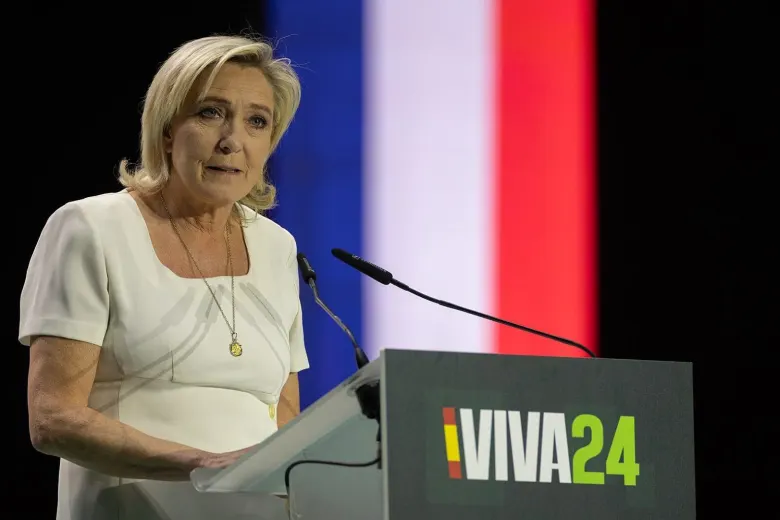
The EU elections over June 6 to June 9 have presented a chaotically merry picture, certainly for those on the right of politics. Not that the right in question is reliably homogeneous in any sense, nor hoping for a single theme of triumph. A closer look at the gains made by the conservative side of politics, along with its saltier reactionary wings, suggests difficulty and disagreement.
In any case, papers such as The Economist were hopelessly pessimistic about the post-Eden fall, which may suggest that democracy, in all its unpredictable nastiness, is working. The lingering nature of the Ukraine War, the obstinate, enduring presences of such nationalists as Marine Le Pen in France and Viktor Orbán in Hungary, all pointing to “a period of political rudderlessness”. In truth, the rudders are being replaced.
In France, Le Pen has managed to point the gun of discontent at the centre of bureaucratic control and (hideous word) governance. The two prominent targets: President Emmanuel Macron and Paris. She has been aided by the fact that Macron has been inclined to pack key positions in government with loyal, reliable Parisians. Last February, François Bayrou, an early Macron enthusiast and Justice Minister, found it hard to accept that 11 of the 15 important ministers in the government were from the Paris area. This revealed a “growing lack of understanding between those in power and the French people at the grassroots level”.
On June 9, Le Pen proved had every reason to gloat, with the gains made by her party sufficiently terrifying French President Emmanuel Macron to dissolve parliament and call an election. Parties of the far-right came first in Austria, tied for top billing in the Netherlands and came in as runners-up in Germany (where Chancellor Olaf Scholz’s Social Democrats were savaged) and Romania.
The party of Italian Prime Minister, Georgia Meloni, also did well, winning 28.9% of the country’s vote in the elections. Predicted to get 24 seats in the European Parliament, the Fratelli d’Italia (Brothers of Italy) have done a shedding act on neo-fascism in favour of a smoother image, while still insisting that Europe’s identity had to be defended “from every cultural subjugation that sees Europe renounce its history to adopt that of others.” Such messaging has come with slick shallowness on social media, including such posts as those featuring “L’Italia cambia l’Europa” (“Italy changes Europe”), or the voter instruction to “scrivi Giorgia” (“write Giorgia”) on their ballot.
Meloni’s march was so significant as to compel EU Commission chief, Ursula von der Leyen, to become a salivating groupie for the right – of sorts. Her sharp policies on migration have drawn the approval of Meloni. Speaking at April’s Maastricht Debate, organised by POLITICO and Studio Europa Maastricht, von der Leyen openly expressed her interest in linking arms with Meloni’s European Conservatives and Reformists (ECR).
The Italian PM has found herself to be an object of much political interest, indispensable to the chess pieces of Europe’s political manoeuvrings. Italy’s reactionary flame has become, for instance, a matter of much interest to Le Pen. To the Italian newspaper, Corriere della Sera, Le Pen emphasised her insistence that a hard-right bloc of parties in the European Parliament could be formed, overcoming the current division between her Identity and Democracy (ID) group and that of Meloni’s ECR.
That said, any union of faux liberal types such as von der Leyen with those of the hard right of Europe is unlikely to be a fragrant one. Von der Leyen has taken heavy shots at Le Pen’s Rassemblement National (National Rally), excoriating its pro-Russian position along with those of Germany’s AfD and Poland’s Konfederacja. “They are Putin’s puppets and proxies and they are trampling on our values.” The promise to Meloni: if you want my dour, camouflaged conservatism, forget the other reactionaries.
What was telling was that the young, having voted in 2019 for parties of the left such as the Greens, had had a change of heart. In May an Ipsos poll revealed that 34% of French voters under the age of 30 were keen to vote for the 28-year-old leader of the National Rally in the European Parliamentary elections. In Germany, the 22% of Germans between 14-29 were keen to plump for Alternative for Germany (AfD), just under double from what was registered in 2023.
For Albena Azmanova of the University of Kent, this presents a curious predicament for those on the progressive side of politics (is there such a thing anymore?). Dissatisfaction that would normally be mined by progressives for political advantage is being left over to the opposite wing of politics. “The left is failing to harness that discontent, although its trademark issues – poverty and unemployment – are now more salient for voters than the far right’s flagship of ‘immigration’.”
An unanticipated phenomenon has manifested: younger voters in France, Portugal, Belgium, Germany and Finland folding at the ballot box for parties of the right and far right. The pendulum has well and truly swung. Europe’s right, bulked by the young, is on the march.
ZNetwork is funded solely through the generosity of its readers.
Donate




