


Manos, a sixth-generation farmer from Thessaly, put it to me bluntly when I asked him to explain why he was prepared to drive his tractor 400km to Athens to camp outside Parliament: “If I don’t, my farm will soon follow our village school, co-op, post office and bank branch into oblivion.”
His story is neither novel nor confined to Greece. We are accustomed to French farmers, in particular, blocking roads and exacting a significant price from politicians before returning to their home turf. Occasionally, an impressive stunt has been staged in Brussels — as in 2012 when a multinational farmers’ coalition sprayed the European Parliament with tons of milk, in protest against cuts to EU milk quotas.
What is new, in this latest round of farmers’ protests, is that it is not only the usual suspects who have taken to the streets of our capitals. Our television screens are showing farmers mobilising across the European Union, from Poland to Ireland. We are not used to German and Dutch farmers, traditionally much wealthier relative to their Graeco-Latin colleagues, entering our cities with the passion — and in the numbers — that we are now witnessing.
If you ask the Dutch or the German farmers why they are revolting, their answer is similar to the one Manos gave me: they will tell you that their way life, their capacity to keep working the land, is in jeopardy. I believe them. But British farmers are also facing an existential threat and they are not blocking motorways. Almost half the UK’s fruit and vegetable growers and a third of dairy farmers face bankruptcy within less than two years. So why are they not blocking Piccadilly or occupying Trafalgar Square in anger? Cultural differences may play a role but a structural feature of the EU explains why European farmers are revolting and British farmers are not.
“British farmers are also facing an existential threat and they are not blocking motorways”
In theory, the EU is all about free-market liberalism; in reality, it began life as a cartel of coal and steel producers who, openly and legally, controlled prices and output by means of a multinational bureaucracy. That bureaucracy, the first European Commission, was vested with legal and political powers superseding national parliaments and democratic processes. And its first task was to remove all restrictions on the movement and trading of steel and coal between member-states. After all, what would be the point of a cross-border cartel if its products were stopped at borders and taxed? Brussels’s second step was to expand the scope of the cartel beyond coal and steel, co-opting the electrical goods industry, car manufacturers and, of course, banking. The third step, once tariffs on manufacturers were removed, was to remove all tariffs.
Alas, that meant, among other things, untrammelled competition from imported milk, cheese and wine for French and German farmers. How could Brussels secure the consent of these larger, richer and therefore politically more powerful farmers to a European free-trade zone? By handing them a chunk of the heavy industry cartel’s monopoly profits.
That’s precisely what the Common Agricultural Policy (CAP) was. You can see it in the Treaty of Rome, which established today’s EU: it is a contract between Europe’s heavy industry cartel and Europe’s wealthier farmers, according to which the largest chunk of the European budget, generated by the former, would be sprinkled upon the latter. In 2021, the EU allocated €378 billion for CAP: 31.8% of its total budget for the six-year period 2021-2027. Of this mountain of euros, about 80% ends up in the pockets of the richest 20% of Europe’s farmers. And the worst thing is, it’s hard to see a way out: these mind-boggling sums, and their unequal distribution, are based on the mid-Fifties deal that gave us the original EU; they’re baked into its structure.
That unequal distribution was justified by claims of “productivity”. Large landowners are far more profitable per acre cultivated, or per farmworker. For instance, according to the Financial Times, in 2021, each additional worker boosted the net value of a small farm — defined as a farm with a total output worth between €4,000 and €25,000 — by around €7,000. By contrast, an additional worker increased the net value of a large farm — one with an output worth more than half a million euros — by €55,000.
As a result, traditionally most farmers in the south of Europe — including in large parts of France, where farm plots are much smaller than, say, in Germany or the Netherlands — merely survived. Meanwhile, their northern colleagues commanded substantial profits, resources and subsidies.
This explains why Greek, Spanish, Southern Italian and French farmers always had the greatest tendency to block roads: six decades ago they were cut a deal that didn’t serve their best interests. Today, however, with de-industrialisation now proceeding apace even in Germany, the original, pan-European industrial cartel that was meant to pay for the rich farmers’ generous subsidies is also in decline.
As for farmers such as Manos, a combination of old problems and new calamities has taken its toll. Last autumn, the climate crisis paid his valley a visit when Storm Daniel destroyed all his equipment by submerging his land in metres of water, before moving south to drown thousands of people in Libya. The usual, ridiculously long, delays that characterise bureaucracy in Greece meant its insurance companies were slow to come to Manos’s help.
But an even uglier source of discontent among his peers is the mass repossessions of farms by the numerous vulture funds. Taking advantage of Greece’s long-standing bankruptcy, they have entered the country to purchase non-performing farmers’ loans, at five cents to the euro, before auctioning off the land. In this way, oligarchic interests grab fertile agricultural land and, with grants and loans from Brussels, cover it with solar panels. Farmers and urbanite Greeks then pay through the nose for the electricity it produces. And as the former are squeezed, domestic food supplies become scarcer.
Now, similar stories are playing out in wealthier parts of the EU: in the Netherlands and Germany. Here, there are three main triggers. Firstly, having surrendered what used to be public electricity utilities to the private cartel hiding behind the Dutch auction houses, the EU does nothing to protect farmers from the voracious appetites of energy speculators and rentiers. Secondly, there is the bureaucratic nightmare farmers must endure before they apply for the smallest of benefits, or even for the right to trim a tree whose branches poke them in the eye as they pass by in their tractors. Thirdly, there is Ukraine: not just the heightened fuel costs and the competition from €13 billion worth of “solidarity” imports last year alone but, more importantly, the prospect that, were the war-torn country to join the EU, most countries that are now net recipients of CAP funds, including Poland, will become net contributors, with their farmers bearing the brunt.
And then, of course, there are the two elephants in the room. One is the EU’s Green Deal. Brussels makes all the right environmental noises, demanding immediate green action, but lacks the ability to pay for it. Take the Dutch farmers’ bone of contention: the clear and present danger of nitrates in the water table, which must be addressed. After decades of turning a blind eye to the problem, their government — pressured by Brussels — suddenly demanded that Dutch farmers solve it by, among other measures, “eradicating” one in three cows.
Even more intractable is the second, and larger, elephant: a 15-year European economic slump that, to my eye, can be entirely explained by the inane handling of the euro crisis. This slump explains why the continent is deindustrialising. It’s why the Common Agricultural Policy can no longer respect the original, Fifties-era deal between Europe’s industrial and agricultural cartels. And it’s also the reason why the EU’s Green Deal is just another European Potemkin village — another product of the EU’s penchant for announcing big numbers that dissolve under closer scrutiny.

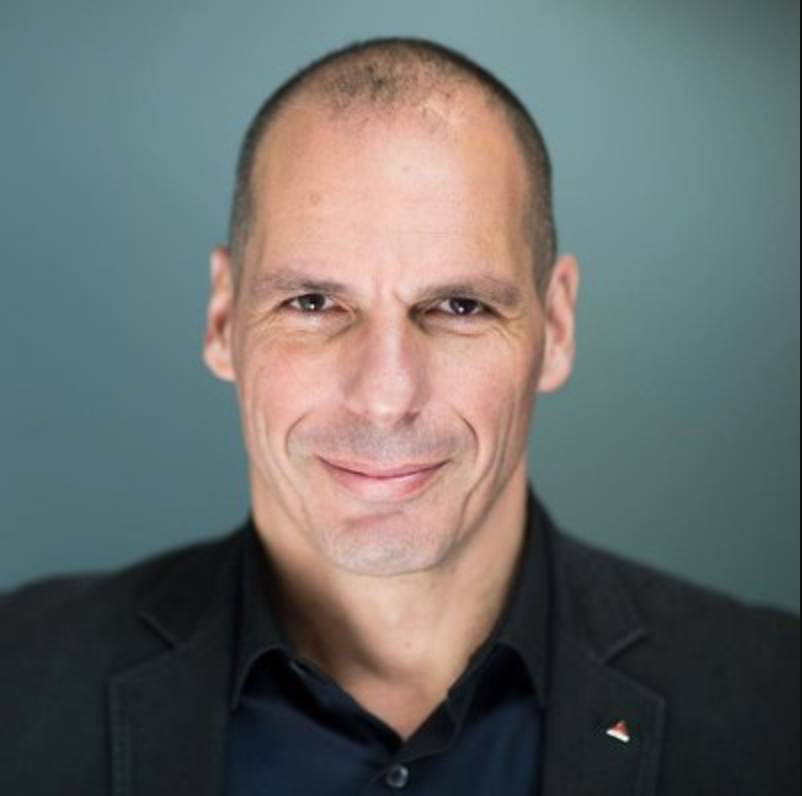
Yanis Varoufakis born 24 March 1961 is a Greek economist, politician, and co-founder of DiEM25. A former academic, he served as the Greek Minister of Finance from January to July 2015. Since 2019, he is again a Member of Greek Parliament and MeRA25 leader. He is the author of several books including, Another Now (2020). Varoufakis is also a professor of Economics – University of Athens, Honorary Professor of Political Economy – University of Sydney, Honoris Causa Professor of Law, Economics and Finance – University of Torino, and Distinguished Visiting Professor of Political Economy, Kings College, University of London.
ZNetwork is funded solely through the generosity of its readers.
Donate




