

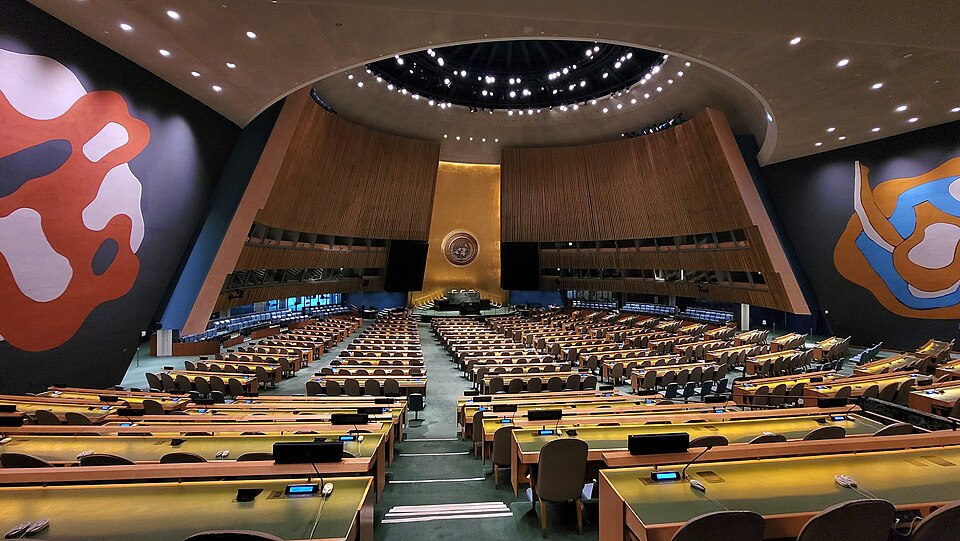
As world leaders gather in New York for the 81st United Nations General Assembly, the institution faces a fundamental challenge: how to address increasingly global problems in a world where national governments are struggling to reconcile sovereignty, competing interests and international cooperation.
World leaders are arriving in New York for the United Nations General Assembly amid wars, economic uncertainty, technological disruption and growing questions about the future of international cooperation.
The General Debate, scheduled for September 22–28, brings together representatives from nearly 200 countries under the theme “Restoring trust, managing transformation: A United Nations that delivers for all.”
Yet behind the diplomatic speeches and official declarations lies a deeper question: Is the international system still equipped to address a world that has changed so dramatically since the United Nations was established in 1945?
The challenge may extend beyond disagreements among governments. The very nature of political power is changing.
A world that no longer fits within national borders
For centuries, the nation-state has been the principal structure through which societies organize political authority, economic development and collective security.
Today, however, many of humanity’s most consequential challenges operate beyond the effective control of any individual government.
Artificial intelligence is being developed by corporations and research institutions whose technologies cross borders almost instantaneously. Climate change disregards national boundaries. Cyberattacks can originate thousands of miles from their targets, while cryptocurrencies and digital financial systems challenge traditional mechanisms of monetary oversight.
Energy supplies, international shipping routes and global supply chains connect distant societies in relationships of mutual dependence.
Even political life is no longer exclusively national.
Elections increasingly unfold within an international information environment, where foreign interference, allegations of interference and competing narratives circulate through social media and global news networks.
Whether particular allegations are substantiated or not, the public debate surrounding them can itself become an international political issue.
The result is a growing contradiction: governments remain responsible to their national populations, yet many of the forces shaping those populations’ lives are increasingly transnational.
This does not necessarily mean that nation-states are disappearing or losing all their authority. Rather, their capacity to act independently is being tested by problems that require cooperation beyond their borders.
The return of national sovereignty
As global interdependence increases, governments are also facing political pressures to regain control over economic policy, immigration, technology, trade and national security.
For some political movements, international institutions are seen as necessary instruments of cooperation. For others, they represent constraints on national sovereignty and democratic accountability.
These competing perspectives have contributed to disagreements over the role of multilateral organizations, international agreements and global governance.
The United Nations finds itself at the center of this tension.
Its effectiveness depends on cooperation among sovereign states, but those same states frequently pursue objectives that are difficult to reconcile.
The ongoing wars in Ukraine and the Middle East, alongside conflicts in Sudan and other regions, have intensified scrutiny of the organization’s ability to prevent violence and resolve international disputes. The UN also faces financial difficulties and renewed debates over reforming the Security Council.
The institution is therefore confronting two simultaneous challenges: the increasing complexity of global problems and the difficulty of securing agreement among governments.
New York: A city reflecting the world’s contradictions
Outside the United Nations headquarters, the contradictions of international diplomacy are visible in the streets of Manhattan.
New York City has declared September 21–25 Gridlock Alert Days, with extensive street closures, security checkpoints and motorcades expected to disrupt traffic throughout Midtown and the East Side.
The NYPD has deployed thousands of officers, supported by specialized units including heavy weapons teams, bomb squads, K-9 units and counter-drone personnel.
At a September 17 security briefing, Police Commissioner Jessica Tisch said authorities were preparing for an increase in demonstrations while facilitating constitutionally protected protest activity. Officials reported no known specific credible threats to the gathering at that time.
U.S. President Donald Trump and Israeli Prime Minister Benjamin Netanyahu are among the leaders expected to address the Assembly, bringing additional attention to the diplomatic gathering and the demonstrations surrounding it.
For New Yorkers, the immediate consequences are traffic delays, restricted movement and an extraordinary security presence.
For the international community, the gathering raises a much larger question about how nations can coexist and cooperate in an increasingly interconnected world.
An institution built for another era
The United Nations emerged from the devastation of the Second World War, when governments sought to establish a framework capable of preventing another global catastrophe.
Its founding principles emphasized sovereign equality, peaceful dispute resolution and international cooperation.
More than eight decades later, the organization continues to provide a forum for diplomacy, humanitarian assistance and international agreements. Yet its institutional structure remains rooted in a world where national governments were the dominant actors in international affairs.
Today, multinational corporations, financial networks, digital platforms and technological systems exercise influence that can extend across numerous countries simultaneously.
Artificial intelligence illustrates this transformation particularly clearly.
Decisions made by a relatively small number of companies and governments can have consequences for employment, education, security, information and human rights across the planet.
The question is no longer simply how governments negotiate with one another, but how humanity develops institutions capable of addressing challenges that no government can manage alone.
This year’s General Assembly includes discussions on AI governance, climate action and institutional reform, reflecting the growing importance of these questions.
Guterres calls for hope and cooperation
For UN Secretary-General António Guterres, this is his final General Assembly high-level week before the conclusion of his term at the end of 2026.
As world leaders gather, he has emphasized the importance of international cooperation and the need to maintain hope despite the scale of contemporary challenges.
In remarks published by the United Nations ahead of the gathering, Guterres recalled that the organization’s Charter begins with the words “We the peoples,” emphasizing that international cooperation ultimately concerns humanity as a whole, rather than governments alone.
His message comes at a time when the UN is facing questions about its relevance, funding and capacity to respond to international crises.
Yet the challenges confronting the organization also demonstrate why cooperation remains necessary.
Climate change cannot be resolved by one country. Artificial intelligence cannot be governed effectively through isolated national regulations alone. International trade, energy security and the prevention of war depend on relationships that extend beyond national jurisdictions.
From the United Nations to a united humanity?
Perhaps the most important question emerging from this General Assembly is not simply whether the United Nations can be reformed, but whether our understanding of international cooperation must evolve.
The world is becoming increasingly interconnected, while many of its political institutions continue to operate through competing national interests.
This tension creates instability, but it also opens a discussion about the future of global governance.
How can national sovereignty coexist with shared responsibility? How can international institutions become more democratic, accountable and representative? And how can ordinary people participate more meaningfully in decisions that affect humanity as a whole?
These questions cannot be resolved through diplomatic declarations alone.
They require a broader transformation in how societies understand power, responsibility and their relationships with one another.
As world leaders address the General Assembly this week, the United Nations faces a challenge that extends far beyond the conflicts dominating today’s headlines.
The world is already interconnected. The unresolved question is whether humanity can develop the political institutions, cultural understanding and shared responsibility necessary to live together in it.
ZNetwork is funded solely through the generosity of its readers.
Donate




