


An old friend asked me to write a short piece on what I think we (progressives) should do now. I mentioned some immediate ways to stem the Trump Blitzkrieg. I largely agree with the Nicholas Kristof price of eggs approach, although I think it’s also essential to demonize “Elon the Nazi.” Politicians should be embarrassed to take his money, just as they would be embarrassed to take money from ISIS or Al Queda.
But the Democrats really do need to take some big steps to reform themselves. There are many good progressive policies they should be pushing, like a big hike in the minimum wage, cracking down on drug prices, preventing insurers from ripping people off.
But they also need a moment of reckoning with their past. The Democrats were considered the party of the establishment in the 2024 election. This is a bad place to be when people are angry.
And people have cause to be angry. The Democrats supported a variety of policies that had the effect of redistributing income upward, from ordinary workers to highly paid workers (e.g. professionals, high-level corporate executives, and Wall Street types).
The most visible policy in this category was trade. And Democrats have their fingerprint all over it, with NAFTA having been signed by Clinton and China being admitted to the WTO, also under Clinton. It’s true that more Republicans than Democrats in Congress supported these trade policies, but that doesn’t matter. The person sitting in the White House was a Democrat.
And these deals really were bad news for workers without college degrees. By exposing manufacturing workers to direct competition with low-paid workers in China and other developing countries they cost the country millions of good-paying union jobs in manufacturing, and they lowered the pay for the jobs that remain. With unionization rates in manufacturing now only slightly higher than the rest of the private sector, the wage premium that workers used to enjoy in manufacturing has largely been eliminated.
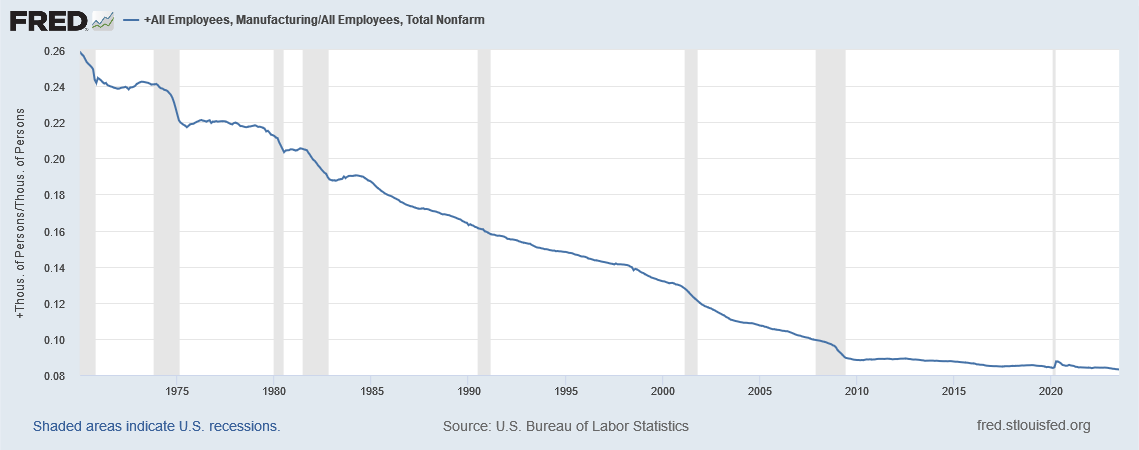
Not only was the Democrats’ trade policy very bad news for the country’s workers. They also lied about it. I don’t know how many times I have seen this graph showing manufacturing employment as a share of total employment. The story here is that there is a steady decline from the 1970s until 2010. In this story, there is nothing to see in the decade of the 00s, when the trade deficit exploded.

But then there is the other graph showing manufacturing employment since 1970. The basic story is that there are cyclical ups and downs, but only a modest decline until 2000. Then we lost 3.4 million manufacturing jobs, 20 percent of all manufacturing jobs, from 2000 to 2007, before the Great Recession.
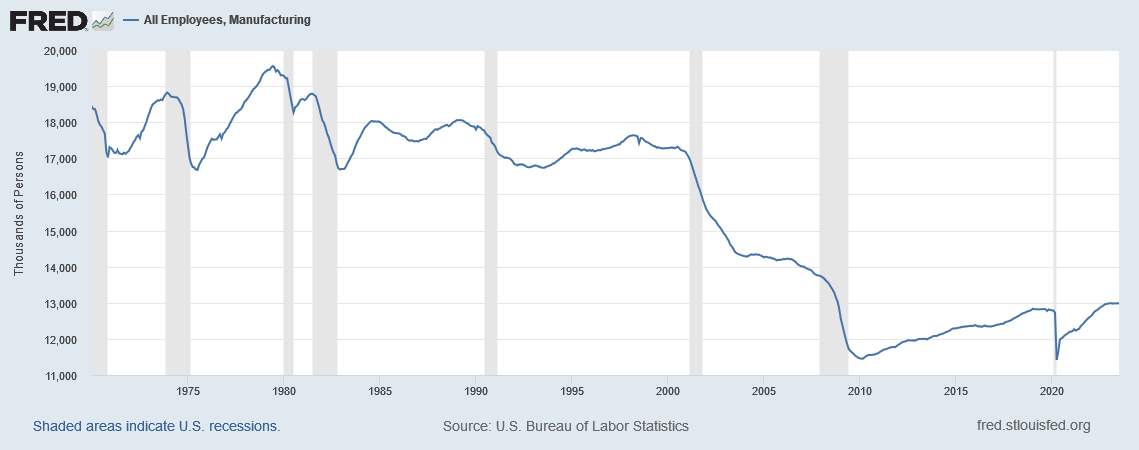
This was the impact of trade. Millions of workers saw their lives ruined. Cities and towns across the Midwest saw their main employers lay off much of their labor force or go out of business altogether. The workers and communities affected have a right to be angry.
Also, we should be clear, it was a lie to say this was “free trade.” We didn’t expose our doctors to competition with their lower paid counterparts in the developing world or even Europe and Canada. As a result, our doctors get paid twice as much as doctors in other wealthy countries.
We also made government-granted patent and copyright monopolies longer and stronger, a move that is 180 degrees at odds with free trade. This redistributed a huge amount of income upward, most obviously in the case of prescription drugs. We pay hundreds of billions of dollars a year ($4,000 per household) more than we would if drugs were sold in a free market.
Pushing trade deals that were designed to screw ordinary workers and redistribute income upward predictably made the victims angry at the Democrats. An apology is definitely in order, even (especially) if that means throwing Bill Clinton under the bus.


Dean Baker is co-director of the Center for Economic and Policy Research in Washington, DC. Dean previously worked as a senior economist at the Economic Policy Institute and an assistant professor at Bucknell University. He has also worked as a consultant for the World Bank, the Joint Economic Committee of the U.S. Congress, and the OECD's Trade Union Advisory Council.
ZNetwork is funded solely through the generosity of its readers.
Donate




