


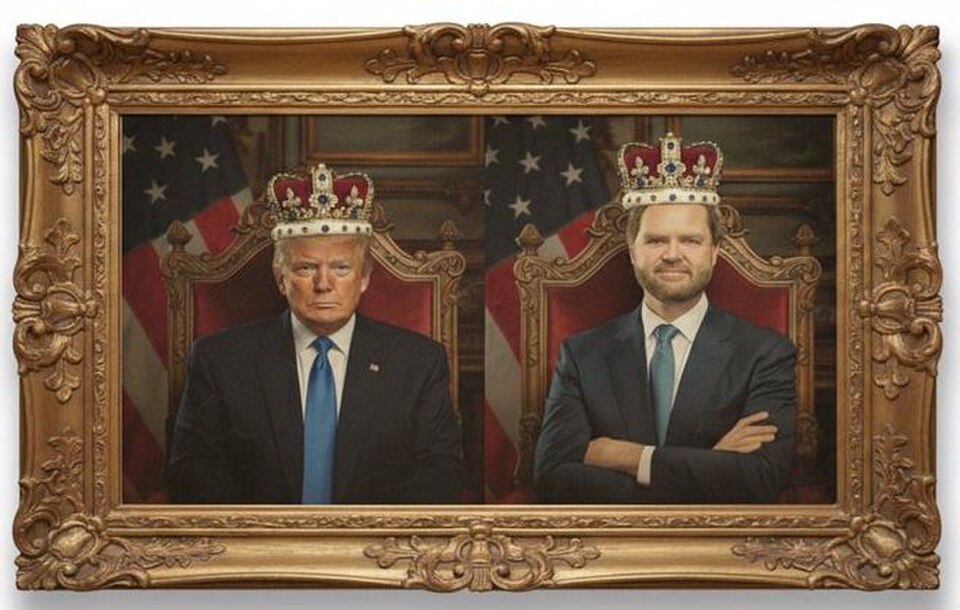
Earlier today, the Supreme Court declared war on U.S. democracy. It also declared war, basically, on modern society, on everything it takes to function in the 21st century. And I’m not sure that people understand that yet.
Really shocking decisions handed down by the Supreme Court. There were a couple that were not awful. Lisa Cook gets to stay at the Federal Reserve, although that in itself is a huge contradiction to the important stuff that the court did. I mean, Lisa is important and the Fed is important, but much more important is Humphrey’s Executor, which is the generations-long precedent that says that when Congress creates an independent agency, it is independent. It’s able to make decisions.
Of course, the president has some role. Typically, the president can choose the agency’s head subject to congressional approval, but the president can’t just go and fire officials that he doesn’t like for whatever reason or for no reason, because the agencies that operate the U.S. government and basically run our society are supposed to be professional. They’re supposed to be following their legal mandate. They’re not supposed to be personal tools of a dictator in the White House.
Well, the court just scrapped that. Now, lawyers, people who are legal experts, can do a better job of explaining just what went down. But what I think is important to understand is not only does this give essentially dictatorial powers to the occupant of the White House, but it also makes it extremely difficult for the economy to function. It makes it extremely difficult for society to function.
We live in a complicated world, a world of technology, where there are all kinds of spillovers, all kinds of ways in which it’s important that there be well-established ground rules. If you’re a business, take the example of medicines and foodstuffs, where we have an FDA, Federal Drug Administration, that is charged with ensuring that products that people consume are safe. We do that for very good reason. We know that not just that that there have been examples, historically, of products that were foods, medicines that were not at all safe, but also that people want some assurance.
The fact that something has been FDA approved is a bit of a warranty, that it might turn out to be very harmful, but probably not. Businesses that want to invest in developing stuff need to know that there are some ground rules that determine what they can and cannot sell.
Now imagine that all these decisions are made by political appointees who are loyalists to the president, who basically do whatever the president wants, whatever the people around the president want.
Do you want to invest in something where you have absolutely no idea what the ground rules will be, whether it will be approved or not? Do you want to invest in a whole business line when, for all you know, the White House will abruptly decide that your product isn’t safe and that a competitor’s product is, based on spurious grounds?
And what would cause those decisions to happen? Well, how about the fact that some businesses are better at the business of bribing the president and his family than others. And if you think that this is outlandish — you know, a few years ago you might have said this was outlandish, things like that wouldn’t really happen — well, as we speak, these things are happening all the time.
So you are setting up a situation in which, you know, it’s a little bit like traffic laws. Traffic laws, yeah, they can be annoying, but aren’t we all kind of glad that there are in fact rules about when you can turn and when you can go through an intersection? In order to function, in order to drive your car around you need to have a set of stable traffic rules, not a situation in which a police officer can decide you broke the law and the other guy did not because I say what the law is. And especially not where the police officer does that based upon who’s been paying him off or who he expects to be paid off.
The real world is far more complex than traffic rules but we need those rules and we need some stability and those rules cannot be specified with every letter, every punctuation mark set by Congress. The world is too complicated and changes too much. You need to have standing ethos, standing doctrine at the agencies that make modern life possible.
Now all of that is gone.
Now, it just adds to it that all of this is being done to empower a president who is the worst possible person for this job. This is not somebody you want supervising anything, everything that Trump touches turns to crud because he doesn’t care and he doesn’t actually understand or recognize that there’s such a thing as expertise as knowing what you’re doing.
So this would be terrible even if we had a temporarily competent administration. But now you’re doing all of this, the Supreme Court is doing all of this to empower the guy who brought you the Reflecting Pool, who brought you the Iran war. Utter nightmare.
Now, what will happen, hopefully, we emerge at the other end having fended off dictatorship. Then, I mean, as everybody knows, this Supreme Court is not actually empowering the presidency. It is empowering this president. And as soon as there’s a Democrat in the White House, suddenly there will be all kinds of restrictions on what that person can do.
Well, this cannot go on. This is a clear argument that says we have to one way or another disempower the Supreme Court. I don’t know enough to tell you what is the best route to do that but court packing or something else is going to have to happen. Because this has been the clearest signal yet that we have six people (there are three who are not part of it, but we have six people) who are fundamentally hostile to democracy, fundamentally hostile to the modern world and determined to put the catastrophically bad leader that we currently have sitting in the White House in charge of everything, which is a nightmare scenario on every level.
Take care, I guess.


Paul Krugman is an American economist and journalist who received the 2008 Nobel Prize for Economics for his work in economic geography and in identifying international trade patterns. He was also known for his op-ed column in The New York Times.
ZNetwork is funded solely through the generosity of its readers.
Donate




