

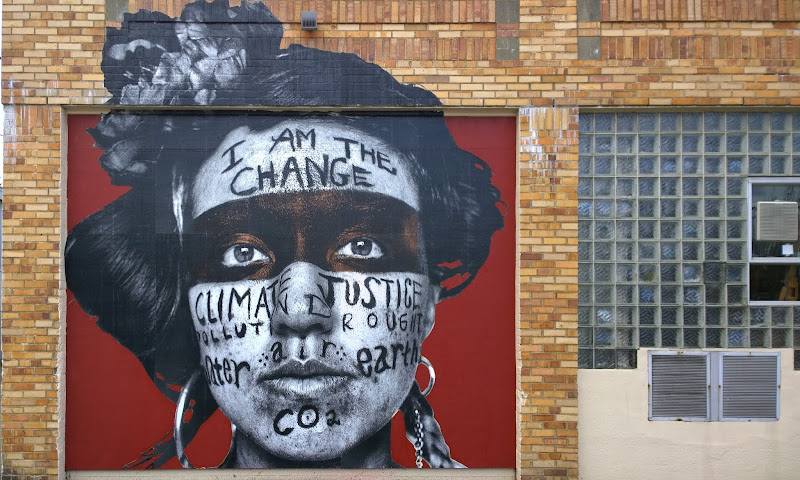
There is one crucial argument that the climate justice movement carried with it. For a brief period of time, it seemed like it was integrated into the general knowledge of social movements. It wasn’t.
The argument is about the meaning of climate emergency.
It is not an argument about public discourse or even about policy. It is an argument carried at the core of the climate justice movement, an argument directed at all social movements. This argument wasn’t integrated into social movements’ collective knowledge.
This short note aims to clarify that the climate crisis is not just another crisis among crises and not a topic among many topics. There is something substantially unique about the climate crisis that transforms the terrain of struggle entirely and for everyone.
The climate crisis is an existential crisis.
The current trends of carbon emissions and the associated warming scenarios put at risk the viability of human civilization on Earth. When scientists warn about the increasing probability of “the end of the world as we know it”, they are not using a metaphor. We genuinely do not know how to even model that planet. The scenario is not just “this world, but much worse”; it is actually a planet that we don’t know about.
All ecosystems will be harmed, many beyond repair. All countries will enter into social and political crisis (there is good reason for the billionaires to build bunkers for themselves). This is not a worse situation of suffering, it is a completely new category of generalized (and still uneven and increasingly uneven) suffering.
And don’t forget: it is much worse than we think; for decades it has been worse than scientists’ predictions; it will probably always be much worse than we will ever be able to conceive as a species.
The climate crisis gets worse under business-as-usual.
This is a unique phenomenon from a social struggle viewpoint.
If men kill 250 women per day today and if we let them act as they do now (no relaxation of current norms), then we would expect them to kill around 250 women per day in a decade from now.
If there is 30% youth unemployment in a country and if economic policies of the governments and the corporations remain the same, we would expect youth employment to remain around 30% next year.
In general, we would expect things to get worse due to novel decisions and new actions. Lives of migrants would worsen with the introduction of new xenophobic laws. Working conditions would worsen with right-wing labor reform.
This is not the case with the climate crisis. It is a very different monster.
A business-as-usual scenario (meaning running the fossil fuel industry as today) will create 5ºC warming, in comparison to the 1.5ºC warming so far.
This is hell on Earth. Most populations (humans and non-humans) will not be able to live where they are today.
Identifying the current status quo not just as the cause of the problem but also as the accelerator of the problem is a novel situation brought on by the climate emergency.
Abolition of fossil fuels from virtually all economic activity is a necessary condition to human existence. This will take a lot of work, particularly political work from the bottom and to the left – tough work that the climate justice movement of five years ago shied away from doing with due seriousness.
The climate crisis gets exponentially worse under business-as-usual.
This is also a unique phenomenon in another sense.
All emissions cause additional warming. They make things worse. But how much worse?
If we have 1.5ºC so far, then should we expect 3ºC to be double as bad? This would be the common sense interpretation of any social problem: if there are four ongoing regional conflicts rather than two, then we would expect the suffering to apply to more or less double the population; if the price of bread doubles, then we would expect access to bread to halve.
This logic does not work for the climate crisis. We know that the difference between 1.5ºC and 2ºC is catastrophic. Many global ecosystems collapse at this point. From 2ºC to 3ºC, the question is about the habitability of large chunks of the planet. Many coastal cities will be semi-permanently inundated, entire countries will turn into deserts. From 3ºC to 4ºC, most economic activities (like producing food or trading at the international level) will be disrupted globally and for long periods. There will literally be not enough food available in the world while the temperature and humidity in the streets will be deadly for long periods. Social conflicts within and between countries will be the new norm. And we all know the weapons they already have and the ones they’re developing. From 4ºC onwards, we don’t know, no fiction went that far.
The impacts grow exponentially. Each added carbon in the atmosphere has a cumulative, non-linear effect. That’s why we have to stop fossil fuels today, and not tomorrow.
The climate crisis begins to automatically get worse after a certain point.
To complicate the matter further, there are physical and chemical processes embedded in the Earth system that make warming irreversible. Run-away climate change can be extremely counter-intuitive for movement organizers, so let me go over it.
The already emitted carbon is locked in. Only a minor part of this can be taken off. But that’s not the problem.
The current increased temperature is locked in. Only a minor cooling can be caused. But that is also not the problem.
After a certain level of warming, the very fact that we reached a certain temperature will cause further warming. So, at some point, the acceleration of warming will be locked in. This is the problem.
A simplified example runs as follows. When we cross the 2ºC warming threshold, the global forest ecosystems collapse. The burning trees emit carbon to the atmosphere. This added carbon already pushes us to further warming. So imagine a scenario where we cross 2ºC warming but we stop the economy altogether. In that case, there are no new “human-made” emissions, because we stopped all economic activity. Yet, there are still new emissions causing new warming! From 3ºC onwards, we expect methane reserves in the permafrost to enter into collapse. With 4ºC warming, methane reserves under the ocean might be liberated. Each of these tipping points would push us to the next degree of warming. This domino effect is what keeps climate scientists awake at night.
Such dynamics are not present in any other social issue.
We can imagine peace in the world. It can take time, but it is possible. If we don’t win it today, if we don’t win it next year, it will still be possible.
We can imagine a world without femicide. It can take decades, there can be advances and setbacks, but victory will remain within our horizon.
The fight against racism will never be lost. If we didn’t win it in the 1960s, we can still continue fighting and the victory will always be accessible as functions of our determination and collective political intelligence.
We would never think of a problem becoming self-reinforcing to the extent that it becomes uncontrollable: that’s unique for the climate crisis.
That is why stopping fossil fuels today has a qualitatively different impact than stopping them in two decades. Tomorrow will already be too late for hundreds of millions of lives down the line.
Strategizing under climate emergency
Let’s recap:
- The climate crisis is an existential crisis.
- The climate crisis gets worse under business-as-usual.
- The climate crisis gets exponentially worse under business-as-usual.
- The climate crisis begins to automatically get worse after a certain point.
What does this mean for movement organizers? It means that all the parameters of struggle, of all struggles, changed. No previous experience, no past assumptions can be carried over to this new situation without major revision.
The climate justice movement did not grasp the full depth of these statements. Most of the co-optation, demobilization and political derailing can be explained with the lack of audacity that the movement had in relation to its own argument.
In terms of strategizing, here are a few immediate corollaries.
Things not getting worse is not enough.
The governments, the policies and the institutions that brought us here are the ones responsible for our predicament. They put on the line all human life on Earth. They kicked off a system of multiple, self-reinforcing genocides. They are not “the lesser evil” in any sense of the word. They are the main drivers of fascism. All. Of. Them.
The “minimal program” is revolution. Any strategy that washes the image of the establishment is complicit in mass murder. Any social movement organization following such a strategy is suicidal, as it participates in its own literal elimination.
Fossil fuels must go.
We cannot have a chance of winning unless we dismantle fossil capitalism very quickly. Emissions are undermining the ground on which we are fighting. This is not about “gaining time”, it is about gaining ground to stand up and fight. It is about having a physical reality in which struggles can still happen and hope to win.
The establishment is diverting the public attention with words like “transition” or “green investment”. These are off-topic. Wind turbines don’t cut emissions, cutting emissions cuts emissions. The point is to dismantle the fossil fuel industry in its entirety. This point is now a necessary criterion for any realistic strategy for any struggle.
We must aim for winning in the short-term.
Now, our struggles and movements can also be considered as the struggle and the movement. We can see ourselves fighting against the same enemy, capitalism, in different terrains. From a strategic viewpoint, some terrains can sometimes be more fruitful. Maybe a cost-of-living crisis would agitate better than any other subject for a period of time in a country. Perhaps migrant rights would give us better leverage to build class solidarity in a specific moment.
Whatever our specific struggle is, the climate crisis gives us new information: we have very little time left to win our entire agenda.
This is the core meaning of the climate emergency. The emergency is that we must have winning strategies, we must plan to win all, and we must have short-term plans to win all. This is an entirely new framework for strategizing. No one in our movement histories designed strategy under non-negotiable delivery deadlines given by physics and chemistry.
We must be extremely smart and extremely attentive.
We have very little time to win. So, on the one hand, we have no time to waste with bad strategy. We have no time to repeat mistakes. We don’t have time to ignore lessons gathered from past movement experience.
On the other hand, we have no time to waste with non-strategic activity. The climate emergency serves as a reality check for all our action plans. We must have observable and refutable strategic goals that are compatible with building people’s power, and concrete plans of actions that will deliver those goals in the short-term.
By this point in history, these four conclusions should have already been obvious to movement organizers of all areas of intervention. These conclusions provide us with an anchor to a strategy discipline of unprecedented clarity.
The subtle climate denialism entrenched within the social movements causes an unacceptable ambition gap in our organizing efforts and our strategies. We need to face the new reality in which we operate. This means revisiting our premises on globalization, class struggle, theories of change, and organizational models. The recently published book All In: a revolutionary theory to stop climate collapse aims to provide an honest, full-scale attempt in this direction.
ZNetwork is funded solely through the generosity of its readers.
Donate

1 Comment
Perhaps the only way to battle fossil fuels is to make it too cheap and efficient to ignore.
Why?
Because most think with their fast-scrolling dopamine, think whatever is necessary to make a very small majority rich.
Influential political and economical academia are too intellectually atrophied or are too incentive-struck to leave their rusty paradigms. And science always takes a generation to innovate, let alone the rest of the people.
Let’s therefore – even if it is ridiculous – fight these suckers on their turf with undeniable, unbeatable brilliance. Or we will perish.