


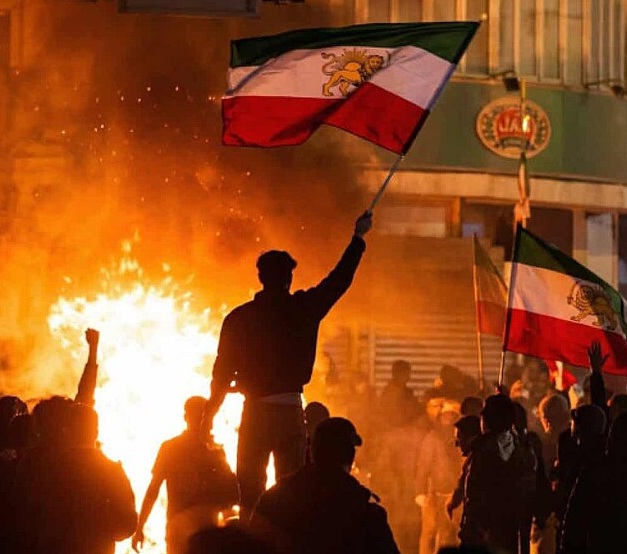
Israel’s longstanding campaign to lure Washington into war with Iran seems to have fizzled once again—for now, anyway. But in their attempt to invent a casus belli, their spy agencies employ tactics—disinformation, infiltration, and incitement of rioting—that help sustain the patently false impression that Tehran, not Tel Aviv, is home to the Middle East’s cruelest regime.
“We Are with You in the Field”
In late December, people in several cities across Iran took to the streets in nonviolent protest over the crushing economic conditions spawned by US attacks on Iran’s currency and the further intensification of US sanctions. Police were deployed, but the protests were peaceful, so they stayed on the sidelines.
Then, suddenly on January 8, shocking violence broke out across Iran, and most of the peaceable protesters vanished from the streets. They’d been displaced by young toughs, many of them armed.
Video (released by both government and anti-government forces) showed arsonists setting fire to businesses, mosques, a fire station (killing the firefighters inside), and other buildings, as well as public buses. Roving gangs, reportedly armed by Israeli agents, gunned down hundreds of people.
Max Blumenthal at The Grayzone reported,
“In Kermanshah, where anti-government rioters shot and killed 3 year-old Melina Asadi, groups of militants were filmed firing automatic weapons at police. In cities from Hamedan to Lorestan, rioters have filmed themselves beating unarmed security guards to death for attempting to impede their rampages.”
Suspecting foreign incitement, officials in Tehran shut off all internet connections beyond Iran’s borders. Sure enough, the violence ended as suddenly as it had started two days earlier.
There soon emerged more evidence that the riots had been orchestrated from abroad. Israel’s spy agency Mossad, which has many agents and collaborators on the ground in Iran, had put out the following message through its Farsi-language X account: “Go out together into the streets. The time has come. We are with you. Not only from a distance and verbally. We are with you in the field.” In an interview, Yoav Gallant, a former Israeli defense minister, was quite clear: “The regime in Iran must fall . . . At this moment, when what matters most is the mass action on the ground, we need to stay in the background and steer things with an invisible hand.“ Even former US Secretary of State Mike Pompeo got in on the action, posting, “Happy New Year to every Iranian in the streets … also, to every Mossad agent walking beside them.”
US sanctions had ruined Iran’s economy, bringing people into the streets in protest. Israel took it from there, using the nonviolent demonstrations over economic issues as cover for whipping up deadly riots against the government.
On January 20, speaking at the Davos World Economic Forum, US Treasury Secretary Scott Bessent pulled back the curtain a bit more, boasting that the sanctions and currency manipulation inflicted on Iran had been highly successful, because “their economy collapsed,” so “people took to the streets” and now “things are moving in a very positive way.”
(Helena Cobban, president of the non-profit Just World Educational, has pointed out that Bessent was saying, in effect, that the Iran sanctions “were intended to inflict such harsh pain and misery on entire populations of civilians that those civilians take action to change their government.” And, she added, that fits the definition of state-sponsored terrorism. Israel’s role in converting peaceful protest into armed uprising was a further terrorist act.)
As the violence in Iran was peaking, Reza Pahlavi, son the last Shah of Iran, tweeted support for the riots from his place of exile in the Washington, DC suburbs: “Our goal is no longer merely to come to the streets; the goal is to prepare for seizing the centers of cities and holding them.” Pahlavi has longed to retake the throne in Iran ever since his father, a brutal tyrant, was overthrown in the revolution of 1979.
Corporate media coverage of events in Iran has been abysmal—light on facts and heavy with Israeli propaganda. Social media were hijacked, too. Data analysis by the staff of Al Jazeera showed how a #FreeThePersianPeople hashtag that went viral during the riots
“…appears to be a politicized information operation constructed outside Iran and led by networks linked to Israel and its allies. The campaign successfully hijacked legitimate economic grievances, reframing them within a broader political project that links the ‘liberation of Iran’ to the return of the monarchy and foreign military intervention.”
Sina Toosi of the Center for International Policy wrote for The Nation that given Washington’s seemingly unlimited tolerance for the Israeli regime’s genocide in Gaza,
“What animates US and Israeli policy is not outrage at repression but hostility toward an adversarial state that resists their regional dominance … The claim that the United States has suddenly discovered a principled concern for Iranian lives is not merely implausible. It is an insult to the intelligence of anyone paying attention.”
Much of the American public does have sincere concern for the safety and wellbeing of the Iranian people. But the best way to help them is to demand that Washington end the sanctions on Iran, not instigate societal conflict and collapse.
Israel: The Bully’s Little Sidekick
The US and Israel have been trying and failing to topple Iran’s government for decades. But now, the Zionist regime is more tightly focused on Iran than ever. Its fraudulent “ceasefire” with the Palestinians, and its colonial “Board of Peace,” will simply be the final phase of the genocide, ending (in their fantasies, at least) with expulsion of all Palestinians from Gaza and the West Bank.
This last phase is to be quieter, more bureaucratic, than what came before—and managed by the US and some of its other client regimes. The butchers in Tel Aviv hope they can then devote more of their own effort toward asserting dominance over the entire region. And that means taking down the government in Iran.
Afraid to launch an all-out war against such a large, militarily powerful state, Washington and Tel Aviv have long bombarded the people of Iran with sanctions, financial attacks, propaganda, and psychological warfare, hoping to impose enough misery to spur a mass uprising capable of overturning the government. As Middle East Eye put it, they have sought “regime collapse without the costs of a direct military intervention”—with just a little exchange of bombs and missiles from time to time.
As recent events have shown, that was wishful thinking. Authentic protests in Iran remained nonviolent, and no one called for installation of the much-hated, much-ridiculed Reza Pahlavi as Iran’s leader. Clearly, external stoking of violence and chaos was required to convince the world that Iran is imploding, and that’s what we’ve now seen.
Israel and the US may be feeling their oats right now, but they have made themselves pariah nations with their genocide of the Palestinian people and their aggression against any society on any continent that refuses to comply with their neocolonial ambitions.
Polls show that the numbers of people around the world who hold negative views of Israel have risen dramatically. Last year, Pew found the regime to be 33 points underwater on that question, with 62% of responses unfavorable and 29% favorable. Pew also found a dramatic increase in unfavorable views of the United States, largely related to our economic, military, diplomatic, and media sponsorship of the genocide in Gaza.
For the past two years, Israel has ranked dead last among the world’s countries in the Nation Brands Index, a national-reputation score. Furthermore, institutions around the world are divesting from billions of dollars in Israel Bonds, which are essential to sustaining its economy. The global Boycott, Divestment, and Sanctions (BDS) movement against Israel is snowballing.
And crucially, writes Mohamad Elmasry, a professor at the Doha Institute for Graduate Studies,
“Gone, at least for now, are the days when Saudi Arabia viewed Iran as its foremost enemy, when Qatar saw Saudi Arabia as its principal threat, or when Egypt treated Qatar as the chief source of regional instability. Increasingly, Arab regimes, with perhaps the exception of the UAE, now view Israel as the region’s most destabilizing force.”
The loathing that most of the world has for Israel is richly earned. For many, the genocide—not only the raw death toll but also the sadistic relish with which the Zionist regime has tortured an entire society for the past 28 months—was the last straw.
The one element of the state that once drew the most respect, its much-vaunted military, has proven once and for all to be a pathetic fraud. The Israeli Occupation Forces are cowards. Against Iran, Syria, Yemen, Lebanon, Gaza, everyone, they attack mostly or entirely from afar, with shelling and bombing and drones and cyberattacks and, yes, beepers. They rely heavily on clean, safe, white-collar warfare: espionage, propaganda, and sabotage. But they’re picking fights they can’t finish.
When they have dared to engage in battle on the ground, as in Lebanon, they’ve been routed. Their troops’ attempts to invade, capture, and hold ground in Gaza also have been totally hapless failures, except during “ceasefires”, when only the Palestinian resistance ceases and only the IOF fires.
Then, whenever Israeli forces gin up the “courage” to bomb the elephant in the region, Iran, they usually act like a bully’s little sidekick: picking fights, then running and hiding behind Washington’s skirts, crying, “Save us, please!”
We Americans must accept that our government and its client Israel are rogue states. Together, they will continue posing a threat to the rest of the world until we force our own government to stop funding and start sanctioning Israel—and to end our own attacks, both military and economic, on other nations.
ZNetwork is funded solely through the generosity of its readers.
Donate

