

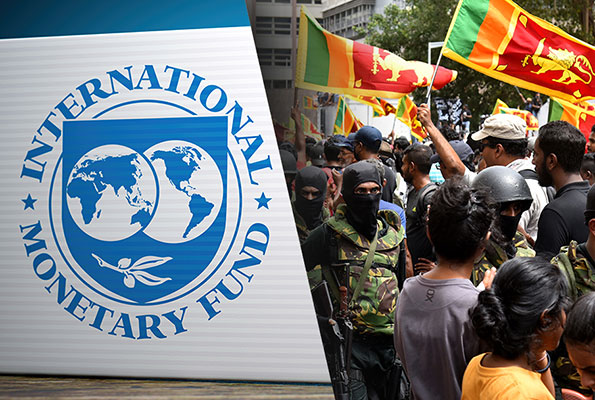
For nearly a year now, many in Sri Lanka have been fervently chanting three letters — IMF (International Monetary Fund).
As the country’s familiar balance of payments problem escalated last year, citizens experienced crippling shortages and painfully long power cuts. They took to the streets in a staggering mass protest and ousted the Rajapaksas, who they held responsible for their suffering. The chant, seeking IMF support, persisted through these dramatic developments.
In July 2022, former Prime Minister Ranil Wickremesinghe was elected President, through an urgent parliamentary vote. One of the first tasks he set for himself was to negotiate an IMF deal to resurrect the country’s battered economy. Sri Lanka entered a staff level agreement with the Fund on September 1, 2022.
Looking for a bail-out
Mr. Wickremesinghe recently announced that his government had completed 15 tasks prescribed by the IMF, in preparation for its assistance. The IMF’s provisional $2.9 billion package will come through by end of this month, he said.
In fact, Sri Lanka had hoped to tap it by the end of last year, or at least in January this year, but the process had dragged on. One of the main reasons for the delay had to do with written financing assurances from China, Japan, and India, Sri Lanka’s top three bilateral creditors. The IMF had made its programme contingent on their cooperation. India took the lead and sent its assurances to the Fund this January, with the Paris Club group of creditors, which includes Japan, following suit. China’s written financing assurances alone are pending.
Should the IMF package kick in later this month, either with China coming on board, or with other official lenders expressing confidence for the Fund to go ahead and clear it, Sri Lanka will see it as a critical milestone in its economic recovery. Evidently, a $2.9 billion-Extended Fund Facility, over a period of four years, is not big money for Sri Lanka. Even after streamlining imports to save dollars, the island nation spends well over a billion dollars every month on essential imports alone. Exports totalled $978 million in January, pointing to an enduring trade deficit.
However, an ongoing IMF programme helps Sri Lanka become more credit worthy in the eye of global lenders, be it multilateral agencies like the World Bank or the Asian Development Bank, bilateral partners, or private creditors. The bankrupt nation that defaulted on its $51-billion external debt last year hopes that with an IMF programme, it can borrow again. After falling into a cycle of indiscriminate borrowing, especially in the last 15 years, Sri Lanka finds itself in a position where its problem, and its solution, look eerily similar at this point.
Tackling corruption
What could potentially make a difference this time is the IMF’s emphasis on fixing Sri Lanka’s corruption vulnerabilities, which has been a rallying point for many Sri Lankan economists and policy analysts. It is corruption that led Sri Lanka to this precipice in the first place, they argue. Corruption, coupled with the state’s tendency to implement “populist” welfare programmes that are “unsustainable”, made the country’s economy fragile over time, in their view. So much so that 16 of the past IMF agreements could not turn the tables for Sri Lanka.
Critics of the IMF, a very small minority in Sri Lanka, see an IMF package as part of the problem, not the solution. They worry that the austerity measures that come attached with it will be a deadly blow to the people, especially the country’s working class that is worst affected in this crisis. Apart from that, there is no raging public debate on, or popular resistance to, the IMF within Sri Lanka unlike in say, Argentina in recent times. On the IMF package, the average Sri Lankan is preoccupied more with when it might come through, rather than whether the country really needs it.
Even worker unions, currently protesting against the sharp increase in taxes and utility bills — introduced by the government in anticipation of the IMF programme — are resisting only the specific policy measures that are hurting them. Otherwise, they appear reconciled to yet another IMF-led reform agenda, an “inevitable, bitter pill”, as it is often projected.
Food insecurity
Over the last year, poor families have been forced to reduce their food intake drastically. Soaring prices have kept eggs, fish, and meat out of reach for many, raising concern among medical practitioners over nutrition levels in the community. With inflation persisting over 50%, half of the families in Sri Lanka are forced to reduce the amount they feed their children, humanitarian organisation Save the Children found in a recent survey. Additionally, they warned of a “full-blown hunger crisis”. The World Food Programme, in its January update, estimated that 33% of Sri Lankan households are food insecure.
Irrespective of when the IMF programme kicks in, and how much more money Sri Lanka can borrow after that, it will be a rather rocky road before possible recovery.
The country is currently witnessing a new wave of protests, mainly by workers and professionals, as people’s economic hardships increase. The government also faces criticism for the recent postponement of local body elections, even as multiple surveys point to a significant rise in support for opposition parties. But for those looking for policy coherence, such as the business community, the Wickremesinghe administration symbolises a version of stability. Democracy can wait, they contend, since economic recovery is urgent. For many others, Mr. Wickremesinghe, who lost his mandate in the last general election and rose to power with the support of the widely despised Rajapaksas’ party, represents continuity of a political order they fought to change. They see election as a vital barometer that will reflect this sentiment.
Meanwhile, how Sri Lanka charts its path of economic recovery will be evident in the coming months. Nearly half a century after liberalising its economy — Sri Lanka was the first in the region to do so — the country has confronted some fundamental questions, about how much it produces, how much it still imports, and how little its export basket has diversified in all these years.
These are questions that go beyond the problem of corruption. These are also questions that have a bearing on the country’s overall progress, which can’t be measured without factoring in the extent of inequality.
The latest Household Income and Expenditure Survey of 2019, conducted before the pandemic and Sri Lanka’s crisis, showed an increase in the Gini coefficient, a measure of income distribution, to 0.46, reflecting widening inequality. The IMF has said that a key element of its programme would be to mitigate the impact of the crisis on the poor by raising social spending and improve the coverage and targeting of a social safety net.
As the government goes ahead with its austerity measures, it remains to be seen if it can support its most vulnerable citizens.
ZNetwork is funded solely through the generosity of its readers.
Donate




