


On the Times article, I understood it differently. The tone was set in the first paragraph: a remote section of Afghanistan, where people could hear on the radio that in the rest of the country everyone was celebrating their liberation and the gifts of the wonderful Americans, and that they were the last ones still suffering. Then comes a literary rendition of the horrors of famine, with no attribution of causes, apart from the drought and the Taliban. And at the end comes “a miracle,” the magnificent American rescuers finally made it even to their remote corner and might save them too, though perhaps it is too late.
That’s highly effective propaganda, like articles in the British press during the Irish famine describing with much feeling and literary skill how awful it is to suffer famine, but ignoring the British role, blaming either Irish oppressors or circumstances out of control, and lauding the magnificent British for liberating the Irish from their travail.
But you’re quite right that material can be found in the mainstream press that utterly undermines the propaganda system. For example, I learned in the NY Times in 1962 that the US airforce was bombing South Vietnam and that huge numbers of people were being driven into concentration camps to “protect” them from the indigenous guerrillas who they were supporting. And I learned in 1999 that the claim that US was bombing Serbia in response to ethnic cleansing and to return its victims to their homes was a complete fabrication. And on, and on. Nonetheless, within the intellectual culture there is virtually no departure from the doctrine that the US was defending South Vietnam (perhaps unwisely) from terrorists attacking the country from outside, that the US undertook the noble mission of bombing to reverse ethnic cleansing and return refugees who had been driven out of Kosovo to their homes, etc. Filtering doesn’t end with the media. The media, particularly the elite “agenda-setting” media, are part of a general intellectual culture, overwhelmingly dedicated to support of power.
Not just in the US. This is close to a historical universal, though there are dramatic exceptions. I just returned a few days ago from Turkey, where very prominent journalists, writers, lawyers, human rights activists and others show remarkable courage in condemning state repression and atrocities, facing serious dangers and often suffering imprisonment or worse. That’s true enough in Istanbul, where at least there is some marginal international attention, but even more so in the Kurdish southeast, which is a kind of prison camp for 10-15 million people, huge numbers of them driven out of the devastated countryside by some of the worst state terror of the 1990s. They continue to struggle. Here, where we face no threat, there is virtually no protest over the fact — easily discovered — that the US bears prime responsibility for the past and continuing atrocities, and could easily end them. The most that intellectuals will concede, occasionally, is that our policy was “flawed” or that we “looked the other way” and were “inconsistent” in our undying commitment to human rights everywhere. By any moral standards, that’s far below the most vulgar commissars, who could at least plead fear. The cowardice of privileged intellectuals in the West stands in glaring contrast to the courage of their counterparts in countries where they really do face serious dangers, in large part a result of our cowardice.
Nonetheless, at least in more privileged and powerful countries, support for power is the norm, overwhelmingly. There is nothing surprising about the fact that it is also true here.
Why do the media often provide crucial information undermining established doctrine? One important reason is that journalists are no different from other people. Many are honest, dedicated, courageous people who pursue their craft with honor and admirable professional integrity. They want to find the truth, whatever it is, and to report it honestly. Sometimes they succeed, though there is plenty of filtering at the news-management level. Furthermore, those in decision-making positions in the economic, political, and ideological domains have to have a tolerably realistic picture of the world. The editorial pages of the Wall Street Journal may be mostly a comic strip, but the news pages are often excellent, and some of the best reporting in the world can be found in the London Financial Times and other business journals. In addition, the discipline of the intellectual community can be trusted to shape what appears into forms that will serve power interests, to a substantial if not overwhelming extent.
Noam Chomsky

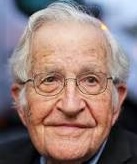
Noam Chomsky (born on December 7, 1928, in Philadelphia, Pennsylvania) is an American linguist, philosopher, cognitive scientist, historical essayist, social critic, and political activist. Sometimes called "the father of modern linguistics", Chomsky is also a major figure in analytic philosophy and one of the founders of the field of cognitive science. He is a Laureate Professor of Linguistics at the University of Arizona and an Institute Professor Emeritus at the Massachusetts Institute of Technology (MIT), and is the author of more than 150 books. He has written and lectured widely on linguistics, philosophy, intellectual history, contemporary issues, and particularly international affairs and U.S. foreign policy. Chomsky has been a writer for Z projects since their earliest inception, and is a tireless supporter of our operations.
ZNetwork is funded solely through the generosity of its readers.
Donate




