

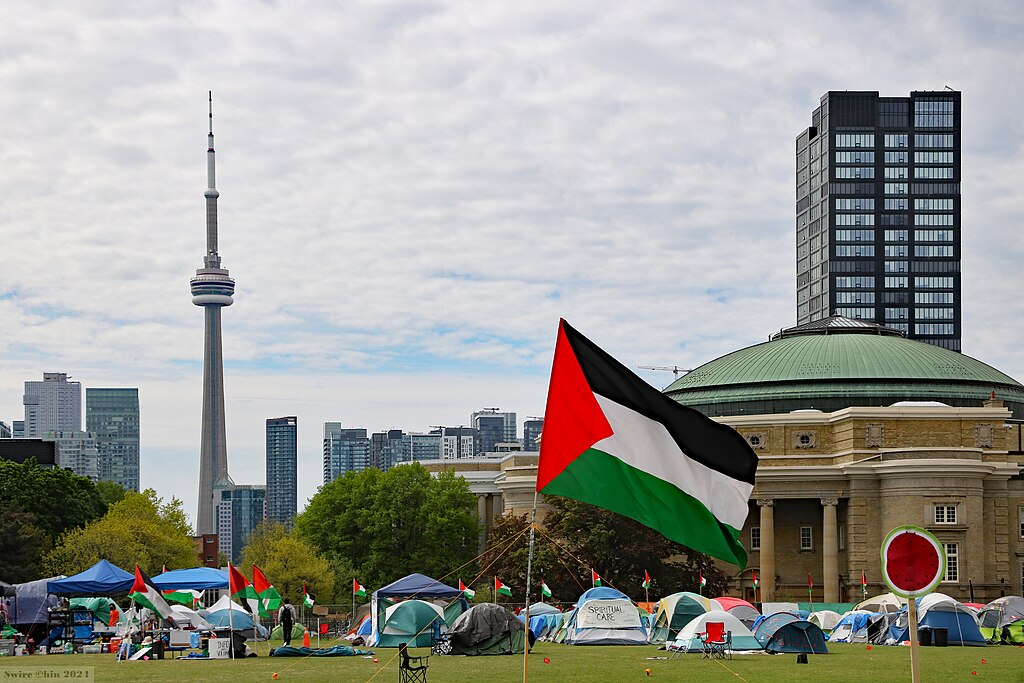
By the spring of 2025, many had declared the student Palestine solidarity movement dead. Since Donald Trump’s election, the crackdown had been swift and merciless: Mahmoud Khalil, who had become the face of Columbia’s Gaza solidarity encampment, was detained by ICE agents in March and held for 104 days in a Louisiana detention center. Rümeysa Öztürk, a Turkish PhD student at Tufts, was grabbed off a Somerville street by masked federal agents for cowriting an op-ed calling for divestment. At NYU, eleven students received year-long suspensions after a nonviolent library sit-in. At the University of Minnesota, seven students faced up to two and a half years of suspension and $5,000 in alleged damages.
Trump’s Department of Education has launched investigations into sixty universities, ostensibly for the purpose of “combating antisemitism” but widely understood as aiming to silence support for Palestine. Campus after campus adopted policies of “institutional neutrality,” a euphemism for shutting down dissent. The message was clear: speak out for Palestine, and your education — your future — would be forfeit.
But at my college graduation ceremony in May of this year, my classmates and I weren’t ready to give up. As Chris Canavan, Oberlin College’s Chair of the Board of Trustees, moved to the podium, hundreds of my peers and I stood up from our seats, turned our backs, and chanted “Free Palestine.” The majority of my graduating class participated in this act of protest.
Student activists have used graduation ceremonies as platforms for dissent at schools across the country. Despite the profound repression of Palestine solidarity activism on American campuses, many of us continue to demand that our institutions stop investing in companies that profit from Israel’s genocidal campaign of retaliatory violence in Gaza.
As the Chair of the Board of Trustees, Chris Canavan plays a central role in overseeing how the college manages its $1 million endowment. Canavan sets the tone and agenda for what the rest of the trustees take seriously. Like many schools, Oberlin’s endowment is invested in broad market index funds, which tie the university to companies that profit from Israel’s relentless siege of Gaza’s civilian population.
While Oberlin has not released the complete list of its investments, patterns across campuses and student divestment campaigns suggest a high likelihood that the college is invested in companies with condemnable practices. These might include military contractors like Lockheed Martin and Northrop Grumman, which supply weapons and technology used by the Israeli military, or companies linked to the construction of settlements, such as Caterpillar Inc. and Elbit Systems. Does the university invest its endowment in Palantir, the US-based big data company whose AI software Israel has used to target and kill Palestinian civilians? We don’t know, because the institution refuses to disclose its investments, hiding behind the obscurity and complexity of packaged portfolios.
Since student Palestine solidarity campaigns began intensifying in 2023, colleges have responded to student demands for divestment with the defense that they don’t directly choose investments, keeping their endowments instead in broad index funds like the S&P 500 or MSCI All Country World Index. Student activists reject this passivity and feigned lack of control. It is a deliberate evasion that shields institutions from responsibility while their money fuels apartheid and violence. Using broad market financial tools without oversight or ethical screening, higher institutions are still effectively entangling themselves with firms like Boeing and Palantir and everything these companies stand for — which, as our graduation protest indicated, is everything the majority of students stand against.
Some student bodies have had more success than we at Oberlin have in tracing institutional investments. An analysis of the Harvard Management Company found that HMC has over $194 million directly invested in Booking Holdings, which the United Nations ties directly to the construction of illegal Israeli settlements in Palestine. Activists have compelled the University of California to disclose $32 billion invested in concerning assets, which include weapons manufacturers that sell directly to Israel. From George Washington University to Cambridge, students who have had success in exposing institutional investments are confirming that colleges are deeply financially invested in Israeli apartheid, occupation, and violence.
At Oberlin, our protest on commencement day was rooted in our longstanding demands for financial transparency. We want regular investment reports that disclose which firms manage the college’s money and track changes in holdings over time. But transparency is just the start: ultimately, we demand complete divestment from companies that supply weapons, technology, and services to aid Israeli violence. We demand that our colleges instruct managers to select packages that screen out companies complicit in apartheid, surveillance, or military aggression.
Divestment may be difficult, but it’s not a pipe dream. Oberlin itself recently announced that it had become carbon neutral. This means that the college no longer holds any investments in fossil fuel corporations, an achievement secured through the selection of investment packages that exclude companies that don’t align with the college’s climate goals. There’s also precedent at Oberlin for applying ethical investment screens to foreign policy concerns: after a decade of student activism in the 1980s, the college divested from companies doing business with apartheid-era South Africa. Following sustained protests, including a three-day occupation of the Cox Administrative Building in 1987, the Board of Trustees finally agreed to total divestment.
Our graduation protest was not about performative activism or creating chaos for its own sake. It was about forcing a reckoning. We refused to celebrate the trustees without questioning what they represent. At a moment when students across the country face suspension, arrest, and deportation for speaking out, we used the biggest platform available to us to voice our dissent.
Since the crackdown on campus Palestine solidarity activism intensified earlier this year, administrators have hoped that harsh punishments would silence the movement, and that students would eventually move on to other causes. They were wrong. Despite every attempt to crush dissent, students continue to question and expose their institutions’ complicity in Israel’s assault on Gaza. We will not be intimidated into silence about our universities’ role in funding apartheid and mass death.
ZNetwork is funded solely through the generosity of its readers.
Donate
