



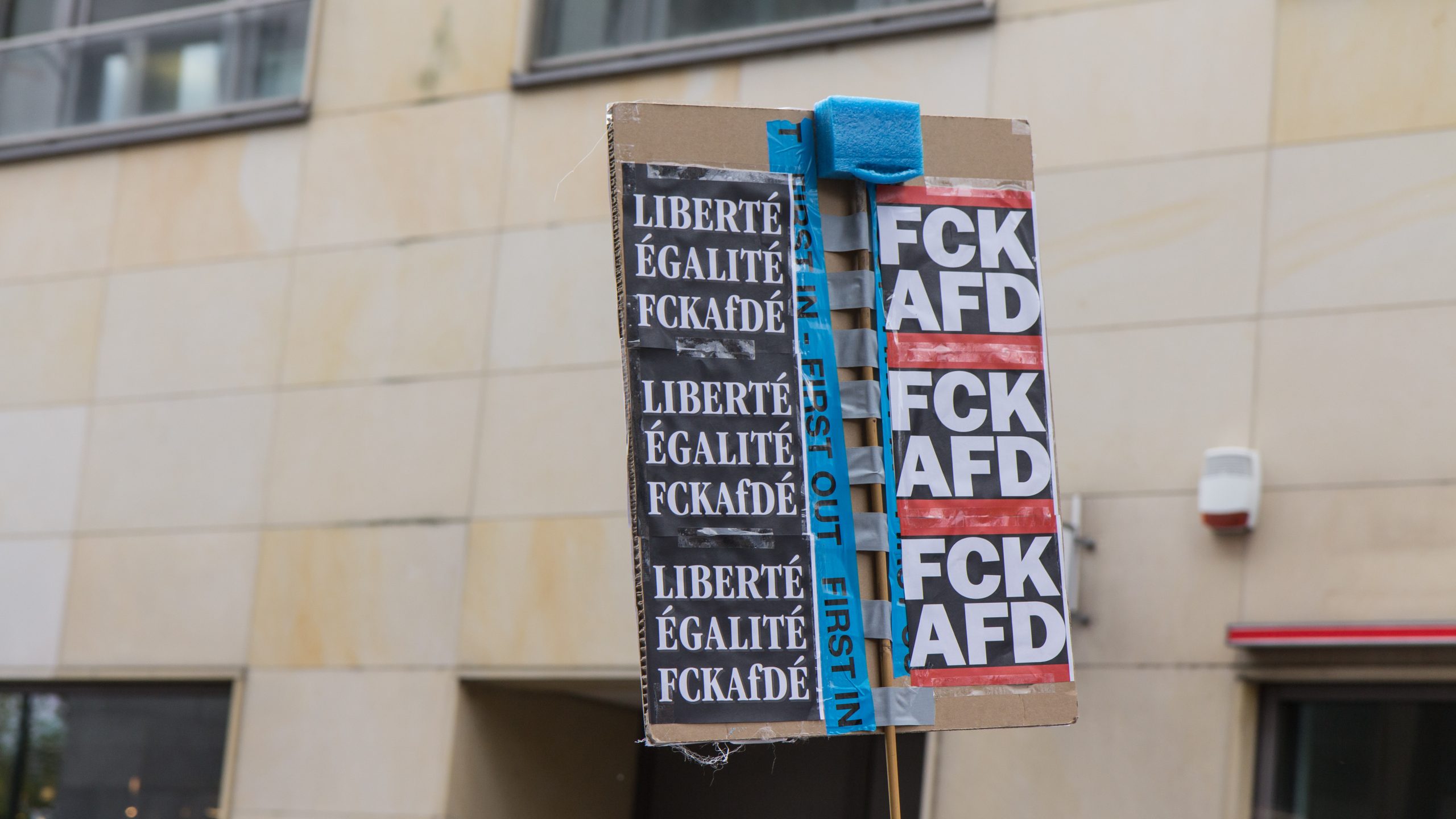
Germany’s neo-Nazi party, the AfD, fabricates and benefits from conjuring up fear. By using fear as a vehicle for far-right propaganda, the AfD doubled its vote share in the 2025 federal election compared to the previous one.
Worse still, recent polling places the AfD ahead of the conservative CDU – albeit by just one or two percentage points. Nonetheless, the rise of the AfD now appears almost unstoppable.
The doubling of support for the AfD is based on a merging of two groups: long-standing supporters and a substantial influx of new voters.
In the 2025 Bundestag election, the far-right AfD secured nearly 21% of the vote, forming a relatively stable bloc representing about one-fifth of all German voters. Among these are a growing number of working-class voters. This raises three urgent questions:
- How did a neo-fascist party achieve such an increase?
- How deep are the AfD’s inroads into Germany’s working class?
- Did recent political and economic crises aid the AfD’s rise?
Many observers describe the AfD’s growing success as a “penetration” into Germany’s petty-bourgeois and working-class segments. Support for the AfD is no longer limited to political outsiders.
Recent survey data make for sobering reading. A representative poll of 6,700 workers revealed that the AfD’s doubling of support was mirrored in increased backing from working-class voters.
Remarkably, the number of workers who had previously voted for the AfD in 2021 was nearly matched by those who switched to the party for the first time in 2025.
Where did these new voters come from? No single pattern emerged. Roughly equal numbers of workers who had previously supported the CDU and the SPD in 2021 shifted to the AfD by 2025.
An exception was the staunchly neoliberal, zealously pro-business FDP, which lost all federal parliamentary representation in 2025.
FDP voters disproportionately moved to the AfD, although the FDP had always drawn very little support from the working class – it was even less so in 2025.
Even more concerning: the AfD gained substantial traction among previous non-voters. Around 15% of working-class AfD voters in 2025 had abstained in 2021.
As expected, few voters from Die Linke (Germany’s progressive The Left) or the Greens switched to the neo-fascist AfD. The survey confirmed this commonly held assumption.
Moreover, 16% of new AfD voters previously supported small, often fringe, parties. In short, the AfD has absorbed a notable share of Germany’s political periphery.
Worse, the AfD has successfully pulled moderate working-class voters from the political centre into the far-right camp.
Many of these voters had no strong ideological leanings – neither staunchly conservative nor progressive. Their move to the AfD appears driven more by frustration than ideology.
The newly recruited AfD working-class voters differ from the party’s traditional base. The older, core AfD voter is more likely to be male, middle-aged, with a low to medium level of education (often unskilled), and more likely to reside in East Germany.
In contrast, the recent election saw the AfD make inroads among women. Among those who voted for the AfD for the first time in 2025, there was no significant male surplus. While the party remains male-dominated, female support has increased.
This shift does not signal a “feminisation” of the AfD – most AfD voters are still male voters. The party still presents a heavily male leadership.
Its use of a lesbian, Swiss-resident figurehead appears more like a PR-marketing tactic than a reflection of gender balance.
Additionally, more voters aged 56–65 joined the AfD’s support base. Combined with the male-dominated leadership, this trend has deepened the perception of the AfD as a party of older men.
Interestingly, many of the new AfD voters express more “progressive” views – particularly on economic issues – than the party’s older base. They support reducing inequality and raising the minimum wage.
Even Hitler’s Nazi Party masked its fascist goals with a façade of anti-capitalism, calling itself a “workers’ party” while privately reassuring corporate bosses that they will continue to make profit under the Nazis.
Similarly, the AfD pushes xenophobia while attempting to appeal to economic anxieties. Two issues unite AfD voters across class lines:
- Xenophobia, particularly against migrants and refugees
- Resentment toward social welfare recipients
These attitudes are shared broadly among AfD voters, regardless of social background and class.
Economic redistribution and inequality are not the main motivators behind working-class support for the AfD. It is racism and xenophobia.
A staggering 95% of AfD voters support limiting immigration. Around 70% even support the AfD’s euphemistically named “remigration” plan – mass deportations that amount to ethnic cleansing.
Removing millions of workers (30% of Germany’s workforce has a migration background) would amount to economic suicide. And yet, these absurd fantasies continue to win votes.
Historically, similar propaganda worked: from Hitler’s “Jewish-Bolshevik World Conspiracy” to Trump’s “Mexican rapists,” Brexit, Orban’s nationalism, and Putin’s empire fantasies.
AfD voters show low levels of empathy, especially toward refugees from Ukraine. A worrying 64% of AfD voters, and 24% of other voters, expressed no sympathy for Ukrainian refugees. Dehumanisation runs deep.
Among working-class AfD voters, 85% agree with the narrative that refugees should “go to the back of the queue.”
Around two-thirds believe welfare recipients live comfortably “at the expense of society” – a distant echo of Reagan’s mythical “welfare queen” – that never existed.
This far right strategy divides society horizontally – worker against worker – rather than vertically: worker versus capital.
Such resentments are particularly high among workers who feel “systematically” neglected. Right-wing tabloids and AfD propaganda have convinced many that “others” get more.
Social scientists call this “perceived deprivation” – a zero-sum belief that someone else’s gain is your loss.
Yet most AfD voters are not workers. The majority comes from three groups:
- the traditional petty bourgeoisie of the middle class;
- the nostalgic who look back to the illusionary romanticism of a bygone era; and
- the opportunistic and resentful.
Still, many workers feel the collapse of what used to be perceived as a “moral economy” that is fair to all.
Neoliberal capitalism has stripped away this sense of fairness. But rather than blame corporations, the AfD directs anger at scapegoats: refugees and migrants.
Worse, the AfD has weaponized fears around AI and ecological transformation. Many unskilled workers fear losing jobs due to decarbonization and digitalization. These fears have turned into votes for the far right.
The Covid-19 pandemic and dissatisfaction with government policies have further increased AfD support. Despite the absurdity of the Corona Dictatorship narrative, it resonated.
When inflation spiked due to the war in Ukraine and the collapse of Germany’s energy ties with Russia, the AfD again blamed refugees – not the energy dependency built under Merkel and Schröder.
The AfD rechanneled economic anxiety into xenophobic sentiment. It worked.
Seven Strategies Against Germany’s Neo-Fascist AfD
The far-right playbook is clear: fabricate a crisis and present yourself as the savior. This tactic has succeeded globally. But it can be defeated:
- Countering Propaganda: Trade unions, civil society, and quality media must consistently expose the AfD as a neo-Nazi threat. More effort is needed to break through right-wing filter bubbles.
- Support for Democracy: Democracy must be defended practically, not abstractly. Remind people that being elected does not make a party democratic – Hitler was elected too.
- Real Help for Real People: Offer tangible, visible support – especially in housing, health, education, and transport – not vague “investments in infrastructure.”
- A Positive Vision of the Future: Offer real, hopeful alternatives. Present a sustainable and inclusive future – unlike the AfD’s dystopian, xenophobic propaganda narrative.
- Adult Education: Invest in adult education to inoculate people against far right ideology. Workers with little autonomy or education are more vulnerable to far right propaganda.
- From Xenophobia to Capitalism: Expose the true causes of inequality: capitalism and neoliberalism – not migrants. The enemy is not the Syrian nurse or Turkish kebab chef. It’s corporate power and right-wing media manipulation.
- From Migration to Real Issues: Shift the political conversation to real challenges: climate change, AI, economic transformation, and an aging population. Ignore AfD’s baiting on migration to lure the debate into its ideological orbit.
The inevitable conclusion to all this is the following. Like Hitler’s Nazi party, today’s AfD is not a party of the working class.
But it can make inroads with the right propaganda. Workers are not immune to far-right narratives.However, Germany’s civil society is not defenseless. If trade unions, democratic institutions, and quality media implement these seven strategies, the tide can be turned. The neo-fascist AfD and the global far right can be defeated.
ZNetwork is funded solely through the generosity of its readers.
Donate

