

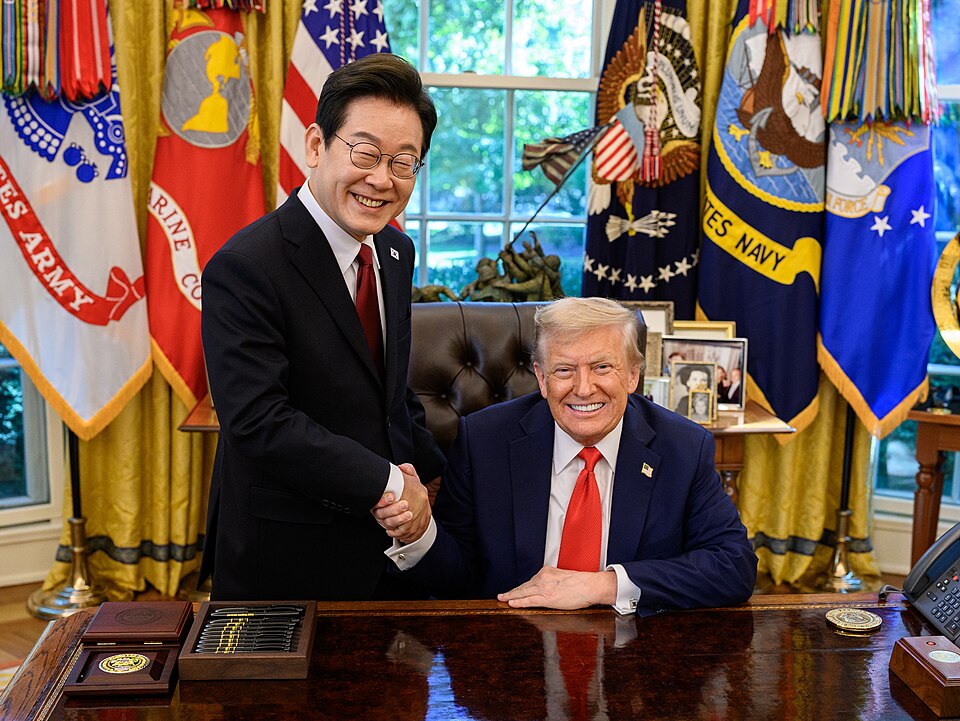
The Lee Administration leaked the possibility of deploying Korean forces to the Strait of Hormuz on 03 September. The backlash was immediate from Korean civil society that opposes any type of support for Trump’s war of aggression. Furthermore, recent polls reveal that even 55 per cent of Lee’s supporters oppose the dispatching of forces. And while the Lee administration has publicly backtracked, stating that nothing has been decided, it is, nonetheless, quietly undergoing the process of deployment: more than simply an assessment of the security conditions on the Strait of Hormuz, the Lee administration sent a team to check key military bases and ports that could be used at the United Arab Emirates.
Despite growing public opposition, the Lee administration is expected to introduce at the end of September a motion into the National Assembly, where it is likely to pass given his party’s considerable majority. Unlike his predecessor, the impeached Yoon Suk-yeol, President Lee is not a pro-US ideologue; he is a pragmatist. Why then is Lee going out on a limb with this deployment when the rest of the world is staying out of it?
Well, South Korea’s history has always been entangled and shaped by US foreign policy. The darker side to South Korea’s pop-culture is a country dominated and shaped through US policy and interventions. Today, it hosts the largest overseas US military base and controls the Korean military (through wartime operational control). In effect, it’s never been a sovereign state. Its economic, political, and military interests have always been beholden to the United States.
Today, Lee is horsetrading with Trump: military support in exchange for more favourable terms in the US’s AI global supply chain of semiconductors and data centres along with a return of wartime operational control. While Lee’s pragmatism is navigating the real structural constraints on South Korea, it is ultimately short-sighted and harmful to Koreans and the world.
The war in Iran is inflicting considerable pain to the world’s economies, including South Korea that imports 61 per cent of its crude oil through the Strait of Hormuz. Yet, even from a completely pragmatic perspective, sending Korean forces to Hormuz does nothing to resolve this problem. In fact, getting entangled with US aggression against Iran would strain the 64-year diplomatic relations with Iran while putting a target on South Korean assets in the region. Furthermore, if the world’s greatest naval and air power cannot secure freedom of navigation in the Strait of Hormuz, how could South Korea’s contribution make a difference? In fact, the deployment of Korean troops prolongs this war of aggression by giving Trump cover and leverage to demand that other countries, such as Japan, also deploy forces.
This isn’t the first time that South Korea would deploy forces due to US requests. In 2004, after pressure from the George W. Bush Administration, the Roh Moo-hyun administration deployed non-combat support troops to Iraq. In response, a militant Islamic group kidnapped a Korean translator and, when the Roh administration refused to cancel further and withdraw current deployment, beheaded the translator.
Most importantly, this war of aggression is not only illegal under international standards, but deployment also violates article five of the Korean constitution that mandates the government to ‘maintain international peace’ and ‘renounce all aggressive war.’ Thus, whether intervening in the frontlines, or in the rear, whether combatant or non-combatant, any deployment would be complicit in Trump’s war of aggression.
Ultimately, as Hamid Shahrabi, an Iranian activist and co-founder of the Global Resistance for Peace & Justice states, securing free passage through the Strait of Hormuz can be achieved but not through military pressure and destruction but by adhering to the ‘Islamabad MOU, which outlined measures to ensure free passage through the Strait.’
Being dominated by the US brings out the pragmatic among South Koreans. Yet, the world demands that we fight and that we hold the line against Trump. Deploying forces will prolong Trump’s illegal war of aggression. Fortunately, if Koreans can be pragmatic, they can also be fierce fighters against US imperialism when provoked. Instead of fanning the flames of war, we should fight to extinguish Trump’s forever wars.
This article was produced by Globetrotter.
ZNetwork is funded solely through the generosity of its readers.
Donate




