


Last month a coincidence of birth and death signaled a transition for South America and indeed for the world.
The former Chilean dictator Augusto Pinochet died even as leaders of South American nations concluded a two-day summit meeting in Cochabamba, Bolivia, hosted by President Evo Morales, at which the participants and the agenda represented the antithesis of Pinochet and his era.
In the Cochabamba Declaration, the presidents and envoys of 12 countries agreed to study the idea of forming a continent-wide community similar to the European Union.
The declaration marks another stage toward regional integration in South America, 500 years after the European conquests. The subcontinent, from Venezuela to Argentina, may yet present an example to the world on how to create an alternative future from a legacy of empire and terror.
The United States has long dominated the region by two major methods: violence and economic strangulation. Quite generally, international affairs have more than a slight resemblance to the Mafia. The Godfather does not take it lightly when he is crossed, even by a small storekeeper.
Previous attempts at independence have been crushed, partly because of a lack of regional cooperation. Without it, threats can be handled one by one. (Central America, unfortunately, has yet to shake the fear and destruction left over from decades of U.S.-backed terror, especially during the 1980s.)
To the United States, the real enemy has always been independent nationalism, particularly when it threatens to become a ‘contagious example,’ to borrow Henry Kissinger’s characterization of democratic socialism in Chile.
On Sept. 11, 1973, Pinochet’s forces attacked the Chilean presidential palace. Salvador Allende, the democratically elected president, died in the palace, apparently by his own hand, because he was unwilling to surrender to the assault that demolished Latin America’s oldest, most vibrant democracy and established a regime of torture and repression.
The official death toll for the coup is 3,200; the actual toll is commonly estimated at double that figure. An official inquiry 30 years after the coup found evidence of approximately 30,000 cases of torture during the Pinochet regime. Among the leaders at Cochabamba was the Chilean president, Michelle Bachelet. Like Allende, she is a socialist and a physician. She also is a former exile and political prisoner. Her father was a general who died in prison after being tortured.
At Cochabamba, Morales and President Hugo Chavez of Venezuela celebrated a new joint venture, a gas separation project in Bolivia. Such cooperation strengthens the region’s role as a major player in global energy.
Venezuela is already the only Latin American member of OPEC, with by far the largest proven oil reserves outside the Middle East. Chavez envisions Petroamerica, an integrated energy system of the kind that China is trying to initiate in Asia.
The new Ecuadorian president, Rafael Correa, proposed a land-and-river trade link from the Brazilian Amazon rain forest to Ecuador’s Pacific Coast ‘” a South American equivalent of the Panama Canal.
Other promising developments include Telesur, a new pan-Latin American TV channel based in Venezuela and an effort to break the Western media monopoly.
The Brazilian president, Luiz Inacio Lula da Silva, called on fellow leaders to overcome historical differences and unite the continent, however difficult the task.
Integration is a prerequisite for genuine independence. The colonial history ‘” Spain, Britain, other European powers, the United States ‘” not only divided countries from one another but also left a sharp internal division within the countries, between a wealthy small elite and a mass of impoverished people.
The main economic controls in recent years have come from the International Monetary Fund, which is virtually a branch of the U.S. Treasury Department. But Argentina, Brazil and now Bolivia have moved to free themselves of IMF strictures.
Because of the new developments in South America, the United States has been forced to adjust policy. The governments that now have U.S. support ‘” like Brazil under Lula ‘” might well have been overthrown in the past, as was President João Goulart of Brazil in a U.S.-backed coup in 1964.
To maintain Washington’s party line, though, it’s necessary to finesse some of the facts. For example, when Lula was re- elected in October, one of his first acts was to fly to Caracas to support Chavez’s electoral campaign. Also, Lula dedicated a Brazilian project in Venezuela, a bridge over the Orinoco River, and discussed other joint ventures.
The tempo is picking up. Also last month, Mercosur, the South American trading bloc, continued the dialogue on South American unity at its semiannual meeting in Brazil, where Lula inaugurated the Mercosur Parliament ‘” another promising sign of deliverance from the demons of the past.
Noam Chomsky is emeritus professor of linguistics and philosophy at the Massachusetts Institute of Technology. His most recent book is ‘Failed States: The Abuse of Power and the Assault on Democracy.’
© 2007 The International Herald Tribune

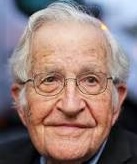
Noam Chomsky (born on December 7, 1928, in Philadelphia, Pennsylvania) is an American linguist, philosopher, cognitive scientist, historical essayist, social critic, and political activist. Sometimes called "the father of modern linguistics", Chomsky is also a major figure in analytic philosophy and one of the founders of the field of cognitive science. He is a Laureate Professor of Linguistics at the University of Arizona and an Institute Professor Emeritus at the Massachusetts Institute of Technology (MIT), and is the author of more than 150 books. He has written and lectured widely on linguistics, philosophy, intellectual history, contemporary issues, and particularly international affairs and U.S. foreign policy. Chomsky has been a writer for Z projects since their earliest inception, and is a tireless supporter of our operations.
ZNetwork is funded solely through the generosity of its readers.
Donate




