


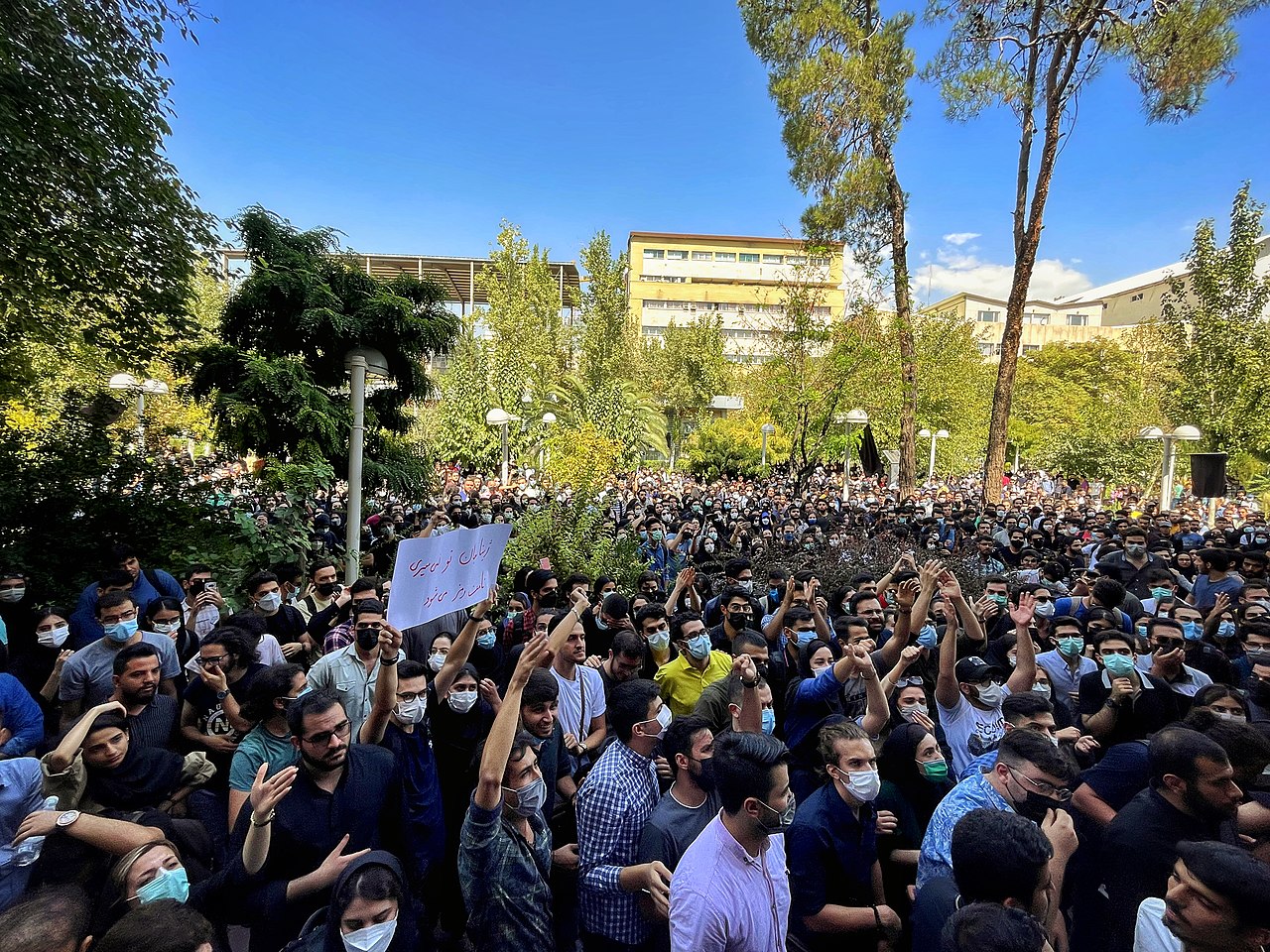
The uprising sweeping Iran in response to the murder of 22-year-old Kurdish-Iranian woman Mahsa (Jîna) Amini by the country’s morality police for “improper dress” is one of the truly monumental political events of our time. The upsurge began as an outraged response by women across Iran, who share the practically universal experience of harassment — and worse — by that police force. But it has quickly developed into something greater and deeper, with men taking up the cause of women’s rights, the whole protest wave taking up the slogan of the Kurdish freedom movement — “Women, Life, Freedom” — and huge crowds in the streets raising longstanding grievances with the Iranian government’s restrictions, repression and its presiding over a disastrous economy.
Despite severe repression — with the state killing more than 200 people and hurting countless people with unbridled brutality and especially targeting Kurdish and Baloch areas — the uprisings are persisting and animating more sectors of Iranian society. Students and faculty at Tehran’s Sharif University faced the police in a defiant occupation and battle. Oil workers have gone on strike. And Iran’s adolescent girls have unleashed a new wave of revolt, chasing away administrators, taking over their schools, and — as with women of all ages — choosing to defy mandatory head covering.
As this revolt shakes Iran to its core, however, it has barely registered in the mainstream U.S. public. After initial quiet, Biden and other U.S. officials are making a calculated move to voice rhetorical support for the protests. This may undermine them, however, by giving the Iranian state an alibi to paint the revolts as machinations of Washington. The Biden administration did do something useful by finally heeding the years-long call to lift a sanction on telecommunications. On balance, however, Washington is discussing the escalation of its extensive, devastating sanctions regime — the very one responsible for Iran’s economic catastrophe. Indeed, think tanks in Washington that have long cultivated militarism against Iran are holding events to assess and take advantage of the new situation.
Ironically, while the U.S. government and right-wing organizations are stirred to action, and we are seeing more coverage in the mainstream media, it is the U.S. left — beyond Iranian and Iranian American folks — that appears quiet in comparison. There is little conversation, and with some exceptions, little is being published in left and progressive media.
A number of things explain the muted response. The U.S. progressive community struggles in general when it comes to relating to international politics. Moreover, we have been consistently divided and often uncertain about our role when the U.S. is not the primary antagonist driving a violent injustice — something which also helps explain the division and confusion in the progressive community here when Russia invaded Ukraine. This challenge is especially complicated when the force that is committing the injustice is a state — however repressive, corrupt or reactionary — that is considered to be an enemy of the U.S. In the case of Iran, for example, some on the left wrongly consider Tehran to be playing a progressive, anti-imperialist role by countering U.S. power.
The current revolt in Iran not only has profound implications for Iranian society; it also offers those of us here who seek a freer world an opportunity to overcome the historic obstacles to our ability to relate to liberation struggles abroad.
To that end, Truthout spoke with some left-wing Iranians in the large and diverse diaspora to see what they think we in the U.S. progressive community could be doing more of in solidarity with this revolt.
Perhaps the first thing is truly appreciating the significance of the uprising itself — for Iran, and for all of us.
Alex Reza Shams, a graduate student in anthropology at the University of Chicago, asserts that “the revolts in Iran should inspire us all to remember that resistance is possible even in the most oppressive of circumstances.”
“For decades, the Iranian state has crushed independent political organizing — and yet despite that, people have kept hope alive and have continued dreaming of a different future,” he continues. “Hope is something that cannot be killed — and it can inspire us to do great and previously unimaginable things — like rise up against a tyrant even when we don’t think there is much of a chance that we might succeed.”
Second, it’s important to identify and appreciate our relationship to Iranian society as residents of the United States. After all, while the current uprising is first and foremost directed at the brutal Iranian state, the U.S. has played a decisive role in producing untold suffering for generations of Iranians. As Azadeh Shahshahani, a human rights lawyer and the legal and policy adviser at Project South in Atlanta, points out, “U.S. policies have only added to the oppression and suffering of the Iranian people — from the 1953 CIA-backed coup which overthrew Iran’s democratically elected leader to more than 40 years of [devastating] economic sanctions to U.S. support for Saddam Hussein during his invasion of Iran and the ensuing devastating war.”
Not only does the U.S. bear tremendous responsibility for the circumstances that Iranians are revolting against — which are decades in the making — but as people located here, we are in the best position to effect change in Washington.
“Folks on the ground need to recognize where their power is, and who they have power over when leveraged,”
says Hoda Katebi, an Iranian American writer and organizer. “Those of us not in Iran are not in a position to directly exert power on the government in Iran. People in Iran are doing that, and we should follow their lead, understand how we’re implicated in their demands, and act accordingly within the power we have here in the United States. The originally Kurdish slogan of ‘Woman, Life, Freedom’ is about bodily autonomy and mandatory dress codes but it is also about economic justice and liberation. Concretely for us here, that means fighting to lift U.S. economic sanctions that directly impacts protestors and striking workers and ensuring no U.S. intervention in Iranian self-determination.”
Indeed, stepping up the campaign against U.S. sanctions is a straightforward way to offer solidarity that everyone interviewed pointed to. These sanctions are intimately linked with both Iranian suffering and with Tehran’s behavior.
“U.S. sanctions on Iran have impoverished ordinary people and strengthened the most repressive aspects of the regime,” notes Shams. “And the regime has responded to the economic pressure by implementing neoliberal reforms that further impoverish the people — and responding with bullets when they protest. As a result, the situation has become more militarized in Iran than ever before — and the constant U.S. threat of war provides the regime with a rationale to keep it that way.”
Shahshahani also calls attention to the political impact of U.S. sanctions for Iranian society. “Sanctions have negatively impacted civil society and women,” she says. “Iranian women leaders have come out strongly against the current ‘maximum pressure’ sanctions as they isolate civil society groups from international funding, impact socioeconomically vulnerable populations, and limit their political space for participation.”
Clearly, Iranian women, Kurds, workers and students are claiming that space, leaving the Iranian state scrambling as its brute repression fails to extinguish the revolt. But we can imagine how much more spacious social and political life in Iran could be without the suffocating economic sanctions that make it untenable to make ends meet, especially for the most vulnerable.
The people of Iran are the protagonists in this story, defying their government — and American, Islamophobic notions that they are helpless people suffering at the hands of a tyrannical state. But it is abundantly evident that the people of Iran do not need the U.S. to rescue them. They do, however, deserve our solidarity. As people who live in the U.S., we have a role to play in stopping the harm caused by Washington — and helping the people of Iran breathe freer.


Khury Petersen-Smith is the Michael Ratner Middle East Fellow and the Co-Director of the New Internationalism Project at IPS. He researches U.S. empire, borders, and migration and strategizes with activists to work against the violence that the U.S. carries out and supports around the world. Khury focuses especially on U.S. militarism in the Middle East and in the Pacific, and movements that resist it.
ZNetwork is funded solely through the generosity of its readers.
Donate




