

Mexico now faces what Max Weber called “the problem of succession,” which emerges when a country has a charismatic leader. Andrés Manuel López Obrador (AMLO) is Mexico’s most consequential political leader in nearly a century—to find a president of comparable impact, one must go as far back as President Lázaro Cárdenas. AMLO, a textbook case of a charismatic leader, could have been the model for Weber’s reflections on the topic.
In Economy and Society, a book as thick as a block of adobe, the German sociologist dedicated key passages to the question: What happens when a charismatic leader leaves office?
Weber believed that either one of two things occur: authority “is either traditionalized or rationalized,” he said. That is, either a new charismatic leader is produced or charisma’s power is transferred to an institution. The first has yielded the Kim dynasty in North Korea, for example, whereas the latter can be seen in the Institutional Revolutionary Party’s reign in twentieth century Mexico.
In Mexico, the main obstacle to the transition from one charismatic leader to another is the prohibition against presidential re-election, which is a legacy of the Mexican Revolution (1910–1920). The prohibition has held firm even in the face of a leader like AMLO. His charismatic leadership can last through a six-year presidential term but not a day longer.
Claudia Sheinbaum, the ruling party’s 2024 presidential candidate, does not have AMLO’s power and is unlikely to enjoy his level of support among legislators. If she is elected, which is likely, charisma will be transferred from a person, AMLO, to an institution; or rather, back to an institution: to the presidency. This is what Weber called “the charisma of the office.” The presidency will resume its function above whoever occupies it, not below or equal with the person in office, as occurred from 2018 to 2024.
AMLO may try to continue to influence public affairs after he leaves office and he will certainly have the capacity to do so. He could try to be the power behind the throne, much like what took place during the period known as “el Maximato” of Plutarco Elías Calles (1928–1934).
The Maximato ended when Cárdenas, one charismatic leader, displaced the previous charismatic leader, Calles. To do this, Cárdenas made important concessions to the working class and thus reduced the “Maximum Leader of the Revolution” to nothing.
Sheinbaum’s constraints
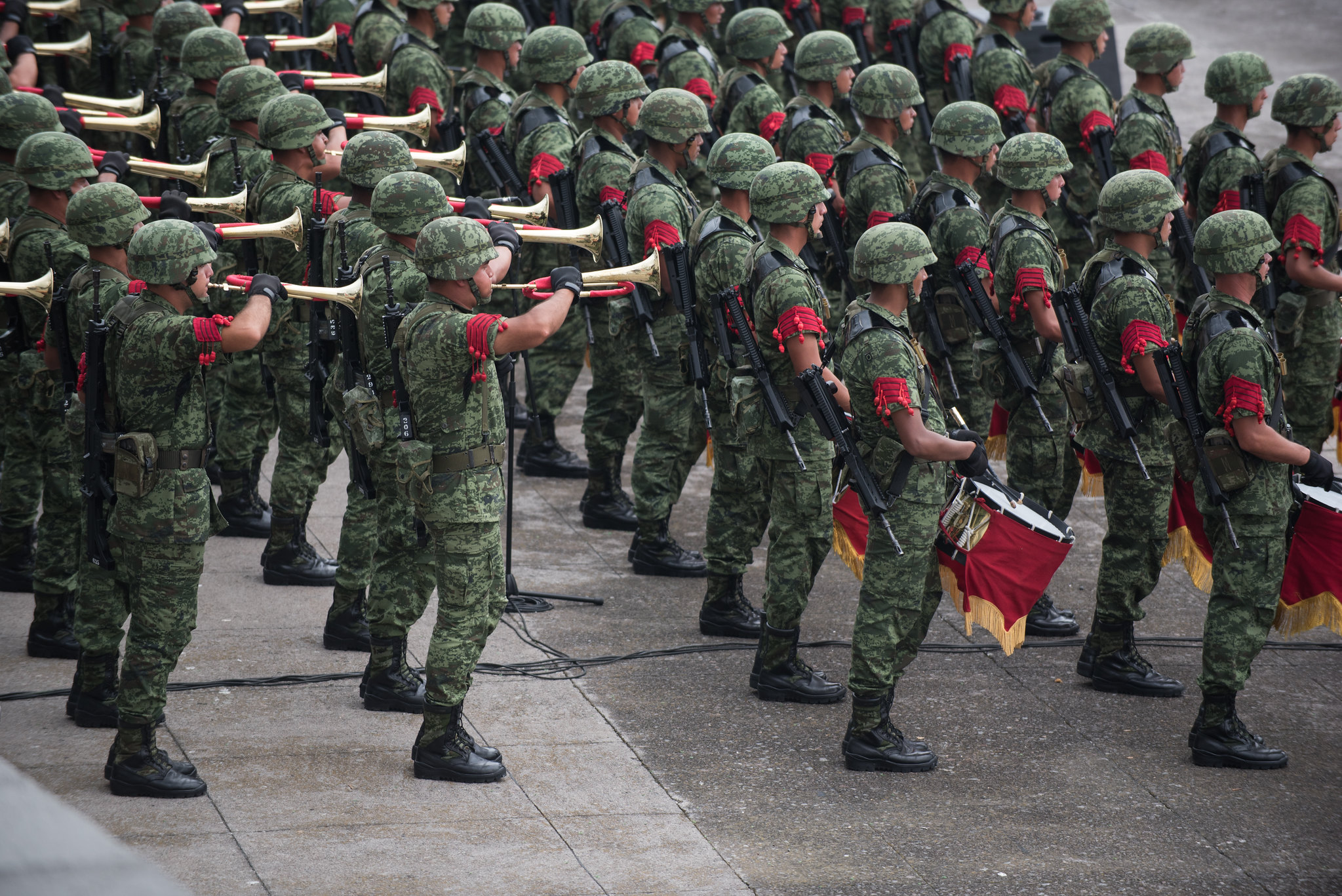
Sheinbaum has a limit that Cárdenas did not: she is not an army general. Neither is AMLO. Charisma comes to an end. The Presidency returns to normality. But something new is happening: the armed forces are circling, rubbing their hands together.
Mexico’s admirals and generals won big during AMLO’s presidency. They now control ports and customs, own airports, run luxury hotels and train lines and sell construction services for public works, among other things. All of this is new.
Public security is the icing on the cake. The army first began to control public security in 1994 and has consistently expanded its powers since 2006, but this has always been understood as something that occurred as an exception to the letter of the law. Now the army controls public security via the National Guard, with the trappings of constitutionality. All of this is courtesy of AMLO, who saw the armed forces as his best bet for leaving his mark on History (with a capital H) during his term.
Even so, under AMLO, the armed forces, even with its increased powers, were subordinated to the presidency. But now, without a charismatic leader, what influence will the Army have? Will it rise above the presidency? Or be on par with it? Or just a little below?
Whatever transpires, the armed forces will have more power in Mexico’s political system since the country had a military president in 1946.
If the military continues to expand the scope of its powers, it will only be a matter of time before Mexico sees something similar to Pervez Musharraf’s ascendency in Pakistan. There, an electoral democracy initially coexisted with the Army, which produced its own politicians. One of them, General Musharraf, became president.
Worse still would be the Egyptian example. There the military openly dismantled the country’s short-lived electoral democracy and seized power. Without any populist pretenses, it imposed former military officer Abdelfatah El-Sisi as president.
Army, party, homeland
Sheinbaum will govern under a militarization that she inherited and with which she appears to have made peace.
On February 19, the Day of the Mexican Army, a previously obscure holiday, Sheinbaum voiced her “recognition of our armed forces” and “gratitude for the aid work that they perform during disasters, their contributions to social development and their help in the construction of infrastructure.”
Sheinbaum has proposed strengthening the National Guard and sending the Army back to the barracks. But she has kept silent regarding what even the Senate knows: almost all of the members of the National Guard are soldiers. And on Ayotzinapa? More silence.
Even if Sheinbaum loses and the opposition, headed by Xóchitl Gálvez, wins, what can be expected from the right? It was the rightwing that spearheaded militarization in 2006.
Before AMLO, Mexico had a civilian government. It appears that we’ll have a civilian-military coalition after he leaves office.
ZNetwork is funded solely through the generosity of its readers.
Donate




