


Is the purpose of zoning to ensure that towns and cities develop according to a rational plan? Does zoning protect the natural environment? Does zoning help promote affordable housing? Does zoning protect residents from the air pollution, noise pollution and dangers from industrial complexes or busy highways?
To begin to answer these questions, consider this example from M. Nolan Gray’s new book Arbitrary Lines:
“It remains zoning ‘best practice’ that single-family residential districts should be ‘buffered’ from bothersome industrial and commercial districts by multifamily residential districts. This reflects zoning’s modus operandi of protecting single-family houses at all costs, but it makes no sense from a land-use compatibility perspective. While a handful of generally more affluent homeowners may be better off, it comes at the cost of many hundreds more less affluent residents suffering a lower quality of life.” (M. Nolan Gray, page 138)

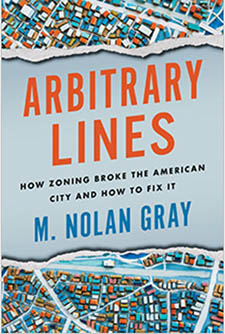
Arbitrary Lines by M. Nolan Gray is published by Island Press, June 2022.
The intensification of inequality, Gray argues, is not an inadvertent side-effect of zoning, but its central purpose.
If you are interested in affordable housing, housing equity, environmental justice, reduction of carbon emissions, adequate public transit, or streets that are safe for walking and cycling, Arbitrary Lines is an excellent resource in understanding how American cities got the way they are and how they might be changed for the better. (The book doesn’t discuss Canada, but much of Gray’s argument seems readily applicable to Canadian cities and suburbs.)
In part one and part two of this series, we looked at the complex matrix of causes that explain why “accidents”, far from being randomly distributed, happen disproportionately to disadvantaged people. In There Are No Accidents Jessie Singer writes, “Accidents are the predictable result of unequal power in every form – physical and systemic. Across the United States, all the places where a person is most likely to die by accident are poor. America’s safest corners are all wealthy.” (Singer, page 13)
Gray does not deal directly with traffic accidents, or mortality due in whole or part to contaminants from pollution sources close to poor neighbourhoods. His lucid explanation of zoning, however, helps us understand one key mechanism by which disadvantaged people are confined to unhealthy, dangerous, unpleasant places to live.
‘Technocratic apartheid’
Zoning codes in the US today make no mention of race, but Gray traces the history of zoning back to explicitly racist goals. In the early 20th century, he says, zoning laws were adopted most commonly in southern cities for the express purposes of enforcing racial segregation. As courts became less tolerant of open racism, they nonetheless put a stamp of approval on economic segregation. Given the skewed distribution of wealth, economic segregation usually resulted in or preserved de facto racial segregation as well.
The central feature and overriding purpose of zoning was to restrict the best housing districts to affluent people. Zoning accomplishes this in two ways. First, in large areas of cities and especially of suburbs the only housing allowed is single-family housing, one house per lot. Second, minimum lot sizes and minimum floor space sizes ensure that homes are larger and more expensive than they would be if left to the “free market”.
The result, across vast swaths of urban America, is that low-density residential areas have been mandated to remain low-density. People who can’t afford to buy a house, but have the means to rent an apartment, are unsubtly told to look in other parts of town.
Gray terms this segregation “a kind of technocratic apartheid,” and notes that “Combined with other planning initiatives, zoning largely succeeded in preserving segregation where it existed and instituting segregation where it didn’t.” (Gray, page 81) He cites one study that found “over 80 percent of all large metropolitan areas in the US were more racially segregated in 2019 than they were in 1990. Today, racial segregation is most acute not in the South but in the Midwest and mid-Atlantic regions.” (Gray, page 169)
Public transit? The numbers don’t add up.
From an environmental and transportation equity point of view, a major effect of zoning is that it makes good public transit unfeasible in most urban areas. Gray explains:
“There is a reasonable consensus among transportation planners that a city needs densities of at least seven dwelling units per acre to support the absolute baseline of transit: a bus that stops every thirty minutes. To get more reliable service, like bus rapid transit or light-rail service, a city needs … approximately fifteen units per acre. The standard detached single-family residential district—which forms the basis of zoning and remains mapped in the vast majority of most cities—supports a maximum density of approximately five dwelling units per acre. That is to say, zoning makes efficient transit effectively illegal in large swaths of our cities, to say nothing of our suburbs.” (Gray, page 101)
Coupled with the nearly ubiquitous adoption of rules mandating more parking space than would otherwise be built, the single-family housing and minimum lot size provisions of zoning are a disaster both for affordable housing and for environmentally-friendly housing. Typical American zoning, Gray says, “assumes universal car ownership and prohibits efficient apartment living. But it also just plain wastes space: if you didn’t know any better, you might be forgiven for thinking that your local zoning ordinance was carefully calibrated to use up as much land as possible.” (Gray, page 96)
Zoning regimes came into wide use in the mid-twentieth century and became notably stricter in the 1970s. In Gray’s view the current housing affordability crisis is the result of cities spending “the past fifty years using zoning to prevent new housing supply from meeting demand.” This succeeded in boosting values of properties owned by the already affluent, but eventually housing affordability became a problem not only for those at the bottom of the housing market but for most Americans. That is one impetus, Gray explains, for a recent movement to curb the worst features of zoning. While this movement is a welcome development, Gray argues zoning should be abolished, not merely reformed. Near the end of Arbitrary Lines, he explains many other planning and regulatory frameworks that can do much more good and much less harm than zoning.
There is one part of his argument that I found shaky. He believes that the abolition of zoning will restore economic growth by promoting movement to the “most productive” cities, and that “there is no reason to believe that there is an upper bound to the potential innovation that could come from growing cities.” (Gray, page 72) At root the argument is based on his acceptance that income is “a useful proxy for productivity” – a dubious proposition in my view. That issue aside, Arbitrary Lines is well researched, well illustrated, well reasoned and well written.
The book is detailed and wide-ranging, but unlike a typical big-city zoning document it is never boring or obscure. For environmentalists and urban justice activists Arbitrary Lines is highly recommended.
ZNetwork is funded solely through the generosity of its readers.
Donate




