

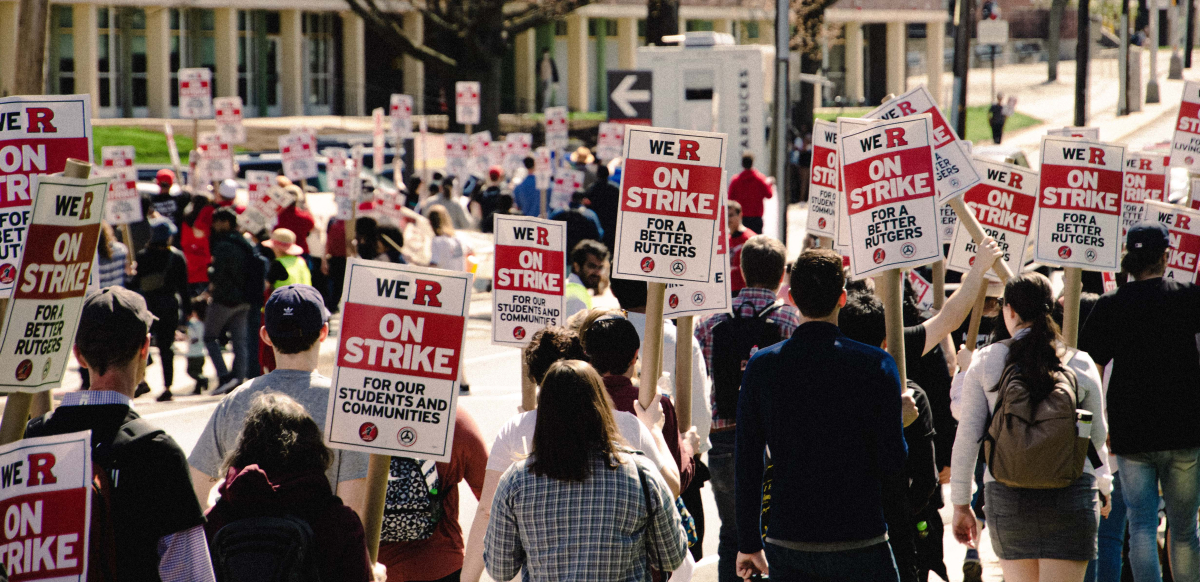
After a five-day strike in April, members of the Rutgers faculty, graduate student, librarian, and clinician unions voted 93 percent to accept a new contract which included dramatic gains.
The strike was the first in Rutgers’ 253-year history, and remarkable in that all instructional workers walked out, including full-time faculty, grad workers, and adjuncts. Rutgers is the oldest large public university in New Jersey with 67,000 students.
The agreement includes big salary gains: 30 percent for the lowest-paid adjuncts in the first year, and 43 percent across the life of the contract, plus 33 percent raises for graduate teaching and research assistants. For adjuncts, it also includes multi-semester and multi-year appointments—a first—as well as professional development funding, binding arbitration for grievances, quicker and new paths to advancement, and a new title (we’re no longer “part-time” lecturers, but simply “Lecturers”).
The seeds of the decision to withhold our labor were sown several years ago. The executive board of the adjunct union was united in the belief that transformative contracts are only won through a massive organizing effort that credibly threatens a strike.
‘NO’ CAMPAIGN A LAUNCHING POINT
The current president and vice president of the union found our way to union office through a 2019 “vote no” campaign we helped to organize. That contract left the vast majority of low-paid adjuncts with no job security raises that barely kept up with inflation. We joined with existing board members to create a more democratic union hellbent on organizing adjuncts into a force.
We reprioritized our union’s budget, devoting a greater share of resources to member outreach. This was not only about the money, but also about creating a true organizing culture in the union, and an organizing committee with executive board and rank-and-file members. Two years prior to the start of our contract campaign, we worked with our parent union, the American Federation of Teachers, to add a full-time staff organizer and then a student outreach coordinator and a media specialist.
Our first major organizing effort began in spring 2022, when we partnered with the union of full-time faculty and grad workers on a campaign to merge our separate bargaining units. The leadership of the full-time faculty union (AAUP-AFT) supported the effort and provided material and financial resources. In fact, it was the shared vision of being recognized as “#OneFaculty” that placed our organizing on new ground. We could truthfully tell reluctant adjuncts that the goal of merging units was now shared by our full-time faculty colleagues. We were stronger together.
The merger campaign drew in dozens of new, volunteer rank-and-file organizers and additional part-time staff organizers to visit or call every member of our union. The result was an unprecedented mobilization. Almost 1,200 adjunct faculty—a majority of the adjuncts teaching at Rutgers—signed merger cards. Some who signed were not union members, and while signing a merger card did not necessarily result in them joining the union, it still built support for the union and our campaign.
BARGAINING: OPEN AND UNITED
While the university refused to recognize the merger (as we expected), the critical principle had been established: we saw ourselves as One Faculty, and demanded in the forthcoming contract campaign that management engage us that way.
That’s precisely what happened. We fought for open bargaining principles to shape negotiations, with considerable (if not complete) success. For example, management tried to limit our numbers at bargaining sessions. On one occasion, as our strike loomed, they refused to enter the room with 50 members observing our negotiations. We held firm, voted, and insisted that we’d only meet with our co-workers present. Ten minutes later, management entered the room to bargain with us.
We also negotiated across all job categories as if we were one bargaining unit: postdocs, grad workers, counselors, adjuncts, non-tenure track, and tenure track faculty. While management initially resisted this, eventually they acceded. Throughout the bargaining process, they seemed thrown off guard by our unity.
Another key element of maintaining unity was that the three faculty unions took our strike authorization votes at the same time. The energy for the strike was unprecedented: 80 percent participation among those eligible to vote, and 95 percent in favor. The effort to organize ourselves into a strike-ready workforce not only set the conditions for the gains we would make, but transformed our unions in the process.
Once the strike began, member participation on the picket lines and creative protests demonstrated our strength, and generated media attention and political pressure on the university. Student supporters of the union rewrote the 1961 Bruce Channel song “Hey Baby” to pressure university president Jonathan Holloway, singing, “Hey Holloway, I want to know, will you raise my wage?” It was very catchy, and went viral on social media. Our singing and dancing and vibrant picket lines garnered student and community support.
DEBATING THE END
The day before the strike was called, New Jersey Governor Phil Murphy offered to host negotiations if we postponed the strike for 48 hours. We welcomed the support from the governor, but we refused postponement. The strike was where our power lived, and we could not halt it on promises of a better deal.
Once negotiations shifted to Trenton, engagement with the governor’s office was tricky. While the state came up with additional funds to support our demands, the governor also wanted us to end the strike to approve a “framework” for the contract. The framework was reached after grueling, week-long negotiating sessions designed to pressure both sides to move toward an agreement.
The unions’ leadership bodies ultimately called for a suspension of the strike, while the bargaining teams continued to negotiate the remainder of the contract. At the same time, we made clear that we would be willing to return to the picket lines if necessary—the strike was “suspended, not ended.”
This was a controversial decision, and it merits a debate. A sizable minority within the union’s governing bodies believed the strike was suspended at a time when the unions retained power to press for greater gains. They called for a delay in signing the framework to further discuss the matter over the weekend. But the governor was threatening to remove tens of millions of dollars he had previously committed if the framework was not agreed to that evening and the strike suspended.
Though it was never overtly stated, it was also suggested that were the framework not accepted that night, Rutgers would seek (and likely receive) an injunction declaring the strike unlawful, something it had not done to that point due to the governor’s request. Under this scenario, if the strike continued, adjunct faculty and perhaps other striking workers could have faced firings.
Whether the unions made the right choice in a highly fraught moment should certainly be debated. What is clear, however, is that without the decision to withhold our labor, few of the enormous gains we made would have been realized. In short, we learned that if you are not preparing to strike, you are not preparing to win.
More remains to be won, but for now, we celebrate our gains, and our historic strike that made them possible.
ZNetwork is funded solely through the generosity of its readers.
Donate




