


On Mother’s Day, May 12, The Boston Globe featured a photo of a young woman with her toddler son sleeping in her arms.
The woman, of Mayan Indian heritage, had crossed the U.S. border seven times while pregnant, only to be caught and shipped back across the border on six of those attempts. She braved many miles, enduring blisteringly hot days and freezing nights, with no water or shelter, amid roaming gunmen. The last time she crossed, seven months pregnant, she was rescued by immigration solidarity activists who helped her to find her way to Boston.
Most of the border crossers are from Central America. Many say they would rather be home, if the possibility of decent survival hadn’t been destroyed. Mayans such as this young mother are still fleeing from the wreckage of the genocidal assault on the indigenous population of the Guatemalan highlands 30 years ago.
The main perpetrator, Gen. Efrain Rios Montt, the former dictator who ruled Guatemala during two of the bloodiest years of the country’s decades-long civil war, was convicted in a Guatemalan court of genocide and crimes against humanity, on May 10.
Then, 10 days later, the case was overturned under suspicious circumstances. It is unclear whether the trial will continue.
Rios Montt’s forces killed tens of thousands of Guatemalans, mostly Mayans, in the year 1982 alone.
As that bloody year ended, President Reagan assured the nation that the killer was “a man of great personal integrity and commitment,” who was getting a “bum rap” from human-rights organizations and who “wants to improve the quality of life for all Guatemalans and to promote social justice.” Therefore, the president continued, “My administration will do all it can to support his progressive efforts.”
Ample evidence of Rios Montt’s “progressive efforts” was available to Washington, not only from rights organizations, but also from U.S. intelligence.
But truth was unwelcome. It interfered with the objectives set by Reagan’s national security team in 1981. As reported by the journalist Robert Parry, working from a document he discovered in the Reagan Library, the team’s goal was to supply military aid to the right-wing regime in Guatemala in order to exterminate not only “Marxist guerrillas” but also their “civilian support mechanisms” – which means, effectively, genocide.
The task was carried out with dedication. Reagan sent “nonlethal” equipment to the killers, including Bell helicopters that were immediately armed and sent on their missions of death and destruction.
But the most effective method was to enlist a network of client states to take over the task, including Taiwan and South Korea, still under U.S.-backed dictatorships, as well as apartheid South Africa and the Argentine and Chilean dictatorships.
At the forefront was Israel, which became the major arms supplier to Guatemala. It provided instructors for the killers and participated in counterinsurgency operations.
The background bears restating. In 1954, a CIA-run military coup ended a 10-year democratic interlude in Guatemala – “the years of spring,” as they are known there – and restored a savage elite to power.
In the 1990s, international organizations conducting inquiries into the fighting reported that since 1954 some 200,000 people had been killed in Guatemala, 80 percent of whom were indigenous. The killers were mostly from the Guatemalan security forces and closely linked paramilitaries.
The atrocities were carried out with vigorous U.S. support and participation. Among the standard Cold War pretexts was that Guatemala was a Russian “beachhead” in Latin America.
The real reasons, amply documented, were also standard: concern for the interests of U.S. investors and fear that a democratic experiment empowering the harshly repressed peasant majority “might be a virus” that would “spread contagion,” in Henry Kissinger’s thoughtful phrase, referring to Salvador Allende’s democratic socialist Chile.
Reagan’s murderous assault on Central America was not limited to Guatemala, of course. In most of the region the agencies of terror were government security forces that had been armed and trained by Washington.
One country was different: Nicaragua. It had an army to defend its population. Reagan therefore had to organize right-wing guerilla forces to wage the fight.
In 1986, the World Court, in Nicaragua v. United States, condemned the U.S. for “unlawful use of force” in Nicaragua and ordered the payment of reparations. The United States’ response to the court’s decree was to escalate the proxy war.
The U.S. Southern Command ordered the guerillas to attack virtually defenseless civilian targets, not to “duke it out” with the Nicaraguan army, according to Southcom’s Gen. John Gavin testimony to Congress in 1987.
Rights organizations (the same ones that were giving a bad rap to genocidaire Rios Montt) had condemned the war in Nicaragua all along but vehemently protested Southcom’s “soft-target” tactics.
The American commentator Michael Kinsley reprimanded the rights organizations for departing from good form. He explained that a “sensible policy” must “meet the test of cost-benefit analysis,” evaluating “the amount of blood and misery that will be poured in, and the likelihood that democracy will emerge at the other end.”
Naturally, we Americans have the right to conduct the analysis – thanks, presumably, to our inherent nobility and stellar record ever since the days when the continent was cleared of the native scourge.
The nature of the “democracy that will emerge” was hardly obscure. It is accurately described by the leading scholar of “democracy promotion,” Thomas Carothers, who worked on such projects in the Reagan State Department.
Carothers concludes, regretfully, that U.S. influence was inversely proportional to democratic progress in Latin America, because Washington would only tolerate “limited, top-down forms of democratic change that did not risk upsetting the traditional structures of power with which the United States has long been allied (in) quite undemocratic societies.”
There has been no change since.
In 1999, President Clinton apologized for American crimes in Guatemala but no action was taken.
There are countries that rise to a higher level than idle apology without action. Guatemala, despite its continuing travails, has carried out the unprecedented act of bringing a former head of state to trial for his crimes, something we might remember on the 10th anniversary of the U.S. invasion of Iraq.
Also perhaps unprecedented is an article in The New York Times by Elisabeth Malkin, headlined “Trial on Guatemalan Civil War Carnage Leaves Out U.S. Role.” Even acknowledgment of one’s own crimes is very rare.
Rare to nonexistent are actions that could alleviate some of the crimes’ horrendous consequences – for example, for the United States to pay the reparations to Nicaragua ordered by the World Court. The absence of such actions provides one measure of the chasm that separates us from where a civilized society ought to be.
Noam Chomsky's most recent book is Power Systems: Conversations on Global Democratic Uprisings and the New Challenges to U.S. Empire. Conversations with David Barsamian. Chomsky is emeritus professor of linguistics and philosophy at the Massachusetts Institute of Technology in Cambridge, Mass.

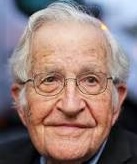
Noam Chomsky (born on December 7, 1928, in Philadelphia, Pennsylvania) is an American linguist, philosopher, cognitive scientist, historical essayist, social critic, and political activist. Sometimes called "the father of modern linguistics", Chomsky is also a major figure in analytic philosophy and one of the founders of the field of cognitive science. He is a Laureate Professor of Linguistics at the University of Arizona and an Institute Professor Emeritus at the Massachusetts Institute of Technology (MIT), and is the author of more than 150 books. He has written and lectured widely on linguistics, philosophy, intellectual history, contemporary issues, and particularly international affairs and U.S. foreign policy. Chomsky has been a writer for Z projects since their earliest inception, and is a tireless supporter of our operations.
ZNetwork is funded solely through the generosity of its readers.
Donate




