

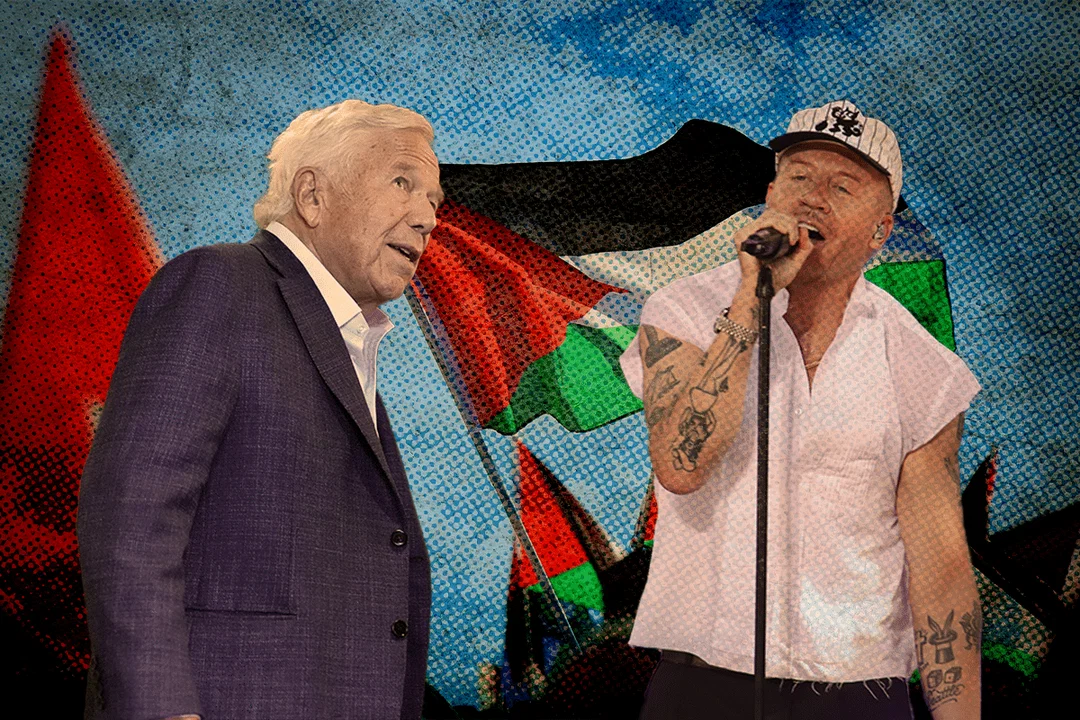
As a kid, I knew three things about the guy who owned my favorite NFL team. He was short, from Ohio, and he was a good owner because he spent money. After 40 years of further review, that stands as the ideal total knowledge about a sports owner. And while the sprint toward the opposite informational state belongs to our entire age, New England Patriots owner Robert Kraft stands out for his dedication to revealing how the sausage gets made.
A few years ago, 90% of Kraft’s obituary would have been about owning the NFL’s greatest dynasty. By now, artfully gritted-teeth quotes from players traded too early have been cut to make room for the Florida hand job excursion, the Epstein lawyer who made it go away and his extortion of an Ivy League university to do public relations for a genocide. But for a handy guide to how the consent gets manufactured, how the actors take cover and why you leave it to the pros, you couldn’t do better than Robert Kraft.
It all starts at Macklemore.
The name might as well be “Fleek Cronut brought to you by Dat Boi” for most people these days, but it wouldn’t be a surprise if Robert Kraft made a note of the rapper’s May 2024 release, “Hinds Hall,” which addressed both the takeover of Columbia University’s Hamilton Hall by student protestors of the Gaza genocide and the Israel Defense Force’s killing of a 5-year-old girl. Kraft most definitely noticed when Macklemore took to a stage at MetLife Stadium, at a stop on a tour making its way to Kraft’s own Gillette Stadium, to let “the people all the way in Gaza to the occupied West Bank know that we have not forgotten about them. I say, ‘Free Palestine.’ I say ‘Free Lebanon.’”
Principals’ accounts differ as to what came next, but allegedly, Kraft leaned on Ed Sheeran — alleged pal to Macklemore and tour headliner — letting him know that he was banning him from performing at Gillette, and threatening that other NFL owners would follow, unless Sheeran turfed him from the tour.
Sheeran, who appears to both physically and morally consist of mashed potatoes, complied and booted Macklemore off to Mackle less again. Unfortunately, a paste bag from Suffolk appearing to decide who gets to say what and where about national autonomy didn’t sit especially well with Sheeran’s Irish support acts, who promptly quit the tour in solidarity. Instead, Sheeran chose to try to post through it and deflect blame by disclaiming political messaging and pleading impotence in the face of tour promoters’ interests. Both were lies.
For one, Sheeran does not mind taking political stances when they result in praise. For another, he has sold 200 million records in 15 years. In adjusted dollars, two of his previous three tours rank in the top 10 highest grossing of all time. He is an industry unto himself and — this is critical — the reason the tour exists. When discussing an artist tour of this stature, the politics permitted are typically the way they are for the same reason the merchandise is typically in triple digits, the ticket prices are in four, and 2,000 seats disappeared onto the secondary market before even going on sale: Because the artist is fine with it that way — and, probably for no greater reasons than avarice, accounting or basic convenience, likes making this amount of money this way.
Kraft, meanwhile, provided the funniest of explanations, claiming,
“This decision is not about diminishing the suffering of innocent Palestinians or denying anyone the right to advocate on their behalf. But that advocacy should not come at the expense of the Jewish community or obscure the responsibility of Hamas … whose horrific actions have caused immeasurable suffering for Palestinians and Israelis alike.”
Like all its other uses in the discourse, Kraft’s framing about mandating both perspectives is just the exit to bigotry it always has been, a baked-in permission to continue in your conduct without criticism. Since hearing from all perspectives and all wounded parties will be untenable in a concert milieu, there’s no choice but to jettison the Palestine guy, which is already the desired outcome. We certainly know Kraft’s commitment to viewpoint diversity doesn’t extend to offsetting moments of American triumphalism with recognition of its victims, because, positive and meaningless murmurings about opportunities aside, he had nothing to say about obvious league collusion not to sign free-agent quarterback Colin Kaepernick in 2017.
Sportswriters knew at the time that Kaepernick’s unemployment amounted to privileged vengeance for kneeling during the national anthem to protest unpunished police killings of Black people. He went visibly off brand in a way that offended the bottom line and the racist sensibilities of an ownership class at perpetual war with its significantly Black labor pool and terrified of labor solidarity of any kind. Kaepernick himself seems to have zero doubt that the same aristocratic privilege to define the permissible is at work again. Fans should have had all removed forever by the end of 2017, after NFL ownership preferred instead to start CJ Beathard, Tyrod Taylor, Nathan Peterman, Trevor Siemian, Brock Osweiler, Paxton Lynch, DeShone Kizer, Brett Hundley, Mike Glennon, Mitch Trubisky and Josh McCown. If you do not follow the NFL, simply think of a sport, craft or skill you’re passionate about, and picture 11 people terrible at it.
Kraft’s explanation for his treatment of Macklemore is also significantly undercut by his other prior political commitments. In addition to effusive praise from Benjamin Netanyahu, Kraft’s relationship with Israel included taking Patriots players on the oorah version of the Birthright tour. He is years into withholding his annual donations to Columbia University in an attempt to extort more punitive treatment of pro-Palestinian voices and activism on campus. He also maintains a massive antisemitism “command center” inside his football stadium.
No, really, for years, Robert Kraft has been regularly bombarding his mind via a private FBI situation room-sized Ludovico Technique of constantly updating antisemitic tweets. Not only is Twitter (now X) a cesspit, and not only does sustained exposure to it push people rightward, but he is deliberately exposing himself to a curated stream of its worst cultivated parts. If being a billionaire is already fundamentally deranging, Robert Kraft is on the same level of the Sanity Index as making foul-mouthed female promiscuity your existential dread, bolting a set of Meta glasses to your face every day and streaming a loop of Pornhub’s Sasha Grey channel, then running home screaming about how now all grass is as flesh.
The lesson, again, is that people over-indexed for good fortune in one respect are not automatically granted proficiency at anything else or immunity from becoming a lunatic about it. The New York Jets are enduring proof to all who watch that money and idiocy can become intergenerational trusts, and just being an NFL owner is proof of someone with an unhealthy relationship to power. (That Kraft could discreetly rent any porn star or escort in the world without noticing the cost but is into cheap hand jobs from people who stand a higher likelihood of not being citizens suggests his is even more abnormally developed.) It’s hard to conclude anything else from trying to blackmail a university over insufficiently repressing people critical of the genocide you can’t support hard enough.
As is the case with all his aristocratic peers, the biggest threat to Robert Kraft’s world view is himself. Doing goodwill outreach for a state conducting a genocide is his choice, as is likening its critics to antisemites, as is being chummy with the biggest fascist in American history. No amount of rapper-shaming or making a video wall out of his permission structure for Islamophobia can paper over those holes in his likability and credibility. The fundamental threat, then, is other people noticing.
The world that artists like Macklemore and activists like him make terrifyingly possible is one in which the victims of Robert Kraft’s preferences are identifiable to everyday people. If not the hope of the better world that exists, they can at least incarnate proof that this one isn’t it. That’s half a step from cries of injustice and just another away from blame. Silencing the first part makes it seem dangerously correct and likelier that the next two steps are set in motion.
If nothing else, this is why you trust the pros. You don’t put billionaires on the ramparts beneath the Overton Window; that’s a gig for people who know when to deploy “both sides” when shutting down one. That same week, ESPN, the network that used to go by the tag line “Embrace Debate,” aired 10 minutes of Ted Cruz on “College Gameday” stumping for a bill that will roll back compensation rights for college athletes that were only recently won after a century of generating billions for what historian Taylor Branch called a plantation system. His arguments ran completely unopposed. Sure, the fans booed the entire time, but here’s the important part Robert Kraft should take to heart: They were just booing Ted Cruz.
ZNetwork is funded solely through the generosity of its readers.
Donate




