

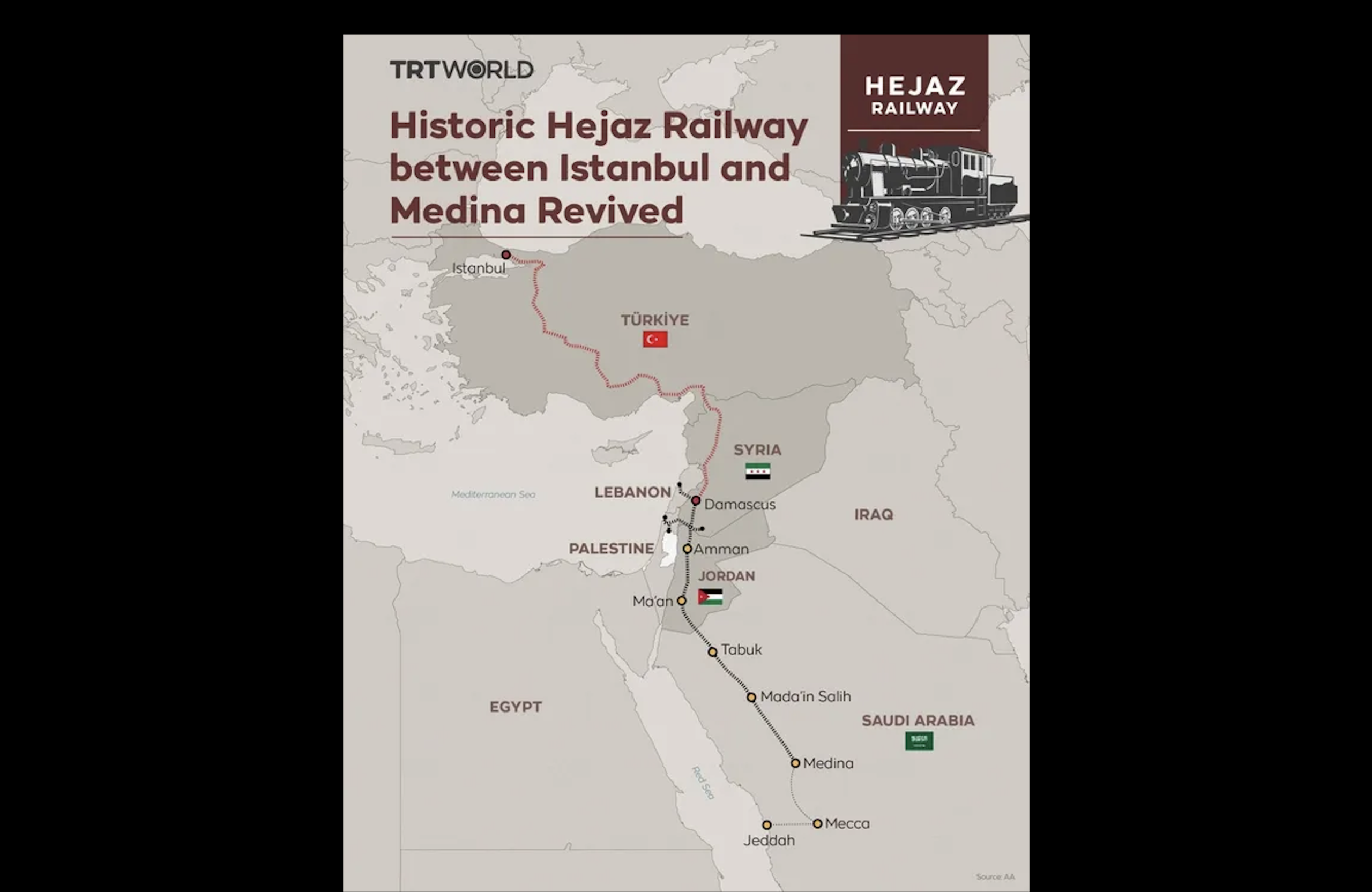
History is not so much past as vigorously present, often a scab to be irritated in fitful anger, or a romantic affectation to be cherished. When it comes to controlling trade and establishing new routes, this is particularly apt. The Hejaz Railway project, seemingly long past, is now being dusted down. In a June 9 memorandum of understanding signed between Türkiye and Saudi Arabia, a railway line is envisaged between the two countries that will traverse Jordan and Syria and create a strategic logistics artery linking the Gulf states to Europe.
According to a media release from the Saudi Press Agency, the agreement will focus “on enhancing cooperation on railway standards, technologies, and related innovations, while facilitating the exchange of expertise and knowledge on best practices in the design, operation and maintenance of railway projects.” There is much in the way of everything railway related – engineering, expertise, maintenance, innovations – but the historical, and strategic potency of the agreement is unmistakable. As former advisor to the Saudi Ministry of Foreign Affairs, Salem Al-Yami, wistfully notes, this new project draws inspiration from the Ottoman-era railway built in 1900, covering 1,300 kilometres from Damascus to Medina.
The MoU between Ankara and Riyadh also came several months after the transport ministries of Türkiye, Syria and Jordan had reached a separate agreement envisaging a technical roadmap lasting five years intended to revivify the transportation infrastructure of the three states.
For Israel, this has more than tickled a nerve. Rather than seeing it as a healthy instance of regional competition on matters relating to transport and trade, a reinvigorated Hejaz railway is seen as threatening to the India-Middle East-Europe Economic Corridor (IMEC). Launched in September 2023, the IMEC, unsurprisingly, positions Israel as the central transit hub linking the Gulf to Europe. But Israeli diplomacy and initiatives have suffered of late, notably after the October 7, 2023 attacks by Hamas which saw a retributive war, not only against the Palestinians in Gaza, but Hezbollah in southern Lebanon and the illegal war launched against Iran in collusion with the United States on February 28.
What is particularly curious in the fearful critiques offered by Israeli figures is the implicit suggestion that Israel’s own economic plans and schemes are somehow free of a political, strategic, even security sting. Underlying this is the implicit suggestion that Israel’s claims to logistical and economic supremacy as a transit hub should be beyond competition from any rivals. Consider, for instance, the views of former Israeli Communications and Media Minister Ayoub Kara, who automatically assumes that the Hejaz Railway project is of a military nature and should be guarded against. “Any cooperation built on security and military ties that is aimed at undermining Israel is a cause for concern,” he told MBN.
Much the same view is held by Mendi Safadi, a member of the ruling Likud Party and head of the Israeli Safadi Center for International Diplomacy, Research, Public Relations and Human Rights. Not missing a trick, Safadi thought it wise to make the railway project something greater than a threat to Israel’s own interests. While there would be “both security and economic risks” to the Jewish state, Europeans also had reason to worry. “Turkey could use this trade corridor as leverage to advance its political objectives.” In an economic world of Trumpian self-interest and exploitation, such a statement comes across as quaint.
Israel’s Transportation Minister, Miri Regev, has led the pack in fussing about the project in the broader context of Israel’s security environment. In a letter to Prime Minister Benjamin Netanyahu, she anxiously claimed that “we are witnessing a rapid transformation of regional partnerships in trade and energy that deliberately bypass Israel and pose a genuine strategic threat to national security.” The Hejaz Railway project, as well as “additional bypass corridors” threatened “to permanently render the Israeli route obsolete.” Were such “bypass scenarios” to be realised, Israel would be left “outside the map of global trade”.
Turkish officials have certainly played up Ankara’s regional ambitions through the vehicle of the Hejaz railway. Last month, just prior to the signing of the memorandum, Türkiye’s Trade Minister Omer Bolat told those attending the AA City Economics Summit in Gaziantep that, “The reduction of Israel’s influence in the region, together with increased political and economic stability among us, will bring economic prosperity, peace and stability to the Middle East, the Gulf and Türkiye’s southern borders.”
Whether this grand scheme materialises beyond the confines of paper and enthusiastic dreams remains a heavily question of significance. Ankara had previously fanned a similar idea in 2009. The current project lacks a clear funding mechanism and sponsor. There will also have to be an understanding on how the route will be governed by all countries concerned. Security promises to be another headache: war-torn Syria, through which much of the railway would pass, remains marred by pockets of instability in the south, with an Israeli presence in the Quneitra Province.
A less pessimistic reading of the project could see Israel benefit in the distant future. “Although at first glance the revival of the railway appears intended to bypass Israeli territory,” writes Gallia Lindenstrauss for Israel Hayom, “an examination of some of the maps published around the time of the signing, including one released by Turkey’s official news agency, shows that the historical connection to Haifa Port appears in them.” Furthermore, given that a lack of suitable railway infrastructure in Jordan remains the great limiting factor of the IMEC vision, Israel might also benefit from an Ankara-Riyadh agreement that engenders construction within Jordan itself. Less a strategic threat to a beleaguered country than a sprig of opportunity that smells of trade rather than war.
Dr. Binoy Kampmark was a Commonwealth Scholar at Selwyn College, Cambridge. He currently lectures at RMIT University. Email: bkampmark@gmail.com
ZNetwork is funded solely through the generosity of its readers.
Donate




