

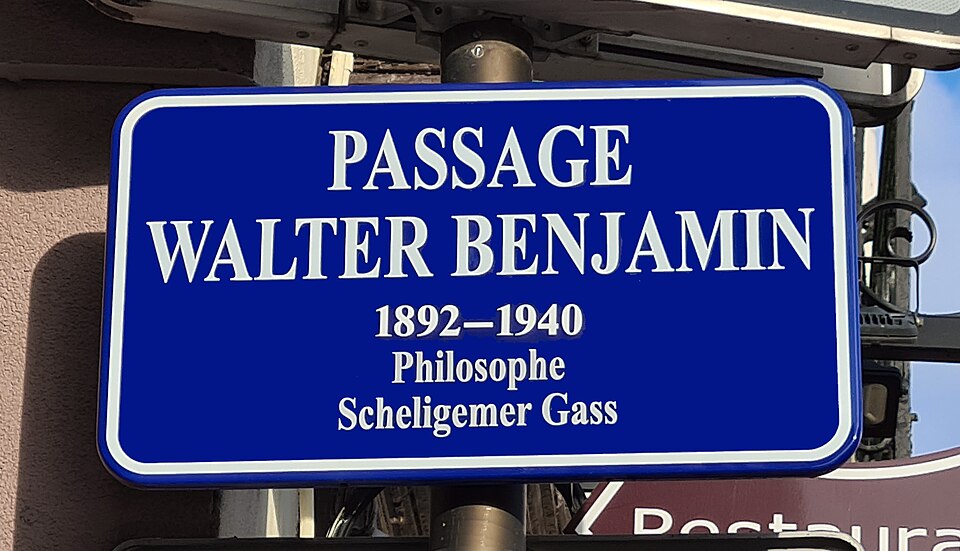
As the Left epitomized by the Democratic Socialists of America resurges and Marxist thought returns to the fore, as a real force, not simply as a bogeyman; as the Midterms loom and, through them, we get our first taste of the 2028 Presidential Election, I revisit Walter Benjamin, specifically his Theses on the Philosophy of History.
I wonder if his Theses are being read not only by candidates and nominees such as DSA-adjacent Abdul El-Sayed, who continues to call himself a capitalist, but also political consultants, pundits such as Hasan Piker, and you, readers and voters on the Left. I wouldn’t blame them or you if they weren’t and aren’t. His Theses are difficult. Frustrating. At the sentence level they often beg for clarity. Prepositions and pronouns are vague. Cryptic prose, poetic flourishes, and obscure references make already difficult and abstract concepts all the more difficult to grasp. Part of the reason why I’m writing this is to force myself to better understand it all. Because his Theses are critical, of this I’m sure, to the Left and this moment.
Say what you mean! I can’t help but beg, as I beg my English Composition students. Of course, this isn’t fair. Benjamin was thinking and writing at a level I certainly can’t. He was also doing so under duress. It was 1940. A German-Jew, he was about to flee Vichy France. He never made it out. Collaborators handed him to the Gestapo. Yet he left this document, a way to guide us through similar times, when the Right with all its Fascist tendencies is tightening its grip over America and elsewhere, and only the Left is fighting back with any real sense of urgency; the Center has failed us. Time and again it has failed us.
Thankfully, “Nothing that has ever happened should be regarded as lost for history,” Benjamin writes (III). His own life and resistance hasn’t been lost, even if the Nazis wished precisely for that, to erase him and everything he represented. He speaks from the grave as he understands the dead always can; he joins, in death, the “retroactive force that will constantly call into question every victory, past and present, of the rulers,” helping us, if we heed his advice, his warnings, “turn toward the sun which is rising in the sky of history” (IV).
Entire careers have been dedicated to Benjamin and his Theses. For the sake of this piece and people like myself, ordinary citizens who understand the stakes and stand up, resisting apathy, I wanted to highlight a handful of his theses I found particularly relevant, that might help all of us on the Left, including our leaders, wrest control back from the Right.
I’ve broken things up thematically, into two parts, allowing me to address our current moment more directly. Roman numerals indicate each individual thesis, of which there are twenty in the original document, allowing you to read on and find within them endless meaning.
Part One: The Spiritual
The Left has had a difficult time convincing people of faith, especially white, working-class Christians, to join their movement. Despite embracing Christian values the Right has altogether scorned and stepped on, like kindness and charity, like loving one’s neighbor, like welcoming the stranger, the Left has lost on cultural issues like abortion and anything considered “woke.” In other words, anything that hopes to remedy the darker chapters of American history and guarantee the basic human rights for everyone, including members of the LGBTQ+ community, which, when you look at it, is all pretty darn Christian….
The Right’s corruption of scripture, ignoring its true teachings while wielding it at every opportunity, at the pulpit and the podium, at every rally and speech, and thinly-veiled publicity stunts, like President Trump holding a Bible upside-down outside St. John’s Episcopal Church, have given many Christians a certain assurance, namely those whose instincts and moral clarity might awaken some unease at what they are seeing and hearing.
Trump being presented as the “Savior,” the “New Moses,” and “Anointed by God” can’t possibly go down well with many Christians. But it gives them an excuse. It gives the Right the benefit of the doubt. The Right, and by extension Republicans: We are the party of faith, they declare. We are the Christian party. And Christian loyalty, especially Evangelical, remains staunch.
But faith and the Left shouldn’t be considered incompatible, even if much of the Left is made up of the college-educated. The educated, the intellectual: you don’t have to be an atheist. Let’s not forget that Benjamin himself was deeply faithful, thoroughly invested in Jewish mysticism; he spent much of his life synthesising Kabbalah and Communism. He understood that faith and theology, Christianity in particular, was essential to the struggle of the working class. Was Jesus not a carpenter? Blessed are the meek. He understood that, by enlisting the services of theology, historical materialism—Marx and Engels’ response to Adam Smith—“is to win all the time” (I). Winning thus: a framework of the world, an interpretation of history, that is distinctly of the Left, in which material and economic conditions are responsible for driving change. As Marx writes in AContribution to the Critique of Political Economy, “It is not the consciousness of men that determines their existence, but their social existence that determines their consciousness.”
Benjamin goes on to note that theology “is wizened and has to keep out of sight” (I). This is no longer the case. Faith is undergoing something of a renaissance, especially among young men, who so critically pushed the last presidential election in favor of Trump. Theology is being wielded out in the open, and mainly by the Right, as I’ve said, from megachurch pastors to Christian Nationalists to run-of-the mill Republicans.
Democrats are finally following suit. Seven clergy, former clergy, and seminarians have successfully become nominees running for Congress. I’m not sure how many of these, if any, belong to the Left, however. But the opportunity is there; James Talarico and Raphael Warnock have been taking it, only natural considering their religious backgrounds. Jon Ossoff has been as well, in one notable instance quoting the prophet Amos to criticize the corruption of the Trump administration. This has undoubtedly helped him surge in popularity and become a clear candidate for president. Despite him being Jewish, this has and will help him appeal to Christians, fellow People of the Book. But again, who of these is truly of the Left?
Every Leftist candidate, nominee, and sitting member of Congress—and by extension all Democrats and Democratically-aligned Independents, especially our future presidential candidate—should be doing the same: obliquely and explicitly, depending on the occasion and audience, preaching, as Benjamin does, echoing Hegel, in a reinterpretation of Matthew 6:33, in all the many ways they can, that the Kingdom of God shall be added unto you if you “Seek for food and clothing first” (IV).
Far from a publicity stunt, these reinterpretations and echoings of scripture not only reflect and crystalize the policies of the Left, often seen as elusive, policies that practice, more closely, the actual teachings of Christ. They can present the universal truths of faith, truths that have allowed faith to persist in the age of AI; that have allowed faith to resurge, or to simply grow more visible; that attend to both the spiritual needs and material needs of the Christian voter, especially those of the working class, many of whom have begun turning on the Right, or at least the current administration; who now or indeed still find themselves without the basic necessities thanks to the economic policies of those they’ve put in power, intentionally or not.
In this way, the Left doesn’t risk disparaging such voters in the vein of “the deplorables,” further pushing them into the arms of the Right, often seen as the lesser of two evils, or apathy. It can welcome them into the fold in a truly Christian manner, a manner that wouldn’t isolate, in its truths, people of other faiths, and people like me, of no faith at all.
Faithful or faithless, “Our coming was expected on earth,” writes Benjamin. “We’ve all been endowed with a weak Messianic power.” In other words, we’re all capable of redemption, and the Left should strive to be an expression of this, redemption in which “happiness is indissolubly bound up” (II). Spiritualism, ultimately, should be pitched as part of the noble struggle against oppression, part of our “courage, humor, cunning, and fortitude” (IV).
Part Two: The Historical
America has a problem with history. Its history is problematic. Its history is brutal. In part because of this, Americans seem to have a particularly terrible grasp of it. So many of my own students, college freshmen, struggle with what I would consider the basics.
I’m not even a history teacher—although I studied history—but I find myself having to explain events that should be foundational by this point in their education, from Gettysburg to Fallujah; that should be context. And it’s not their fault. Besides our bloodsoaked origin story—not an easy thing to teach, especially to children, especially in underfunded schools with underpaid teachers—history in general is scorned, often seen as an “ivory tower subject for pinheaded policy wonks and bespectacled academics.” Our consumer culture emphasizes the more applicable and “practical” sciences, even when jobs in these fields are being replaced by AI, especially those at the entry level. Humanities majors are disappearing.
It’s only natural that Thanksgiving remains the holiday of happy pilgrims and happy Indians feasting on turkey; that slavery remains but a sad afterthought, a necessary sacrifice for progress, as if its effects aren’t still felt today, as if slavery isn’t ingrained in modern society, to blame for the systematic inequalities that contradict the supposed egalitarianism of the American Dream. It’s only natural that conspiracy theories run rampant, the internet and algorithms filling in the blanks, harnessing our inclination for explanations, stories, confirmation.
The danger of this can’t be overstated. The Right understands the power of history, just as they understand the power of scripture. And like with scripture, they are particularly adept at harnessing it—writing it, rewriting it, obliterating it—in order to justify and solidify their power.
All authoritarian governments have this in common, from the Nazis and their false narratives of the Jews and Aryans, to Communist China’s censorship of the Tiananmen Square Massacre, to MAGA America and its white mythos. Trump has “consistently spun historical yarns that stretch the truth, strain credulity, or are downright false.” Because telling history does not mean recognizing it “‘the way it really was,’” writes Benjamin, referencing Leopold Ranke. Telling history means “seizing hold of a memory as it flashes up at a moment of danger” (V).
The Right sees danger everywhere, both real and manufactured. Danger evokes fear, and fear is their ultimate tool. Fear of change and the need to conserve. Fear of the other, the many others: Jews, immigrants, Socialists…. They construct and teach history, through propaganda, pop culture, and formal education—see the White House’ attacks on the Smithsonian, on higher education, and on K–12, the “the radical indoctrination” taking place there—in a way that mirrors their preferred policies and justifies oppression even to the point of genocide.
See the genocide of indigenous Americans: not Americans at all, according to J.D. Vance. In his version of history, Americans arrived “to tame the wild continent.” See the genocide of the Palestinians and the “careful linguistic choices” being used even by mainstream media; history is being “laundered to erase Israeli violence and Palestinian victimhood.” See the man overseeing the latter genocide, whose own personal history—his name—has been altered. No he is not a descendant of the Netanyahu engraved on a 2000 year old ring he keeps in his office, but this is a great way to legitimize both himself and Zionism. And yet “‘The truth will not run away from us,’” our better Benjamin reminds us, referencing Gottfried Keller (V).
The hard work of deception isn’t even necessary; the Left has the truth on their side, and it’s fundamental that they—we—wield it. That we seize hold of every memory of every authoritarian gesture, subversion, and attack, as the danger for us is true and immediate. And we don’t even need to look back very far, to the many Rights preceding ours, testing our particularly bad memory or grasp of the past. We’ve but to look at the 2020 attacks on the Capitol that led to the death of a police officer. We’ve but to remember the 2026 murders of Renée Good and Alex Pretti, the white faces so unsurprisingly superimposed upon countless brown and black, the true targets of a Fascist policy, giving even the privileged white majority no excuses, no way to turn away and ignore what’s happening. We’ve but to incorporate in every speech and conversation a reminder of these events, of these murders, of a history that continues to be brutal, thus “wresting tradition away from a conformist that is about to overpower it” (VI).
To move past any of these events, any of the Right’s previous transgression, for the sake of unity or anything else, such unity but a guise for not doing what’s hard, or an “indolence of the heart,” Benjamin might say (VII), something that has been consistently done, from the Biden failing to aggressively prosecute Trump; to Obama failing to prosecute Bush; to Ford pardoning Nixon: this a fatal mistake that has led us to this particularly dangerous moment, when we can’t even be sure our votes will be counted, let alone honored. Trump is urging Republicans to “cheat like hell” in November, at the same time undermining mail-in voting. How free and fair will the Midterms actually be? This demonstrates a weakness the Right will take advantage of every time, allowing them to remain the victors and thus those who write history; to continue their triumphal procession, “[stepping] over those who are lying prostrate” (VI). We all have this responsibility, not just those who represent us or hope to do so: to teach what is not being taught, to remember what “threatens to disappear irretrievably” (V). We must all become historians, citizens who know that progress doesn’t justify genocide, safety doesn’t justify oppression, and that “even the dead will not be safe from the enemy if he wins,” (VI). And see how the dead, their names, have already been tarnished, including Pretti’s and Good’s. Only then might we fan the “spark of hope in the past,” of which every image is essential, the good and the bad, the light and the dark (V). Only then might we bring about “a real state of emergency,” one capable of combating the “‘state of emergency’” the Right has manufactured and made real. Only then might the Left prevail in their—our—struggle.
ZNetwork is funded solely through the generosity of its readers.
Donate
