

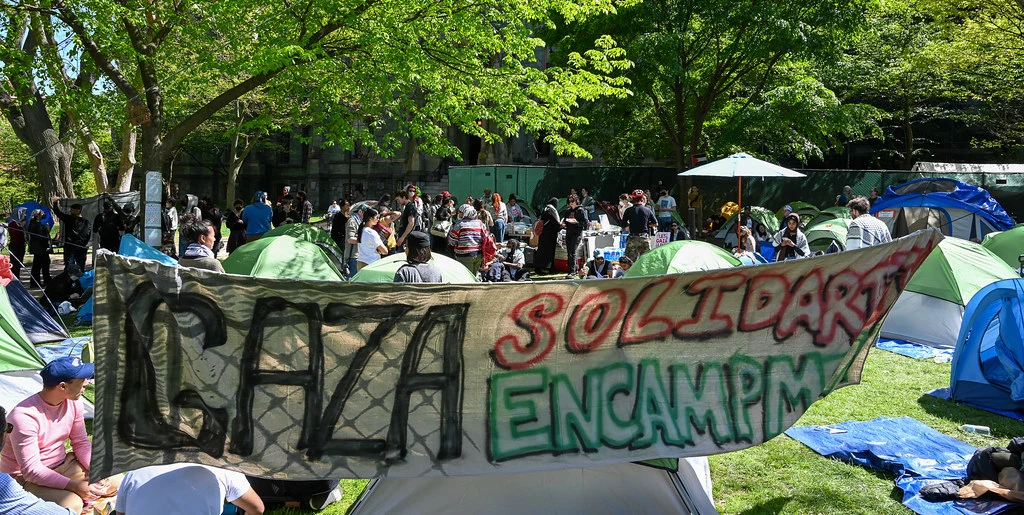
Last spring, campuses across the country became flashpoints of anti-war resistance, as thousands of students mobilized in a powerful demonstration of moral conscience and collective action. Their demands were clear: an end to U.S. complicity in the genocide in Gaza and the dismantling of the war machine that sustains it. This wave of activism commanded both national and international attention.
Yet, in recent months, despite the ongoing slaughter and the White House’s egregious proposals to further orchestrate the ethnic cleansing of Gaza, mainstream coverage of the student movement in solidarity with the Palestinian people—and in opposition to what Martin Luther King Jr. condemned as “the madness of militarism”—has steadily faded from the headlines.
Despite the relative media silence, and amid an intensifying campaign of institutional repression, the campus-based fight against the intolerable status quo has not ceased. Students remain at the forefront of the struggle for a more just, less militarized, and truly democratic world.
What coverage remains has largely functioned to reinforce the narrative that universities—initially caught off guard by the spontaneous protests of the spring—have successfully reasserted control over their campuses from what they have long framed as unruly agitators.
In November, The New York Times framed administrators’ crackdown on campus protests as a success, reporting that their efforts “seem to be working.” These draconian measures have had a chilling effect on campus expression—undermining free speech, stifling dissent, and betraying the university’s role as a laboratory for democracy and social change.
Nonviolent civil disobedience—a cornerstone of student activism from the Civil Rights Movement to the anti-Vietnam War and anti-Apartheid struggles—is now being met with the heavy hand of repression, as both the legal system and university conduct boards enforce arbitrary, vague, and inconsistently applied punitive measures.
These crackdowns have disproportionately targeted advocates for Palestinian liberation and their allies. This assault on Palestine-related dissent has already prompted multiple complaints over civil rights violations.
In just the past two months, several alarming examples of escalating repression have underscored the intensifying crackdown on pro-Palestinian activism:
New York University imposed yearlong suspensions on 11 students for participating in a nonviolent sit-in, in what organizers have decried as an extension of a broader “campaign of collective punishment.”
The University of Rochester expelled four students—who were already facing felony charges—for distributing posters directly naming and accusing university leadership and faculty members of complicity in the military-industrial-academic complex and supporting the U.S.-backed genocide in Gaza.
The University of Minnesota threatened to hand down two-and-a-half-year suspensions and $5,500 fines to seven members of their Students for a Democratic Society chapter for their participation in a campus building occupation in October.
Harvard University adopted the IHRA definition of antisemitism, which conflates nearly all criticism of Zionism and of Israeli policy with antisemitism while simultaneously and hypocritically claiming “institutional neutrality.” Rights groups have condemned this move as “a prescription to chill campus speech.”
The University of Michigan suspended Students for Freedom and Equality (SAFE), the largest pro-Palestine coalition on campus, until at least 2026.
Faculty and staff have not been exempted from this wave of repression. In recent weeks:
New York University also barred two professors from campus for their participation in the nonviolent sit-in at their university’s library, a move experts describe as “tantamount to suspension.”
Columbia University pressured law professor Katherine Franke to resign over her support for pro-Palestine activism, joining others who have lost academic appointments or faced internal investigations due to their principled positions on Palestine.
At Harvard University, Jay Ulfelder, Director of the Nonviolent Action Lab at Harvard Kennedy School, left his position in protest, following David Vine in his departure from American University in September after publishing an op-ed condemning his institution’s complicity in genocide.
This all combines with the Trump administration vowing to further its unconstitutional crackdown on so-called “pro-Hamas students,” threatening international students with deportation through the cynical pretext of combating antisemitism.
This marks the first steps in the implementation of the Heritage Foundation’s “Project Esther,” a component of the broader fascistic Project 2025 agenda. These efforts have been further amplified by militant Zionist organizations like the World Betar Movement, which has reportedly deployed AI to compile lists of students involved in campus protest to be targeted for deportation.
Despite the intensifying climate of repression and intimidation, students, faculty, staff, and community members of conscience remain steadfast in their struggle for justice and a better world and continue to push back:
+ Within the University of California system, People’s Tribunals are being organized to expose institutional complicity, build grassroots power, document evidence, and hold those responsible accountable.
+ Scholars within the American Historical Association overwhelmingly voted to condemn the ongoing destruction of schools, libraries, and universities and the murder of academics in Gaza as scholasticide.
+ At Columbia University, students have initiated legal action against their administration, joining other lawsuits across the country.
+ In California, taxpayers are suing their representatives over the unlawful appropriation of public funds to support genocide.
+ Students at Bowdoin College launched the first encampment since last spring in protest of their university’s intransigence despite a democratic referendum that passed calling for the university to take a public stand against the genocide in Gaza.
ZNetwork is funded solely through the generosity of its readers.
Donate




