


Wealthy donors have long funded think tanks with official-sounding names that produce research that reflects the interests of those funders (Extra!, 7/13). The weapons industry is a major contributor to these idea factories; a recent report from the Quincy Institute (6/1/23) demonstrates just how much influence war profiteers have on the national discourse.


Quincy Institute (6/1/23): “The vast majority of media mentions of think tanks in articles about U.S. arms and the Ukraine war are from think tanks whose funders profit from US military spending.”
The Quincy Institute—whose own start-up funding came mainly from George Soros and Charles Koch—looked at 11 months of Ukraine War coverage in the New York Times, Washington Post and Wall Street Journal, from March 1, 2022, through January 31, 2023, and counted each time one of 33 leading think tanks was mentioned. Of the 15 think tanks most often mentioned in the coverage, only one—Human Rights Watch—does not take funding from Pentagon contractors. Quincy’s analysis found that the media were seven times more likely to cite think tanks with war industry ties than they were to cite think tanks without war industry ties.
With 157 mentions each, the top two think tanks were the Atlantic Council and the Center for Strategic and International Studies (CSIS). Both of these think tanks receive millions from the war industry. The Atlantic Council has long been the brain trust of NATO, the military organization whose expansion towards Russia’s borders was a critical factor in Russia’s decision to invade Ukraine. (See FAIR.org, 3/4/22.) Both think tanks receive hundreds of thousands of dollars from Raytheon and Lockheed Martin, companies which have already been awarded billions of dollars in Pentagon contracts as a result of the war in Ukraine.
CSIS was revealed in a New York Times expose (8/7/16) to produce content that reflected the weapons industry priorities of its funders. It also “initiated meetings with Defense Department officials and congressional staff to push for the recommendations” of military funders.

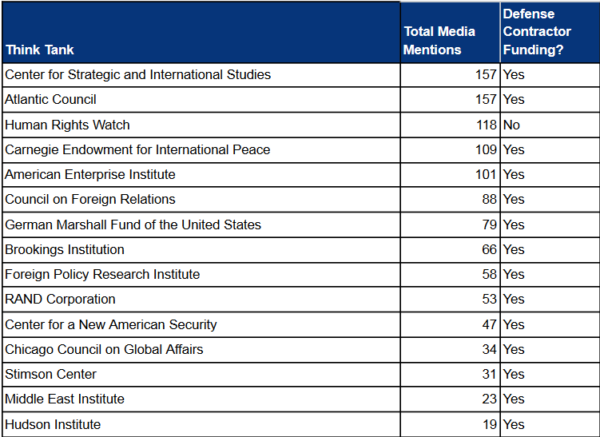
Think tank media mentions related to US military support for Ukraine (Quincy Institute, 6/1/23).
In addition to showing think tanks’ enormous influence, the Quincy report highlights how difficult it is to trace just how much war industry funding these think tanks receive, and exactly whose interests they represent. “Think tanks are not required to disclose their funders,” study author Ben Freeman wrote, and “many think tanks list donors without indicating the amount of donations and others just list donors in ranges (e.g., $250,000 to $499,999).”
While the study was not aimed at establishing a causal connection between weapons industry funding and the think tanks’ positions, it acknowledges that funding typically plays a major role in shaping the institutions. “Funders,” Freeman wrote, “are able to influence think tank work through the mechanisms of censorship, self-censorship, and perspective filtering.” In other words, people with points of view antithetical to the funders likely would not last long in these think tanks.


No compromise with Russia (Atlantic Council, 2/6/23) means no end to the Ukraine arms money flowing to Atlantic Council donors like Lockheed Martin, Northrop Grumman and Raytheon.
Causal or not, there is a marked correlation between war industry funding and hawkish positions. “Think tanks with financial ties to the arms industry often support policies that would benefit the arms industry,” the report noted. For example, one Atlantic Council article (2/6/23) advocated against “any compromise with the Kremlin,” while another, titled “Equity for Ukraine” (1/16/23), argued that Ukraine has a “right to destroy critical infrastructure in Russia and plunge Moscow and other cities into darkness.”
Earlier this year, the president of the American Enterprise Institute—fifth on the list, with 101 mentions—was cited numerous times in the Wall Street Journal (e.g., 1/20/23, 1/25/23) arguing that “tanks and armored personnel carriers are essential,” and agreeing to provide them will “let Ukraine know that it can afford to risk and expend more of its current arsenal of tanks in counteroffensive operations because it can count on getting replacements for them.” AEI (6/9/23) has gone so far as to suggest that the US give tactical nuclear weapons to Ukraine, something that could easily escalate to all-out nuclear war.
The Quincy Institute did not find a single instance in which a media organization disclosed the fact that its source received funding from the war industry, obscuring how interested parties may be shaping coverage or promoting policy recommendations that directly benefit their funders.
The study found that for the few think tanks that receive little or no Pentagon contractor funding, positions on the war are dramatically different. With less influence from the war industry, the study found, these organizations emphasize “expository rather than prescriptive analysis, support for diplomatic solutions, and a focus on the impact of the war on different parts of society and the region.”
Human Rights Watch, which takes no war industry money, “was agnostic on the issue of providing US military assistance to Ukraine,” and instead “focused on human rights abuses in the conflict.” The Carnegie Endowment, which receives less than 1% of its funding from that industry, was never quoted advocating an increase in military spending or weapons sales during the Ukraine War.
One critical way that corporate news media manufactures consent for US foreign policy is by carefully selecting the sources and voices that they present, and narrowing the spectrum of debate. While this can take the form of uncritically repeating pronouncements from government officials, this research demonstrates that there are more subtle ways in which media outlets can push a corporate/state agenda under the guise of independent journalism.
ZNetwork is funded solely through the generosity of its readers.
Donate




