

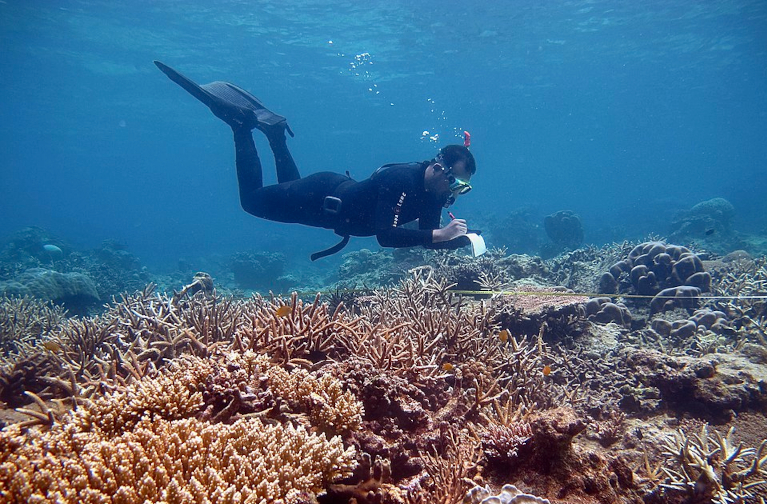
Decades of inaction responding to rapidly increasing carbon emissions, industrial overfishing, point source contamination, and similar compounding pressures on our planet’s oceans have begun obvious, large scale disruption of marine ecosystems. 84.4 % of the world’s coral reefs experienced mass bleaching, and ongoing, record high ocean heat for several years are just some of the recent extreme, systemic shifts. Many of these changes will continue, leading to widespread loss of marine life across various trophic levels, affecting coral reefs and the vast biodiversity they support.
As the severity of human impacts to ocean life rises, however, so have a variety of adaptations combining scientific research, education, mitigation, awareness, and restoration of the incredible life harbored in the wildly diverse coral reefs across the planet. The following interview with Dr. Ewout Knoester of Reefolution.org provides merely a brief introduction into the amazing work in reef restoration and community building by their initiative. Knoester’s efforts in marine ecosystem restoration have received the overall winner of the 11th annual Western Indian Ocean Marine Science (WIOMSA) awards in 2019, in addition to the 2025 International Coral Reef Society (ICRS) World Reef Award. Our discussion below was edited for clarity from an online interview.
King
Please tell us about your background in marine science, and how you came to become involved in coral restoration.
Knoester
It began with my Master’s at Wageningen University, which is a very broad program in aquaculture and marine resource management. So actually, it was very heavily focused on how to extract things from the ocean, not so much conservation or ecology, but I could get into the courses and that way I shifted more and more towards ecology. Coral reefs only entered the picture when I had to do my internship for my masters. Then there was an option to come to Kenya to essentially explore the whole concept of reef restoration, to see if that will be feasible at this specific location, both ecologically and also socially. So that is when I, together with other master’s students, Michelle and Magite, headed down to South Kenya and yeah, started up a small pilot study on reef restoration. That’s actually the first time in my academic career I actually was interacting and studying coral reefs. I didn’t really have the background academically yet. So just as I got in the fields, I had to quickly learn about this, about this ecosystem and essentially that’s what I’ve been doing ever since. So I completed that internship, got a green light essentially for restoration, both socially, and ecologically. It seemed like, OK, it could work here in southern Kenya, and that is when I actually came back for my thesis to do a bit more detailed study regarding how can we do this more efficiently, especially in the nursery phase of reef restoration. And that laid the groundwork for my PhD, again connected to Wageningen University and this specific location here in Kenya. And as this project kind of started growing also with the university and some interested people, we decided to establish an NGO, especially to create funding for the project.
King
What year was this when you started in Kenya, by the way?
Knoester
So the internship was in 2015 and then the decision to start the NGO Reefolution was in 2016. So essentially it was half a year after we completed that internship that the NGO was officially registered. Then back in the Netherlands and I think since 2019, if I’m not mistaken, it was also officially registered in Kenya as a separate independent entity.
King
I know you mentioned your graduate work was more focused on extraction in marine science, and it seems like Wageningen, when I look into it now, is very environmentally focused. So much of science is still ignoring the intersections of conservation and social issues; looming catastrophes like mass human migration, war for resources, and complete wipeout of large swaths of various habitats… We have to build economies that are restoring vital ecosystems really quickly, so that’s why I’m so fascinated with this project, its growth, and the connection of science, education, and community action. So it’s also neat to see that change happen in the universities too. Because investment in the future is going to require a real shift in approach.
Knoester
Yeah, though I have to say like at Wageningen also the master’s, it was extraction, but how to do it sustainably was always the focus already. But indeed that is still extraction based and now it’s more OK, what can we give back and how can we get more? How can we give more back to the ecosystem rather than just seeing it as an extraction source?
King
Yeah, in the short-term, we physically have to restore full ecosystems – replant forests on massive scales – the Greenbelt Movement in Africa is an example of a beginning to this. All these things have to scale so quickly. Mindset change has to happen at all these different levels. That for me is always the tension of like we really have to start putting in viable effort and identify these outlier projects, and identify the minimal effective dose for viable future growth. Like, what’s the least amount of funding that can be applied to optimize existing projects?
I’m wondering about what does it take to watch the coral over the years? Do you have teams constantly doing this? Because this is years and decades of restoration, and I’m sure you want to see what is changing through the full ecosystem. Can you give me details on the ongoing monitoring of biodiversity after the coral is grown?
Knoester
Yeah. So, for the project specifically and the time that I’ve been in the water, it’s been 10 years, so indeed decades, which might sound long. But of course there’s always this issue of the shifting baseline. I’ve never really seen how it how it was before. Also if you look scientifically from before the first big like major impact that was in 1998 like the first heat wave that wiped out half of the coral reefs in this region in the Western Indian Ocean…
King
Right, the big El Nino.
Knoester
Before that event, there’s so little data, so I’m always like, OK if I describe what I see happening on the reef, we have to realize it’s only a very small part that I’m actually observing, and then it’s always good to place in the bigger picture somehow as best as possible to really show what’s going on. And then of course it’s going to be a story of coral decline overall. Like even this small time span, the decline has been still so, so major. It’s quite scary to actually see that happening. And we know it’s not just this location, we know it’s worldwide. So of course this is what we try to fight, what we try to reverse.
But it’s as you mentioned, it’s all a matter of scale and we haven’t both in terms of preventing the damages, but also in terms of restoration, we still need to scale up a lot on both sides.
King
Can you tell me anything else about the peer review papers you’re producing and how? Do you pull in other scientists occasionally or you’re working with like 1 core team?
Knoester
So I have to say that the core team so far has been mainly just me, but definitely supported by a whole bunch of students over the years and of course the local employees here of the restoration project we call “Reef Rangers,” by supporting in performing all the research, helping to analyze the data. But in terms of other researchers on the same level, it’s a few within my group at Wageningen University that I have some time to debate with but not too much actually. So it’s mainly me and the students in the field that investigate all these different topics and the nice thing is we can essentially investigate anything that we think is relevant or interesting or promising to help the coral reefs and that also explains like this whole diversity of topics you mentioned.
Some additional ones even like we also tested this concept of the bio rock where you let low voltage electricity go through a metal structure in which coral is attached. There were many claims that it would increase the growth of coral, make it more resistant against this increasing heat.
Unfortunately we didn’t find these results, but in that way any topic that we think has some promise we can explore, and especially with this focus on trying to get corals that are somehow better able to deal with the heat that is going to increase.
King
Right.
I think that’s one of the most impressive and important elements to all this is just having things that are going to adjust to the heat. I keep an eye on Climate Reanalyzer and the oceans temperatures the last three, three plus years; the records have been broken more and more and so the heat’s already in the ocean.
Knoester
Yeah.
King
So the planet is mostly ocean. The sustained leap in record high ocean temperatures over the last few years is the signal of abrupt change. Geoengineering to block the sun is unlikely sufficient or safe, as the heat’s already in the ocean. There’s all these different talks about quick fix techno solutions, but I feel that we need to adjust society, provide food, stabilize things, refocus the economy to different aspects of environmental change, safety, human happiness, and security… because the heat already is in the ocean. Most of the new techno schemes are not appropriate. We’re certainly going to use technology, but if it’s not appropriate to what’s already happened – the overheating of the oceans – they’re irrelevant but there’s so many industries that are already like up and going and making money and convincing people of something that’s not needed. And that’s, I mean, the things that we need are biological diversity, and that’s represented as critical in the planetary boundaries too. So your project is so awesome to me also because it’s focused on bringing in biodiversity, which supports recreation, scientists, food for the ocean, fish. So that’s phenomenal and it has to scale. Speaking of the amount of fish, the pressures in Kenya and the pressure you’re seeing on the reef beyond just warming and coral bleaching, which is also related to of course ocean acidification. Do you see anything like overfishing or any other kind of point contamination there?
Knoester
Yeah, I would say indeed after the increasing temperatures, overfishing will be the second largest stressor that the corals here have to deal with. Essentially there is this imbalance between the corals and the fish – they both need each other. Fish, especially the herbivorous ones, are important, too keep the corals able to grow, remove the algae, essentially just weeding around the corals is what these fish do and as most of the other fish, they’re just being caught away and it’s just local artisanal fishing that is happening every day on quite a large scale – it already results in overfishing. Of course the population of Kenya is expected to increase still quite a lot more. So this problem is also not going to get any less.
But that’s also kind of how we wanted to have the project work like OK, take fishermen and give them an alternative livelihood in reef restoration, that way at least you can reduce some of the pressure while at the same time support recovery.
So, that was kind of the the whole concept behind the Reef Rangers. But yeah at the moment I think the amount of money generated by fishing is still increasing faster than the amount of Reef Rangers we can employ but at least its pushing it a bit in right direction and then also with the community having established like a small area in which we do the restoration, but then also have a small area in which no fishing is allowed, and other areas in which only traditional fishing methods are allowed. So that way not blocking fishing everywhere because that’s impossible. It’s people’s livelihood. You can’t just say OK, no fishing anymore, but find ways around it so that both the reefs can sustain themselves and people as well.
King
Agreed. There has to be longer term relationships between the environment and the people living there. Can you tell me a little bit about what that looks like on kind of a month to month basis?
Knoester
Yeah. So what we have at the moment is an after school program called the “wildlife clubs” and that organization is endorsed by the county government here; we can do marine conservation every Wednesdays for the local schools. So I think at the moment that there are five schools in the wildlife clubs. So that’s usually about 100 or 150 per school that participate in these conservation sessions that are given by the Reef Rangers. So also people doing the restoration and the work in the fields on Wednesday afternoons, they will pass by the schools and tell more about the ocean, the corals and the work that we do and how that hopefully helps to create better lives for everyone in the area here. So that is the approach we are currently taking. But as you say also it’s a start, but again scalability. So of course we at the beginning when we thought this out, we thought OK, maybe the most efficient way would be to actually change the curriculum Kenya wide to get conservation topics in there, but that was still a bit too far fetched. So this is kind of the solution we work with for the moment.
King
Yeah, I think that’s a great model because you’ve got Reef Rangers talking and integrating with you and they’re also getting in the ocean and working, right. And then they can show the younger kids this is what you do and teach about all ocean conservation.
The things that you’re doing – the education and the restructuring of an ecosystem – that provides real world ecosystem services, food resources, recreation, and more. To me it seems simple and straightforward. It’s like, hey, invest in this, but it still doesn’t fit a lot of the politically minded people looking to invest in high tech dredging of the very last of the oceans to get marine minerals, or investing in rockets to get minerals off of asteroids. I’m like, you got to stabilize society because things are getting wild all over the planet.
I was really impressed with the the 26 cents per fragment for coral restoration cost and that included the dive wage and material cost for building deployment, nurseries and planting of corals. So that’s like a systemic cost and that’s still not scalable right now? Can you tell me more about the kind of background for what’s required and how you calculate costs?
Knoester
Yeah, so, I think for that one it’s also important to clarify like the restoration as we do it and most restoration projects it’s a two-step process. So the first step is to nurture corals in a nursery – make sure you’ve got enough corals to sufficient size. So that is the first step and that is what this publication is about. And then you’ve got the second step, like if you’ve got these big corals from the nurseries to put these corals back onto the degraded reef or artificial reef structures. So for this first step -the nursery reef phase-that one is very efficient. So indeed the price that you mentioned is very cost effective; you can create a very good amount of coral for not too much money in the coral nurseries. But then where the bottleneck is by moving these corals from the nurseries back onto the reef, because that requires again lots of man hours and dives and that is where the cost will increase substantially. So that is where most gains can still be made.
King
Right. I think that’s a core shift if the dive tourism industry could be connected with that. I mean there’s a lot of difficult hurdles, cause usually dive training takes a good bit of money, but there’s still people all over the world that want to see oceans, that want to see living coral reefs. So there should be ways for folks to take their vacations to the beach and ocean, and be part of restoring the coral. I think there’d be a lot of people interested in that, but it’s still difficult. I mean, managing all of that is overwhelming. You need – we all need bigger teams – that are thinking in similar ways. But I’m glad to hear that the actual selecting of the corals that are heat adapted is pretty cheap.
I’ve looked at a couple other coral reef restoration projects and I’m just kind of in general wondering do you talk much with investors or entrepreneurs or scientific endowments? But what’s your feeling overall of the future of investment and scaling?
Knoester
Well, there’s still a very big gap between that goal and what is happening on the ground at this moment. But at least there’s the consensus that that is something we should work towards on a global scale. Realizing this
is another issue. So for us the project actually has mainly been supported through philanthropy. We’re not so much sourcing money from other sources yet, like what you mentioned, the dive industry could potentially be one, but in Kenya it’s also not very big.
And other industries we actually haven’t explored too much or other financing ways. Carbon credits unfortunately for coral reefs don’t work like for mangroves; it’s really helpful for quite a lot of projects in this region but for corals that unfortunately won’t work. Biodiversity credits is another thing that is still very new and that should be worth exploring, but we actually haven’t had experience with that one.
So for the most part we’ve been pushed forward by philanthropy and then also a part by research funds that also help the NGO again to do their work. So that combination has worked pretty fine so far though I have to say last year was quite difficult and I hear that from many other reef restoration projects that the funding has been substantially more difficult than in the past one 1 1/2 year and that’s also something we are noticing. So we actually have to diversify now as well.
King
That’s wild. I wonder if that’s a part of the policy changes and funding cuts linked to the Trump administration and this last effort to get fossil fuels. I’m at a loss for words that the US is really going in this direction after decades and decades of the wars for oil. We saw the damage that was done. We’ve seen generations of people, soldiers coming home totally traumatized, people that I’ve interviewed that are, you know, even 20 years ago – officers that left and were very much against what was happening… and here we are. We have these talks and you think things are going to change and instead they went in this. I hope it’s the last push for fossil fuels, but we’re looking at an invasion of Venezuela which Trump on record admitting this is about oil.
This is causing a cultural tension in the US right now that’s just incredible and it has to get resolved in the next few years. I think it will in some ways and then it’ll just be a difficult grind for us still because the damage that’s been done to the natural world.
…I looked at the kite surfing fundraiser, and I didn’t see too many details online. It appeared that that already happened in the year 2024. Is that correct? And they’re planning on doing it again. Can you tell me anything about how that went down? It sounds amazing.
Knoester
Yes.
Yeah, so for that the winds here really help like one season the wind is just going full south and the other way full north. Yeah, so that was an awareness stunt done by the guides for Kenya to raise awareness for our reef restoration projects. So yeah they almost guided the entire coastline and with stops in between and really needed those cause it was pretty exhausting to them and then they they finished here in the South Coast at the end. So that is where we received the team of I think it was four to five female kite kitters that did that stunt, yeah.
King
Wow.
So they were out together or were people doing it like a relay or they’re like this is dozens of kilometers or 100 kilometers a day or I don’t, is that correct there? So they’re cruising for a long time.
Knoester
It’s all together, yeah. I think the segments where we’re about 50 to 60 kilometers a day, yeah.
King
I think combining those physical extreme activities and raising awareness works well. We can demonstrate that the human body and life in general can do these incredible feats – and adapt to almost anything – like run hundreds of miles, kiteboard the coast of a large nation, skateboard across the US, bicycle around the world… well, we won’t anytime soon change fossil fuels for kiteboards and skateboards and surfboards, but I think that’s still more fun. And that’s why I like partnering with people that are into those activities – plus they are more enjoyable than driving around in cars all the time. More folks in outdoor recreation have to all pull together with ecologists, environmental scientists, and people who want to preserve these habitats because the rate of change that’s happening is so fast right now.
We have to pay attention to the next big kind of shifts that are going to happen in the global ecosystems and be ready to adjust because human migration is going to be resulting from the collapse of ecosystems. Social stabilization partnered with ecosystem restoration will be a lot of the future and providing fish and coral needs to tremendously scale all over the world. It should be integrated as rapidly as possible into education and experience. It’s a huge part of the foundations of all economies.
Knoester
Well, any restoration really.
For now, but that will swap. I mean with renewables getting getting more cost efficient than petrol. It will. It will change. It’s just they’re just delaying it at the moment, but it will come.
King
Yeah, whether it’s distribution, food, the way we get food, the way we travel, the way we transport and the future of our work related back to ecosystems, there’s critical necessity for change. Ok, to kind of wrap up, do you have anything you want to talk about or that I didn’t bring up or?
Knoester
Maybe to to clarify a bit more because about our heat resilient corals, but that definitely is still work in progress. We don’t have the solutions yet. So as I said we tried various ways to look which corals are more heat resilient and and how do they do it.
But that all still is also a work in progress and actually most of what we find is that corals that are currently heat resilient, it seems to be mainly meditated by the area they’re currently living in. So for example very specifically like if these intertidal corals that grow in that area fall dry during low tide, so these corals are exposed to to very high temperatures. So we thought, OK, let’s use these corals for our restoration of deeper reefs. But then as we move these corals away from that intertidal zone, they actually lost their heat resilience. So, so there’s still important intricacies determining how they adapt to higher temperatures, so it must be possible one way or another. But to actually use that in restoration on a large scale, we don’t have those solutions yet, so that’s something we’re still looking into also on a molecular level. So that’s a recent collaboration we started with with a Kenyan university with a molecular lab. So that’s all quite exciting to really understand, OK, what drives heat resilience of corals of the local corals that we have here and then try to use that information to improve the refresh rate.
Um, so as I said, still exciting, but no answers yet.
King
I’m familiar with the Rosenbergs and the hologenome theory of evolution and coral reefs are a wonderful example of this sort of system science, and I’m wondering if you have any idea what’s really adapting. What you’re referring to the difficulty and the corals that are appear to be heat resistant, but then they don’t when transplanted in a different location… Do you have any information kind of along the lines of what’s actually happening there? If it’s not, the coral polyp adapting but the coral reef is as living system with all these other organisms… So could it require the other factors in the ecosystem that aren’t in the deeper core, deeper marine area? Does that make sense?
Knoester
So I think just looking at the coral, ’cause that also is like a combination of indeed the polyp, but you also got these tiny algae living in there. You’ve got the bacteria, you’ve got the viruses, all making up a normally a healthy a coral. So already really zooming in into that should give lots of answers because I think these various aspects living inside the coral could explain quite a lot of what is happening in terms of its response to to thermal stress that then if you zoom out on the ecosystem level.
Again, there might be some interesting things happening with with these algae, but now I’m really speculating because these algae, they can move out of a coral like when bleaching is happening, that’s what happens. So they either are consumed or they leave. So then like this community of algae might might move away or move to a different reef. So I think that really can have an influence on the wider ecosystem, these these algae and potentially if we understand that and we can use that, we can potentially also breed these algae and apply that to a reef and then get heat resilient on a reef scale. So that is one potential thing to look into and and this I mentioned this for algae. Again, we’re moving into technical solutions here, but the same could be said for bacteria, like if there’s certain bacteria that improve the heat resilience of the coral for which there are indications.
King
Right.
Knoester
Then potentially even some kind of probiotic could be applied to a coral or a reef to improve their heat resilience. So these are some of the things, but they’re a bit dangerous as they’re playing around with an entire ecosystem we don’t fully understand it.
King
Oh, that’s cool.
Knoester
Things can also go very differently from what you intend, but these could be potential solutions that other research group are looking into and and we’re also trying to get at least the basics or like to know what we work with. Then we can know if such solutions might be might be viable or not.
King
Yeah, it’s phenomenal. It reflects to me a lot of the changes that we’ve seen in human health where reductionist science said, OK, take this antibiotic, take this, this one targeted, super powerful drug and then it negatively affects the rest of the system, the microbiome. And then we hear OK probiotics. Well then you need the correct prebiotics to support the probiotics and it takes so much more system science and research. But now in the at least in terms of human health with probiotics and prebiotics, the reductionist scientists put their health information out there and then Youtubers translate it. And then on Reddit you have people trying all these different diets and fads and putting it together. And then science goes a lot faster. Now it’s not quite as clean as doing everything in the lab, but figuring out complex adaptive systems is like that. It’s sloppy to a degree.
Knoester
Yes.
King
The world that is looking at corals and asking the systems level perspective questions, what is causing this? Is it the algaes, the corals, the interaction, the bacteria, viruses? Putting that together will give a lot more answers… So thank you so much for your time. And if there’s anything else you’d like to put in there, let me know. Do you have anyone you want to thank for your work?
Knoester
Yeah, well, of course it’s it’s good to realize it’s it’s a whole team. It’s not just me here. So indeed everyone from the team and all the visiting students, as I said earlier, they also greatly contribute to to everything that’s going on. So, what keeps us running. Thank you for your enthusiasm, support, and questions.
ZNetwork is funded solely through the generosity of its readers.
Donate




