


You grew up in a home that was heavily influenced by Ahad Ha’am [7], the father of cultural Zionism.
My father was a great sympathizer of Ahad Ha’am. Every Friday night we would read Hebrew together, and often the reading was Ahad Ha’am’s essays. He was the founding figure of what came to be called cultural Zionism, meaning that there should be a Zionist revival in Israel, in Palestine, and it should be a cultural center for the Jewish people. He wrote in Hebrew, which was novel, because Hebrew was then the language of prayer and the Bible. He saw Jews as primarily a Diaspora community that needed a cultural center that had a physical presence, but he was very sympathetic to the Palestinians. In fact he wrote some very sharp essays, after a visit to Palestine, criticizing the way the new settlers were treating the indigenous population. He said, “You can’t treat people like that.” Also, on practical grounds, he didn’t want to create enemies. A Jewish cultural center in Palestine was his ideal.
Now I won’t swear to the precise accuracy of this, because these are childhood memories, but I remember reading together with my father an essay that Ahad Ha’am wrote about Moses. The basic idea was there are two Moseses—the first is the historical Moses, if there was such a person, and the other is the image of Moses that was constructed and came down through the ages and occupies an important place in the national mythology.
Ahad Ha’am was an early advocate of the idea that later became famous with [the Marxist political scientist] Ben Anderson, when he wrote his books about how nations are imagined communities. He said there’s an imagined—I don’t think he used the term—but there’s an imagined Jewish community, in which Moses plays a central role, and it really doesn’t matter if there was a historical Moses or not. That’s part of the national myth, which is a sophisticated version of what [author [8]] Shlomo Sand was trying to get at. Sand debunks the historical Moses, but from Ha’am’s point of view, it makes no difference.
Did you read Nivi’im, the prophets, with your father in Hebrew?
The word “prophet” is a very bad translation of an obscure Hebrew word, navi. Nobody knows what it means. But today they’d be called dissident intellectuals. They were giving geopolitical analysis, arguing that the acts of the rulers were going to destroy society. And they condemned the acts of evil kings. They called for justice and mercy to orphans and widows and so on.
I don’t want to say it was all beautiful. Dissident intellectuals aren’t all beautiful. You read Sakharov, who is sometimes appalling. Or Solzhenitsyn. And the nivi’im were treated the way dissident intellectuals always are. They weren’t praised. They weren’t honored. They were imprisoned like Jeremiah. They were driven into the desert. They were hated. Now at the time, there were intellectuals, “prophets,” who were very well treated. They were the flatterers of the court. Centuries later, they were called “false prophets.”
People who criticize power in the Jewish community are regarded the way Ahab treated Elijah: You’re a traitor. You’ve got to serve power. You can’t argue that the policies that Israel is following are going to lead to its destruction, which I thought then and still do.
Did you imagine yourself as a navi, a prophet, when you were a child reading those texts alone in your room or on Friday night with your father?

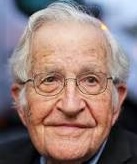
Noam Chomsky (born on December 7, 1928, in Philadelphia, Pennsylvania) is an American linguist, philosopher, cognitive scientist, historical essayist, social critic, and political activist. Sometimes called "the father of modern linguistics", Chomsky is also a major figure in analytic philosophy and one of the founders of the field of cognitive science. He is a Laureate Professor of Linguistics at the University of Arizona and an Institute Professor Emeritus at the Massachusetts Institute of Technology (MIT), and is the author of more than 150 books. He has written and lectured widely on linguistics, philosophy, intellectual history, contemporary issues, and particularly international affairs and U.S. foreign policy. Chomsky has been a writer for Z projects since their earliest inception, and is a tireless supporter of our operations.
ZNetwork is funded solely through the generosity of its readers.
Donate




