


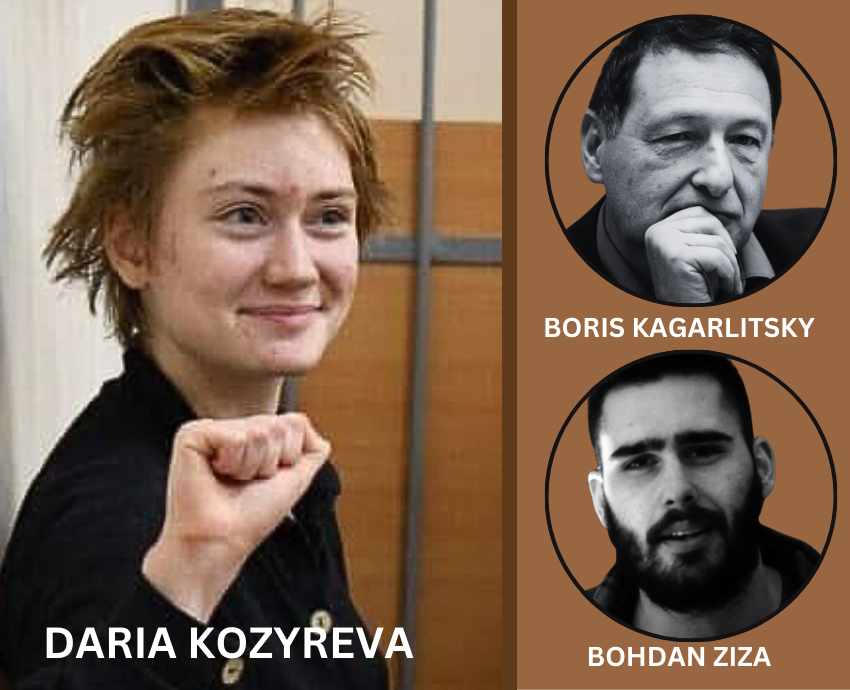
President Vladimir Putin’s regime is using anti-terror laws to step up its repression at home and in Russian-occupied parts of Ukraine.
The case of Russian sociologist and anti-war Marxist Boris Kagarlitsky is well-known. Found guilty of the trumped up charge of “justifying terrorism”, he was sentenced in February to five years’ jail.
But Kagarlitsky’s case is far from unique.
Since the start of Russia’s full-scale invasion of Ukraine in February 2022, almost 20,000 Russians have been detained for anti-war activities and 1000 put on trial, mainly on terrorism-related charges, according to independent human rights group OVD-info.
Since the start of this year, 669 people have been labeled, without trial, as “extremists and terrorists” by authorities under anti-terror laws. This takes the total to more than 14,000 since 2014 — the year Russia started arming separatist forces in Ukraine and annexed Crimea.
It is no coincidence then, as Halya Coynash of the Kharkiv Human Rights Protection Group notes, that Crimean Tatars and Ukrainian political prisoners abducted from Russian-occupied territories make up a significant number of those being repressed.
Bohdan Ziza, a Ukrainian artist from Feodosia, was charged with terrorism in May 2022, after he splashed blue and yellow paint — the colours of the Ukrainian flag — on the door of the Yevpatoria city administration building in Crimea.
For this act of “terrorism”, he was sentenced to 15 years jail last June.
In other cases, Coynash notes, charges often arise “from supposed ‘confessions’ obtained from Ukrainian men or women abducted from their homes and held incommunicado, without access to proper lawyers.”
But Russian authorities are not just targeting individuals.
The Ministry of Justice designated the Russian Socialist Movement (RSD) as a “foreign agent” on April 5 — the first time an explicitly socialist organisation was included in the register.
The Ministry said the designation was justified because the RSD had, among other things, “opposed the special military operation in Ukraine”.
The RSD has since been forced to disband, as the onerous restrictions imposed on it make it impossible for it to continue functioning.
Just as difficult is getting one’s name off the register. That is because being added to the register is really about issuing an implicit threat: leave the country or face further reprisals.
No wonder, then, that the number of related court cases are rising.
Russian courts dealt with an unprecedented 52 cases of “justifying terrorism” during April. If the trend continues, this year will set a new record for such cases.
One of those awaiting trial is 18-year-old student Daria Kozyreva. She is facing up to five years’ jail after sticking a poem by Ukrainian poet Taras Shevchenko on a monument.
Authorities also know that, should they not be happy with the court’s verdict, they can always appeal — and almost certainly get a more favourable outcome.
Human rights defender Oleg Orlov once headed the world renowned organisation, Memorial, until it was declared a “foreign agent” and subsequently shut down due to not meeting the onerous requirements imposed on it.
Unsatisfied, authorities went after Orlov himself, arresting him in 2023 for “repeatedly discrediting the Russian Armed Forces” — another common charge applied to those who express opposition to the war.
Like Kagarlitsky, he was found guilty in October but only given a fine. So, authorities responded in February by designating Orlov a “foreign agent” and having an appeals court replace the original sentence with a two-and-a-half year jail term.
Authorities can also simply lay new charges, as they did with mathematician and political prisoner Azat Miftakhov.
Having completed a three-year jail term in September, Miftakhov was charged on release with “justifying terrorism” and given another four years’ jail in March.
None of this seems to bode well for Kagarlitksy, who will have his final appeal heard by the military chamber of Russia’s Supreme Court on June 5.
But as Kagarlitsky noted in an open letter from prison: “Under today’s conditions, when political action and self-organisation in our country have become extremely difficult, helping our co-thinkers who have been imprisoned is not just humanitarian activity, but also an important political gesture, an act of practical solidarity.”
[You can sign a petition in support of Kagarlitsky and all Russian anti-war political prisoners at change.org.]


Federico Fuentes is editor of the Bolivia Rising blog and a regular contributor on Latin American politics.
ZNetwork is funded solely through the generosity of its readers.
Donate




