

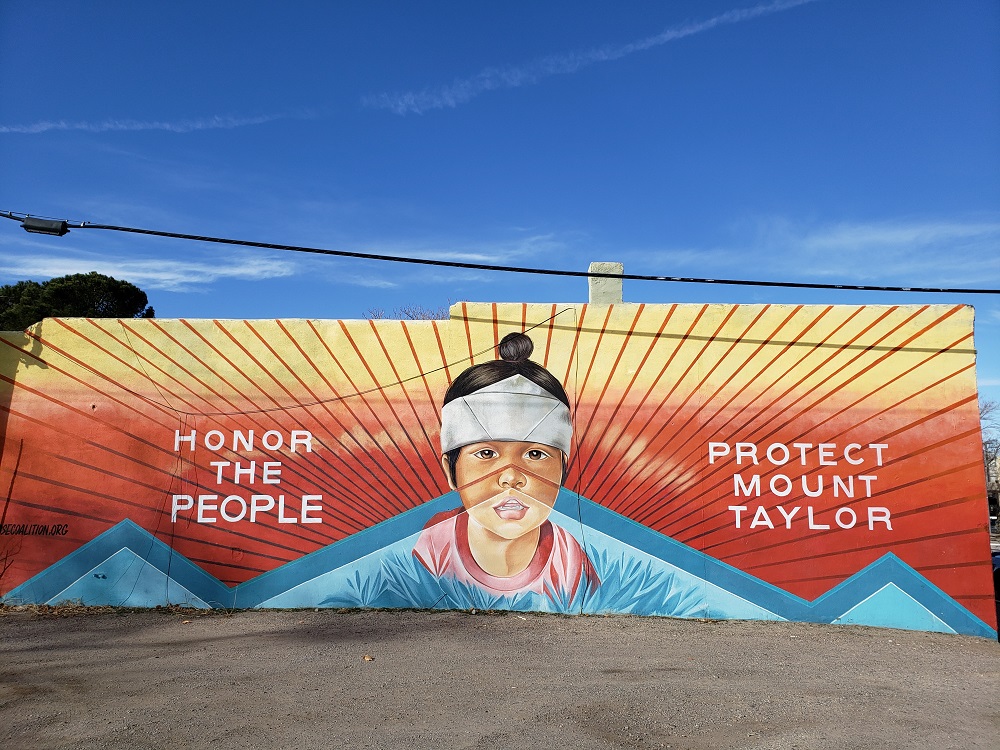
Indigenous people and communities have always been at the front line of climate justice initiatives.
I’m from the Acoma Pueblo in western New Mexico. I was raised practicing a community-centered lifestyle focused on protecting our environment for future generations. Unfortunately, the sustainability that my ancestors and community have worked so hard to cultivate is being threatened.
Just 15 miles east of us in Laguna Pueblo lies the former Jackpile-Paguate Mine, which was one of the world’s largest open-pit uranium mines. The mine, which operated from 1952 to 1982, is today a heavily contaminated Superfund site.
Members of Laguna Pueblo and surrounding communities, including mine, were offered false promises of economic development when the mine opened — at the expense of their health, it turns out. Workers were exposed to dangerous levels of radioactivity, which led to illnesses like cancer and respiratory and kidney disease.
The mine was part of the Grants Mineral Belt, a chain of uranium ore deposits where mining polluted 200 miles of drinking water and irrigation sources. For communities that depend heavily on irrigation to farm food for their families, that contamination was a threat to their lives.
Unfortunately, Laguna Pueblo’s exploitation isn’t unique.
Approximately 500 abandoned uranium mines are awaiting cleanup by the federal government in the Navajo Nation alone, including the site of the largest uranium spill in U.S. history — a tragedy that happened over 40 years ago that still isn’t resolved. Other indigenous communities in the state have similarly borne the brunt of fossil fuel development.
New Mexico, in short, has long suffered from the resource curse. Our extractive industries are actually making the state poorer and standing in the way of a just energy transition.
Now more than ever, it’s time to listen to the communities who deal with the burden of our overreliance on fossil fuels and nuclear energy. This year, my colleagues at the Institute for Policy Studies and I prepared a report — New Mexico at a Crossroads: False Solutions or Just Transitions? — to do just that.
We wanted to find ways not just to pollute less, but also transition to a more regenerative economy overall. We interviewed on-the-ground organizations including the Pueblo Action Alliance (PAA), the Semilla Project and the Southwest Organizing Project (SWOP).
Many of the people involved in these coalitions come from communities that have been treated as sacrificial. They’ve witnessed the repercussions that extractive industries and false solutions have done to their communities.
It’s “youth who are going to inherit this crisis and Indigenous communities that have been saying this for time on memoriam,” Alejandría Lyons of SWOP told us. “We cannot continue to invest in these systems of harm” — we need to “transition to ones that center our communities at the beginning.”
“We don’t wanna be in a position where we’re speaking on behalf of other communities but rather give them the resources and the tools in order for them to speak for themselves,” added Julia Bernal from PAA. “We speak for ourselves as pueblo people.” The extractive economy “goes against our values as indigenous peoples, and we’ll always remain with that firm stance.”
Broadly, these groups all highlighted the need to follow the leadership of communities who have been treated as sacrificial; to repair the historical harm that oil, gas, and nuclear energy have caused these communities; and to address climate change as a complex ecological and social crisis instead of reducing it to a problem of carbon emissions.
Taken together, these steps could create much needed opportunities. “Most of the abandoned wells from oil and gas are on native land,” said Josue De Luna Navarro of the Semilla Project. “When we think of a new economy, it could mean creating jobs and sustaining people’s lives by restoring that land that was abused for extraction.”
We hope our work can help uplift these voices and lead to a better future for all New Mexicans.
ZNetwork is funded solely through the generosity of its readers.
Donate
