


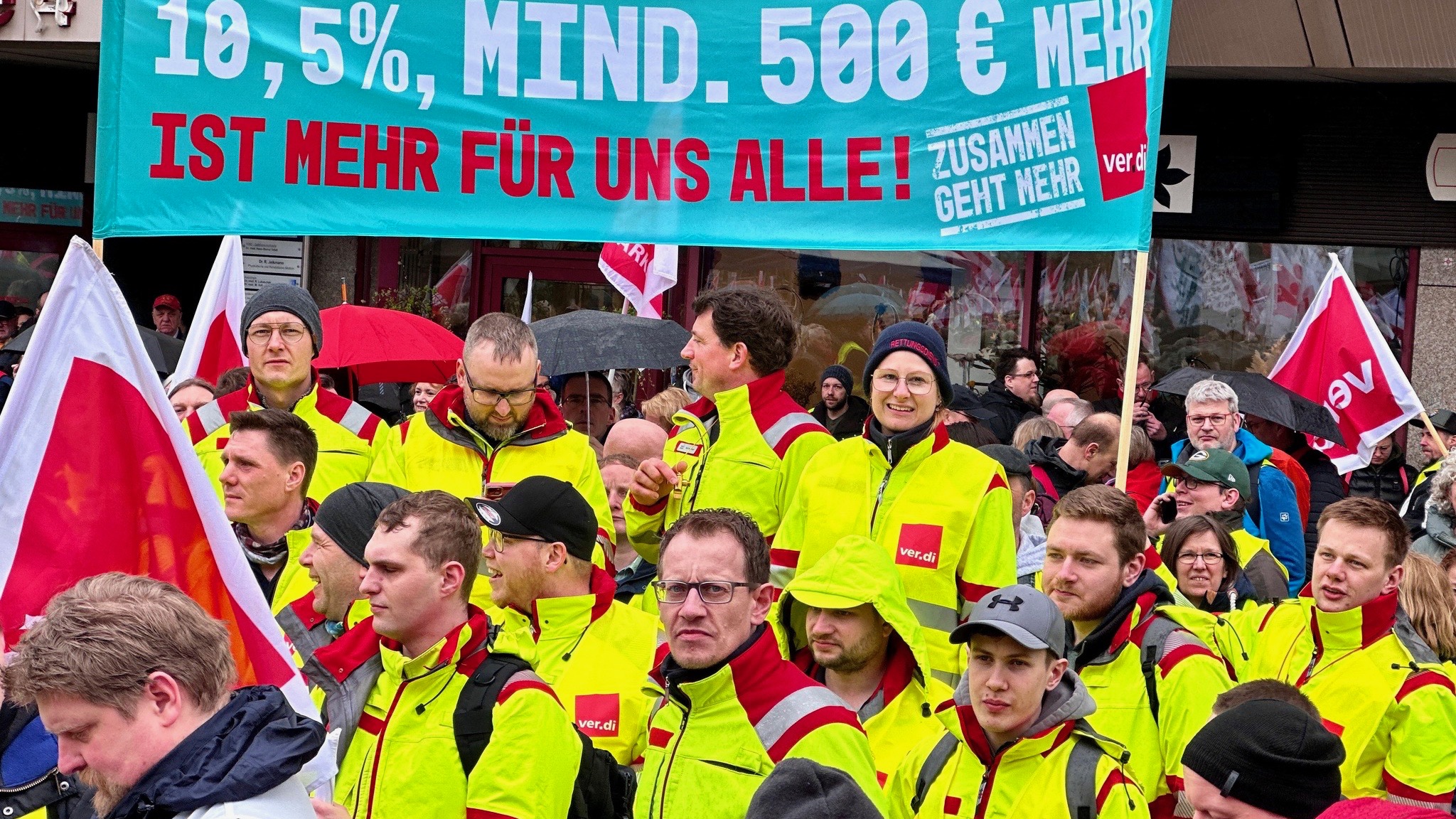
On a cold, freezing, windy, and snowy morning in late January 2026, Germany’s nationwide collective bargaining for public transport workers started under the union motto “Mobility for all and good working conditions for public transport workers.”
It set the tone for collective bargaining in all of Germany’s 16 federal states. But even before the mass strike commenced, in November 2025, collective bargaining on working conditions in public transport had already taken place for 150 municipal companies in as many cities and regional districts, as well as in Germany’s three city states of Berlin, Hamburg, and Bremen.
In East Germany’s Brandenburg and Thuringia and in West Germany’s Saarland, wages and salaries are also negotiated. Since collective agreements differ significantly from place to place, Germany’s public service trade union Ver.di was forced to develop different demands.
Meanwhile, the core demands in several states include shortening weekly working hours, shortening shift periods, extending rest periods, and increasing rates for night and weekend work. Today, there is conclusive evidence that night work shortens life expectancy.
The reduction of working time is particularly significant for improving healthier working conditions. For this reason, workers went on strike nationwide from Monday, February 2, 2026 onwards. In these collective bargaining negotiations, Germany’s municipal employers’ associations (VKA) represent the states.
In Bavaria, Brandenburg, the Saarland, Thuringia, and at Hamburger Hochbahn, higher wages and salaries are also being negotiated. In total, almost 100,000 workers in around 150 municipal transport and bus companies are taking part.
Currently, public transport workers are under enormous strain due to extremely unfavorable working hours, shift work, and constant pressure from management. Workers urgently need improvements to stop high turnover rates and to attract and retain skilled staff for public transport. This kind of work, with its low pay and destructive scheduling, is simply not attractive in Germany.
So far, employers have refused almost any improvement in the negotiations. Worse still, in some cases management has even sought to extend already long shifts. Others have demanded the cancellation of sickness benefits. In other words, public management is trying to turn back the clock.
This behavior represents a direct attack on existing collective agreements. It puts public transport as a public service at risk. Those who refuse better working conditions and fair pay are depriving the many people who depend on public transport of a reliable and functioning system.
Because of this, Germany’s trade unions are forecasting a “hard” round of collective bargaining – unless employers show greater willingness to move in negotiations.
The union’s call for strikes sends a clear signal of determination. Workers are ready to fight for their demands. It can safely be assumed that large parts of Germany’s public transport system will come to a standstill unless public management shows a real willingness to negotiate.
One union negotiator noted that the strike is not only about enforcing current demands, but also about protecting achievements workers have fought for over decades.
Union goals vary from company to company. For workers in some companies, more leave days, a minimum rest period of eleven hours between shifts, and higher vacation pay – with the option to convert that pay into additional days off – are central demands.
In addition, workers want to increase the so-called “turnaround time” to six minutes without exception. This refers to the time drivers have at a terminal stop before starting the return journey – a short but crucial break between driving periods.
There is also a demand to reduce weekly working time from 37.5 to 35 hours – something Germany’s metal industry achieved decades ago.
Nevertheless, state management has already described these union demands as a “disproportionate escalation” and has called for an end to the strike. Worse, state-owned transport companies are even considering legal action. As Katharina Pistor argues in her seminal book, The Code of Capitalism, law is the code of capitalism—though not completely. There are moments when workers win.
Instead of discussing relief from long hours and shift work, management in some states is talking about increasing working time to 42 hours per week – perhaps an attempt to return to William Blake’s “dark Satanic mills” of 1810.
The current collective agreement came into force two years ago. This means there were no strikes and no improvements for workers during that period. Worse, it has already taken five rounds of negotiations to reach no agreement. As a result, strikes have spread across Germany.
Corporate media, of course, tend to focus on the inconvenience to commuters, while unions focus on demands, wages, and working conditions. In media capitalism, strikes are always also fought in the media.
Meanwhile, the workload in public transport has been excessive for years, and the shortage of skilled workers continues to grow. A government that wants reliable public transport must be willing to invest in the people who make it possible, Ver.di argues.
This must also include an expansion of public transport itself. Yet, even at the very beginning of negotiations, employers announced – as they almost always do – that workers’ demands are “not financially viable.” Like a vending machine: you insert 20 cents, press a lever, and out comes the message, “demands are excessive.” At the same time, collective bargaining varies widely between states:
- In East Germany’s Saxony, for example, working time is to be reduced to 35 hours with full wage compensation, and all jobs are to be secured.
- In Hessen and Berlin, the remuneration system is to be revised.
- In Berlin, workers demand €500 more per month instead of a reduction in working hours, as well as 33 days of paid leave for everyone.
In the East German city of Dresden alone, 40,000 people have signed a citizens’ petition to prevent further cuts at Dresden’s Verkehrsbetriebe (public transport company).
Beyond this, a flyer circulated by the Netzwerk für eine kämpferische und demokratische Ver.di – the Network for a Progressive and Democratic Ver.di Union (netzwerk-verdi.de) – argues for a turnaround in collective bargaining strategy. It calls for nationwide collective bargaining instead of fragmented negotiations at the state level, in order to achieve better working conditions in public transport.
For these workers, progressive trade unionists organized in netzwerk-verdi.de argue that fighting together can overcome the disadvantages of the current fragmented system. At present, Ver.di agreements do not apply uniformly across the country. There is no nationwide agreement.
Therefore, efforts should be made to return to a unified collective agreement focused on core demands, such as reducing weekly working hours with full wage and staffing compensation. The network also calls for stronger mobilization and better communication with the wider population.
Current collective bargaining in public transport is about more than improvements for employees alone. It is also about a well-developed, fully funded, attractive, and affordable—if not free—public transport system. The money for such expansion, as well as for more staff and better working conditions, does exist. Corporate assets in Germany alone amount to an astonishing €20 trillion (€20,000,000,000,000), according to the Sixth Poverty and Wealth Report.
As in every capitalist society, however, wealth is distributed extremely unevenly. Only 3% of Germany’s total wealth belongs to the poorer half of the population, while the richest tenth owns 54%.
At the same time, Germany’s so-called “defense” budget is set to triple to €180 billion by 2030. This raises an obvious question: should the wealth of the super-rich remain untouchable while tax revenue – generated primarily by the working population – is increasingly channeled into military spending?
Under current priorities, not a single cent is invested in upgrading public transport. Instead of flowing into Germany’s military-industrial complex, billions of euros could be used to expand public transport, as well as schools, hospitals, and childcare facilities, netzwerk-verdi.de argues.
Public transport matters to everyone. Millions rely on it to get to work, visit friends, attend sports activities, go shopping, study, train, or see a doctor.
If public transport workers go on strike, Germany comes to a standstill. Public transport is also indispensable in the fight against climate change. It must be expanded, not dismantled. That requires billions in investment and many more workers. Successful collective bargaining is only one – albeit important – step in that direction.
For this to succeed, strikes must be organized democratically from below. Strike coordinators should be elected in all companies and networked at the district, state, and national levels. In addition to picket lines at workplaces, there should be central meeting points where workers can gather – together with local residents and workers from other sectors – to demonstrate solidarity.Precisely because public transport is so vital for the working class, this struggle must be supported by all trade unions – strengthened by systematic campaigns that build solidarity far beyond individual unions, workplaces, and companies.


Thomas Klikauer has over 1200 publications (including 16 books) and writes regularly for Cross Border Talks ( Europe), Countercurrents (India), and ZNet (USA) on global warming, labor relations, and Germany’s far right.
ZNetwork is funded solely through the generosity of its readers.
Donate




