An AP article on the latest productivity data from the Bureau of Labor Statistics (BLS) was a bit confused on the relationship between productivity, profits, and job growth. The article noted the 0.3 percent decline in productivity reported for the second quarter. This followed a decline of 0.6 percent in the first quarter. It suggested that this could be bad for hiring since it would reduce corporate profits and leave them with less money to hire additional workers.

Actually, slower productivity growth can be good for hiring. Increased productivity and hiring are alternative ways for meeting additional demand for labor. If employers find that they can't get more productivity out of the existing workforce, then they have no choice but to hire more labor (which could mean overtime) in order to meet an increase in demand.

Profits on the other hand tend to be very weakly correlated with employment growth. Firms will not hire more workers just because they have higher profits, they hire more workers when they feel they have the demand for additional workers. This is why hiring was very weak in 2010 even though profits had bounced back to their pre-recession level.

It is worth noting that productivity is poorly measured and the data are subject to large revisions. For example, productivity growth in the first quarter had been previously reported as 1.8 percent. For this reason preliminary productivity data must always be viewed with considerable skepticism.

It is also worth noting that the weak productivity growth of the last year appears to be offsetting the rapid growth from earlier in the downturn. This has left the economy slightly below its post-1995 productivity growth path. Several analysts had suggested that there had been a qualitative leap in productivity growth earlier in the downturn and offered this as an explanation for slow job growth. It now seems that firms were simply quicker to lay off workers than usual, which explains the unusually fast productivity growth early in the downturn.

Productivity Growth, 1995-2011
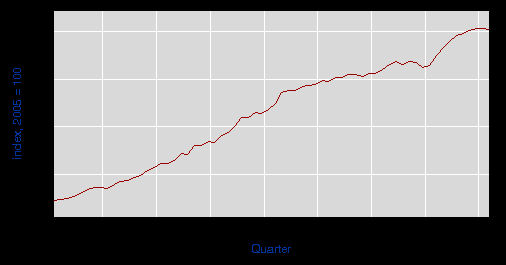


Source: Bureau of Labor Statistics

Dean Baker is co-director of the Center for Economic and Policy Research in Washington, D.C.  He is the author of several books, including False Profits: Recovering from the Bubble Economy.  This article was first published in CEPR's Beat the Press blog on 9 August 2011 under a Creative Commons license.


Dean Baker is co-director of the Center for Economic and Policy Research in Washington, DC. Dean previously worked as a senior economist at the Economic Policy Institute and an assistant professor at Bucknell University. He has also worked as a consultant for the World Bank, the Joint Economic Committee of the U.S. Congress, and the OECD's Trade Union Advisory Council.


ZNetwork is funded solely through the generosity of its readers.

Donate
Donate
Leave A Reply

Subscribe

All the latest from Z, directly to your inbox.

Institute for Social and Cultural Communications, Inc. is a 501(c)3 non-profit.

Our EIN# is #22-2959506. Your donation is tax-deductible to the extent allowable by law.

We do not accept funding from advertising or corporate sponsors.  We rely on donors like you to do our work.

ZNetwork: Left News, Analysis, Vision & Strategy

Subscribe

All the latest from Z, directly to your inbox.

THE WIND CRIES FREEDOM

The Wind Cries Freedom, the new book from Z co-founder Michael Albert, is a sweeping oral history of a future American revolution.

Through thirty interconnected chapters, it draws out the strategies, failures, turning points, and hard-won wisdom of a movement that called itself the Revolutionary Participatory Society. These are not the polished memoirs of politicians: they are the unfiltered accounts of people who organized in neighborhoods, hospitals, universities, stadiums, courthouses, and places of worship, and kept a shared vision alive through cynicism and exhaustion.

The result is speculative political fiction that reads like history: messy, human, and quietly hopeful in the way that only real experience and long thought can produce.

Get your copy and peruse more features on the book’s website below.

“Read it, argue with it, but don’t look away. The future it recalls is one we must still fight to deserve.”

Yanis Varoufakis

“The most unusual and intriguing combination of prophecy, manifesto, and movement building manual that I have ever encountered.”

Bill Fletcher Junior

“This work fills a huge gap in our social movement literature.”

Cynthia Peters

This is your article this month.

We’re glad you keep coming back. If Z’s work has informed, challenged, or inspired you, that’s no accident: there are no paywalls, no ads, and no billionaire owners here, and there never will be. Independent media survives because readers choose to support it.

Billionaires fund their own media. We fund ours. Help us reach 1,000 sustaining donors:

Number of donors689
Our goal1,000

Sustainers at $9/month or more receive the digital Z Magazine.

Already a sustainer? Click here and we won’t ask again. Thank you!

Your reading count is stored only in your browser and is never sent to us.

Sound is muted by default.  Tap 🔊 for the full experience

CRITICAL ACTION

Critical Action is a longtime friend of Z and a music and storytelling project grounded in liberation, solidarity, and resistance to authoritarian power. Through music, narrative, and multimedia, the project engages the same political realities and movement traditions that guide and motivate Z’s work.

If this project resonates with you, you can learn more about it and find ways to support the work using the link below.

Independent media is not disappearing because the ideas are weak.

It is disappearing because platforms reward speed, outrage, and algorithmic visibility over thoughtful analysis.

More than 100,000 people read Z every month, free of paywalls, ads, and billionaire owners. It takes fewer than 1 in 100 of them to fund all of it: 1,000 donors who keep Z independent, for everyone, and build what comes next.

Number of donors689
Our goal1,000

Sustainers at $9/month or more receive the digital Z Magazine.

Subscribe

Join the Z Community – receive event invites, announcements, a Weekly Digest, and opportunities to engage.

Exit mobile version

