

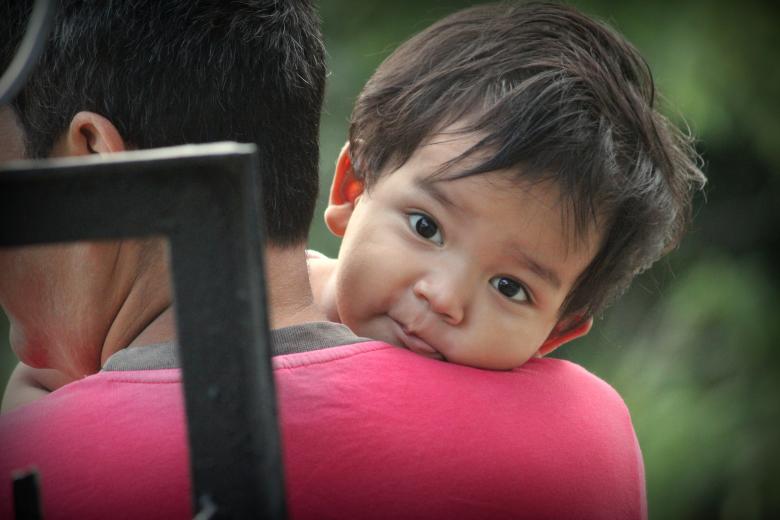
In the movies, people bolt upright, panting after dramatic awakenings from bad dreams. I thought that was an exaggeration until I experienced it behind bars. In my nightmare, my 2-year-old son entered the prison where I was incarcerated. He was trying to reach me, but the prison guards grabbed him and wouldn’t let go. I jolted awake in my prison cell, just like I’d seen on screen hundreds of times, breathing hard and filled with terror.
I’ve never felt more fear, helplessness, or despair than when I was separated from my son, unable to protect him from harm because I was locked up in prison.
This Father’s Day, I’m thinking of the millions of fathers across the country who are living the same nightmare that I did. Nearly half of all men in prison are fathers of minors, and not a day went by when we didn’t talk to each other about our kids.
We know that family connections are essential for children’s health and development, but they’re also essential to the well-being of incarcerated parents. However, federal and state prisons put many barriers in the way of maintaining family relationships. From constructing prisons in hard-to-reach areas that make it difficult for families to visit, to charging exorbitant fees for phone calls, to inhumanely long prison sentences even for nonviolent offenses, the U.S. carceral system seems designed to break up families.
If we look at our criminal legal system through the lens of outcomes, the results are damning. Prison pushes families into deeper poverty, steals away parents from Black and Brown communities, and traumatizes children. It tortures the people it incarcerates by locking them in cages, isolating them through solitary confinement and lockdowns, and subjecting them to often unchecked physical violence by prison guards.
When I had that nightmare in prison, my son was only a toddler. He didn’t understand why daddy was away. During our phone calls, I would tell him I was in a special school, studying to become Superman. But the second time I was incarcerated my son was at a particularly vulnerable age, just entering middle school. And it had a big impact on him — and on me.
My son was just one of the staggering 2.7 million children in the U.S. with at least one parent in prison. According to a study by the Pew Research Center, Black children are over six times more likely and Hispanic children nearly twice as likely to have an incarcerated parent than their white peers.
Without me there, my son started acting out. His grades dropped. He became a more rambunctious kid — and I knew better than anyone that neither the South Bronx, Harlem, nor anywhere else in the U.S. is a safe place to be rambunctious if you’re a Black child.
Numerous studies have found correlations between parental incarceration and criminalized behavior, poor academic performance, and social and emotional problems in children. Prison punishes and traumatizes children just as much as their parents behind bars.
My second arrest was in California, more than 3,000 miles from my son, which made it impossible for him to visit. I didn’t see him for three and a half years. When I started my sentence, my son was still a child. When I came home, he had become a teenager and was almost 15 years old.
When he was 11, my son loved spending time with me. At 15, he wanted to hang out with his friends. None of the things I did to try to connect with him seemed to work. It was demoralizing and I felt like a failure as a father.
When he got into trouble or got a bad grade, I blamed myself. What got me sent to prison was being too concerned about maintaining a comfortable lifestyle for my family, so I gambled with my freedom. It didn’t occur to me then that my son would have been happier living under the Brooklyn Bridge with me by his side than financially stable with me separated from him.
After prison, it took us almost eight years, until my son was around 24 years old, to get our rhythm back.
Prison punishes and traumatizes children just as much as their parents behind bars.
I’ve dedicated my life to transforming this unfair system that mostly serves the interest of wealthy people, where the rich can pay for extravagant, high-powered legal defenses and even buy presidential pardons, and where Black and Brown men are more likely to end up in prison and get handed longer prison sentences for the same crimes.
Improving and maintaining family connections is a key step towards rehabilitation and justice.
One study found that people incarcerated more than 50 miles from home were more likely to experience depression, but 70 percent of the over 1,000 new prisons built from 1970 to 2000 are in rural areas. As long as the state is putting people in cages and separating them from their families, prisons should offer free transportation to family-friendly visitation centers and enact policies that make it easier for families to visit their incarcerated loved ones.
One thing people rarely talk about is the cost of having a family member in prison. I have two incarcerated nephews and I send each of them $50 a month. That’s just for commissary so these young men get enough food to eat, and a bare minimum of comfort. Phone calls cost even more. We need to expand free calls to all prisons and jails nationally.
As a father, I am proud to be a part of LatinoJustice PRLDEF, where we work to advance the principles of prison abolition by confronting the systems that criminalize, incarcerate, and surveil Black and Brown communities. While we view abolition as a long-term goal, we fight for immediate reforms that shrink the reach and power of the carceral system. Our advocacy for decarceration and sentencing reform includes strong support for transformative legislation like the Second Look Act, Earned Time Act, Ending Mandatory Minimums, and parole reform — efforts aimed at reuniting families sooner rather than later. We also challenge systems of surveillance and criminalization, including leading efforts to eliminate the NYPD gang database, a tool that drives incarceration and breaks apart families. Ultimately, we are working toward a future built on care for incarcerated parents — not punishment that devastates entire communities.
The United States has more people locked up in prison than any other country in the world. Keeping nearly 2 million people behind bars hasn’t made our streets safer or our world more just. It has only broken up families. We need to fight for a society that provides the means of life to everyone, not one that punishes people struggling with precarity and deprivation.
I wrote my son a letter from prison at least every other day throughout my entire sentence. My son was the first person I thought of when I woke up in the morning and the last person I thought of before falling asleep at night.
I never stopped being a father. But it shouldn’t have been so hard — for me or anyone else who is incarcerated. On Father’s Day, let’s work toward a world that brings families together rather than tears them apart.
ZNetwork is funded solely through the generosity of its readers.
Donate




