

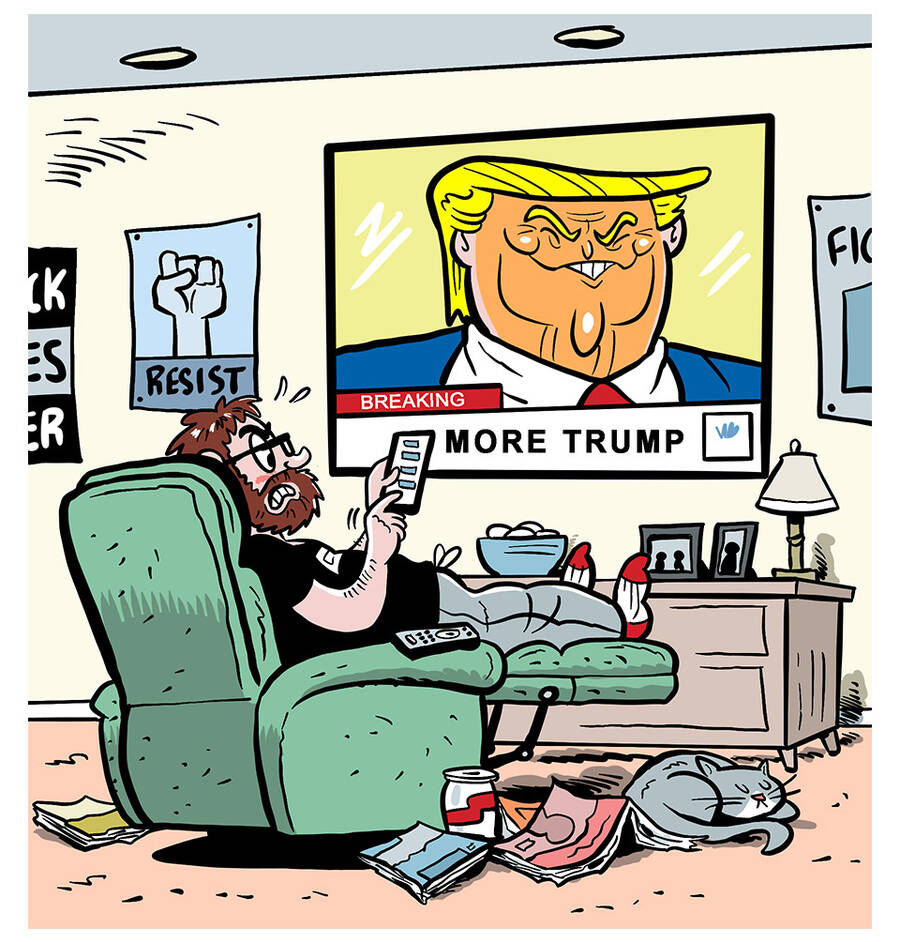
po • lit • i • cal hob • by • ism
noun
1. The act of leisurely reading about politics for the purposes of, say, online
debates and armchair discussions, rather than actively working for change.
“What [political hobbyists] are doing is no closer to engaging in politics than watching SportsCenter is to playing football.” —Eitan Hersh, Political Science Professor at Tufts University
So I shouldn’t read the news?
Read the news! But we often treat reading the news as a form of political participation itself, when it’s at best a gateway to participation. A 2016 study found, for example, that most daily news readers weren’t part of any political group, didn’t go to any political meetings and had never worked with others to solve community problems.
The type of news matters too. Political scientist Eitan Hersh— author of the 2020 book Politics Is for Power: How To Move Beyond Political Hobbyism, Take Action, and Make Real Change—notes that hobbyists tend to focus on national politics while ignoring what’s going on nearby, where they could likely make the most difference.
But being a hobbyist is better than nothing, right?
It depends. Hersh notes how much time being a hobbyist takes — about a third of the respondents in a survey he conducted said they spend two hours reading, watching or listening to news media every day. A Pew Research study from 2010 found that Americans spend 70 minutes on news each day. Some of this time could otherwise be spent knocking on doors, organizing protests and going to community meetings. Hersh also worries hobbyists are more concerned about having “correct” opinions than about understanding one another. Lastly, Hersh argues having so many hobbyists creates a perverse incentive for politicians: They can win elections based on grandstanding sound bites rather than on their actual work.
That seems unfair — don’t hobbyists want change?
In theory, yes. But hobbyists are disproportionately white, college-educated and male — demographics less affected than many others by any policy change. Hersh notes, for example, the college-educated “spend more time on politics than other Americans do — but less than 2 percent of that time involves volunteering in political organizations.” That’s compared with 41 percent “spent mostly in news consumption” and 21 percent “contemplating politics alone.”
So how do I stop being a hobbyist?
Get involved! Attend a meeting about an issue you care about with activists. Volunteer for a municipal election campaign. Talk with your coworkers about forming a union and your neighbors about what the community needs. The good news is that hobbyists are well-informed. Put that information to good use.
This is part of “The Big Idea,” a monthly series offering brief introductions to progressive theories, policies, tools and strategies that can help us envision a world beyond capitalism. For past In These Times coverage of politics in practice, see, “How to Resist, in 6 Books” and “How to Build Fierce and Worker-Centered Unions”.
Dayton Martindale is a freelance writer and former associate editor at In These Times. His work has also appeared in Boston Review, Earth Island Journal, Harbinger and The Next System Project. Follow him on Twitter: @DaytonRMartind.
ZNetwork is funded solely through the generosity of its readers.
Donate
