

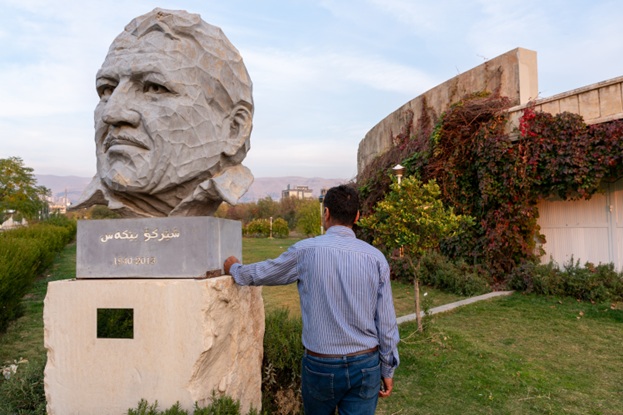
September 16th, 2025 marks the 3rd anniversary of the state femicide of Jina Mahsa Amini, a 22 year old Kurdish-Iranian university student who died in a coma, after she was brutally beaten by Iranian security forces, over an alleged violation of the Islamic Republic’s strict veiling laws for women. Both Amnesty International and Iran International identified eye witness reports that confirm Jina Mahsa Amini was beaten while in police custody. Medical imaging and doctors reports confirmed she died as a result of being beaten. Her killing sparked the largest and most sustained protests in Iran, since the 1979 Revolution that established the Islamic Republic. This decentralized protest movement never had a single unanimously agreed upon name, and it has been variously referred to as the “Jin, Jiyan, Azadi movement”, and the “Jina Revolution.” The slogan “Jin, Jiyan, Azadi” is Kurdish and means “Woman, Life, Freedom” in English. The slogan itself has a long history in the Kurdish Freedom Movement. It was first articulated by Abdullah Öcalan, one of the founding members of the militant left-wing Kurdistan Workers’ Party (PKK). And the slogan was used widely during the 2008 International Women’s Day protests in Turkey. While mass protests in Iran have since subsided, and international media attention shifted focus, issues concerning oppression of women and ethnic minorities, as well as class inequality remain significant issues in the daily lives of Iranians.
What follows contains an interview with one of the early organizers of the protests, and includes his not previously published account of how the protests were first organized and how the protest movement became the largest and most sustained social protest movement in the history of the Islamic Republic. I interviewed this organizer and activist in Sulaymaniyah, a city in Kurdistan Autonomous Region of Iraq, after he fled persecution in Iran. The central feature that led to the mass mobilizations of Iranians is that the issues cut across ethnic lines, and mobilized all sectors of Iranian society. Whereas, in the past, the various ethnic groups within Iranian society did not join together in mass protests. It was the Jin, Jiyan, Azadi Movement that brought all Iranians together in one mass movement. “All of Iran spoke with one voice,” explained a leader of the Democratic Party of Iranian Kurdistan (KDPI), once one of the most militant insurgent organizations involved in armed struggle against the Islamic Republic of Iran. But, since the Jin, Jiyan, Azadi movement, the KDPI advocates for non-violence and civil protest as a means of social and political change.
The following text comes from an interview I had with a 22 year veteran political activist and organizer in Iran, here referred to by the pseudonym Hasan. I met and interviewed Hasan in Sulaymaniyah, a city in the Kurdistan Autonomous Region of Iraq, after he fled Iran. On the day of Jina Mahsa Amini’s funeral, Iranian authorities were already concerned about civil unrest, and they had refused to allow Jina to be buried in her hometown of Saqqez. The authorities sought to control the situation, by not publicizing the location of the funeral and burial ahead of time, in order to limit the potential for protest. However, political organizers were already at work developing their own plans. Hasan made arrangements with someone who had real-time access to the geolocation of the vehicle carrying Jina’s body to the funeral. Hasan then broadcast out the real-time location of the vehicle to his entire activist network. The first location for the funeral was Sanandaj, a Kurdish-majority town. But through the broadcast communication of the movement of the vehicle, more than one thousand people came out in the streets. So, the regime re-directed the vehicle to the city of Tabriz. Tabriz is not a Kurdish-majority city, and the authorities believed that by having the funeral in a non-Kurdish majority location would minimize protest potential. But, it was in Tabriz that the first indication of the multi-ethnic alliance that would become the Jin, Jiyan, Azadi movement first became apparent. The majority of Tabriz are ethnic Azerbaijanis, a Turkic ethnic group. And, in Tabriz, one of the largest cities in Iran, thousands of ethnic Azerbaijanis took to the streets. It was the first time that social protest crossed ethnic lines in this significant way in Iran and it was the first evidence that the protest over the killing of Jina Mahsa Amini would lead to a large-scale national movement. When thousands of protesters gathered in Tabriz, the regime again re-directed the vehicle. But, by that time, the regime was running out of time, and they re-directed the vehicle to Saqqez, Jina’s hometown, for the funeral. Hasan was present at her funeral, and estimates some five thousand people attended the funeral. He recalls people wrote “Jin, Jiyan, Azadi” on her headstone. Following Jina Mahsa Amini’s funeral, protests erupted across Iran.

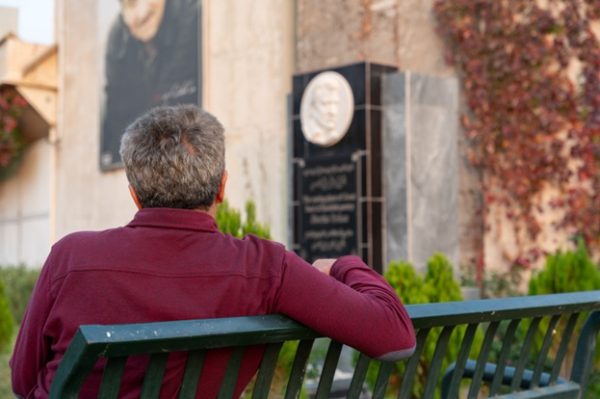
From interviews with participants and organizations directly involved in the movement, the most important aspect for mobilizing so many people was the fact that the grievances and issues motivating the protests were shared across all sectors of society. Whereas, in the past, issues mostly affected one group in society, and protests largely never cut across ethnic lines. But, in the Jin, Jiyan, Azadi movement the underlying issues were experienced by all components of Iranian society. The hijab laws were only popular among the most religious conservatives and many people opposed them. There was also a strong class-based component to the protests as well. Iran, and especially in Kurdish-majority regions experience extreme poverty. The confluence of class and social issues that affected Iranians across ethnic lines provided the grounds for the mass mobilization of protest.
In addition to the multi-ethnic participation in the protests, one of the other key factors was the mobilization of students by teachers. The national teachers union in Iran, the Coordinating Council of Iranian Teachers’ Trade Associations (CCITTA), called for an immediate strike. With students not going to school, they could get out and protest. In this way, students and teachers became the first major segment of Iranian society to create the mass protest movement. Once the Iranian regime students were the focal point in the new movement, the regime began targeting teachers. Hasan was arrested and held in solitary confinement for 50 days. After he was released from jail, he fled Iran.
The protests of the Jin, Jiyan Azadi movement stand as the largest nation-wide mass protest movement in Iran since the 1979 Revolution. While no official statistics exists, eye witness reports from participants indicate that as many as two million people took to the streets in Tehran alone during the protests. Protests occurred in over 150 cities across Iran. These widespread mass protests led to a severe and brutal crackdown by Iranian authorities. More than 19,000 people were arrested during the protests. The UN Fact Finding mission reported 551 people were killed by Iranian regime forces during the protests. The Iranian regime carried out mass public executions which were condemned by the international community. Amnesty International in its report found evidence of “grossly unfair trials.” Because of the extend of persecution and repression by the Iranian authorities, many protesters fled Iran. I interviewed a 19 year-old who joined the protests because he saw young people were leading the movement and he wanted to contribute his voice. This young man, here called Soran, was shot twice and lost one of his kidneys by Iranian security forces. He was arrested and beaten in prison so badly he was also rendered into a coma. Luckily, he survived and his friends and family smuggled him out of Iran. Like Hasan, I met and interviewed him in Sulaymaniyah. I also met and interviewed several young women who also fled Iran after facing persecution for their participation in the protests. When the fled Iran, they joined armed insurgency groups involved in armed struggle against the Islamic Republic.
Jina Mahsa Amini was posthumously awarded the European Union’s highest human rights recognition, the Sakharov Prize for Freedom of Thought, in 2023. The prize was given to her and the Jin, Jiyan, Azadi movement she inspired. Iranian authorities confiscated the passports of Jina Mahsa Amini’s parents and brother and prevented them from traveling to France to receive the award. The family’s lawyer, Saleh Nikbakht, was able to travel and received the award on their behalf.
The Jin, Jiyan, Azadi movement has forever changed the landscape of social protest movements in Iran. Now the entire people have seen that organizing can occur across ethnic lines and across all sectors of society. Organizations like the Democratic Party of Iranian Kurdistan and the Komala of Iranian Kurdistan are already working with labor, women’s rights groups and all of Iran’s varied ethnic groups to create broad-based social, political and economic change in Iran.
ZNetwork is funded solely through the generosity of its readers.
Donate
