


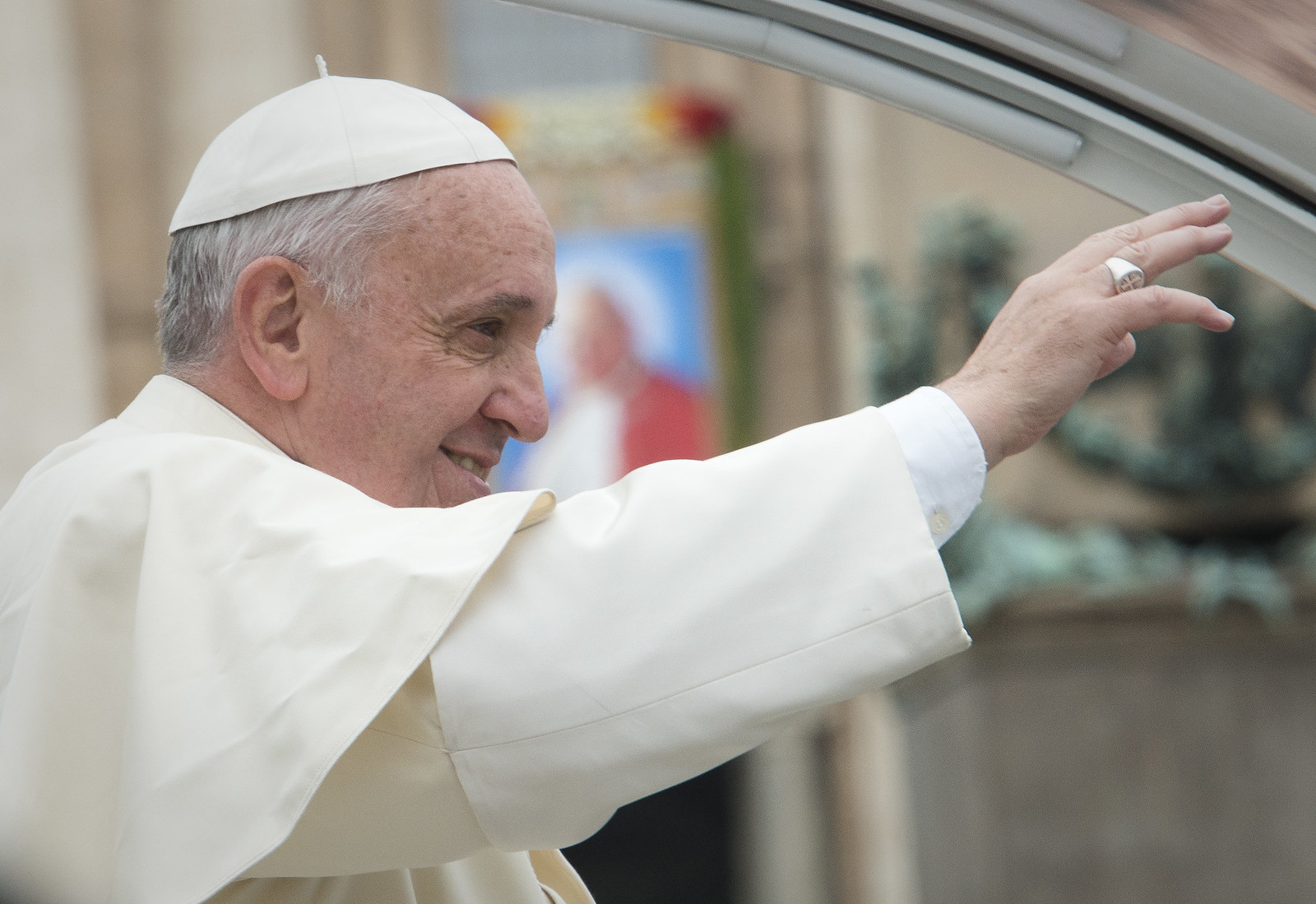
In 2022, Pope Francis created a will expressing his desire that just one word be inscribed on the stone marking his burial place: Franciscus.
Franciscus, Latin for Francis, is the name Jorge Mario Bergoglio chose when, twelve years ago, cardinals elected him to become the Bishop of Rome. He sought union with Saint Francis, known as one who lived on the margins, who discarded his worldly clothes, and who kissed the lepers. Pope Francis longed for “a church that is poor and is for the poor.” He recognized, as Bishop Robert McElroy once expressed it, that “too much money is in the hands of too few, while the vast majority struggle to get by.”
As the spiritual leader of the world’s 1.4 billion Catholics, Pope Francis unified people of different generations. He encouraged genuine love for humans—“Todo, todo, todo.” Or, as the Reverend Martin Luther King Jr.’s personal physician, the late beloved Chicagoan Dr. Quentin Young would often say, “Everybody in, nobody out.”
Pope Francis exhorted people to set aside the futility of war and to always care for those who bear the worst brunt of war, particularly the children. His were the words of a man whose heart aches for children who are being punished to death, sacrificed by powerful people whose lust for greed and power overcomes their capacity for compassion.
“Yesterday, children were bombed,” Pope Francis said in his final Christmas message last December. “Children. This is cruelty, this is not war.” He added, touching the cross he wore around his neck, “I want to say this, because it touches my heart.”
Pope Francis was speaking about the children of Gaza, who have been orphaned, maimed, sickened, starved, forcibly displaced, traumatized, and buried under fire and rubble. In excerpts from the book Hope Never Disappoints. Pilgrims Towards a Better World, published in November 2024, he was blunt about Israel’s accountability, writing: “What is happening in Gaza has the characteristics of a genocide. It should be investigated to determine whether it meets the definition formulated by jurists and international bodies.”
On Easter, the day before his death, Pope Francis expressed in a written message: “I appeal to the warring parties: Call a ceasefire, release the hostages, and come to the aid of a starving people that aspire to a future of peace!”
During the current war, beginning in 2023, Pope Francis developed a strong relationship with parishioners of the Church of the Holy Family in Gaza. By holding virtual gatherings with the hundreds of people sheltering in the church, he was able to stay in daily touch with the realities they faced under Israel’s siege and bombardment. On days when he learned that the bombing was particularly heavy, Pope Francis would call to check in on them as many as five times a day.

Pope Francis carried his antiwar message to the seats of power in places around the world. In September 2015, exasperated by the superpowers’ desire to control others through militarism, he posed a simple question to the U.S. Congress: “Why,” he asked, “would anyone give weapons to people who use them for war? . . . The answer is money, and the money is drenched in blood.”
Pope Francis emphasized the stewardship so vitally needed for future generations to have a habitable planet, sounding an alarm about the need to address climate change. “The world in which we live is collapsing and may be nearing the breaking point,” he stated in a magisterial document released in October 2023. “Despite all attempts to deny, conceal, gloss over, or relativise the issue, the signs of climate change are here and increasingly evident.”
The Pontiff likewise denounced the use of atomic energy for the purposes of war, and declared possession of nuclear weapons to be immoral, asking: “How can we speak of peace even as we build terrifying new weapons of war?”
In accordance with his wishes, Pope Francis will be buried in a basilica dedicated to the Virgin Mary, a place he went to pray before and after each of his forty-seven “apostolic missions.” The Basilica of Saint Mary Major is located in one of Rome’s poorer neighborhoods, a church in a neighborhood with refugees. Francis has entrusted himself to the protection of Mary, the mother of Jesus.
I’d like to think that those words, “Todo, todo, todo,” will break down the barriers creating illusory divisions between us, leading us toward true egalitarianism, embracing Earth and one another, grateful always for the chance to “choose life, so that you and your descendants can live.”
Beloved Franciscus, “Oremus.” Let us pray.


Kathy Kelly (born 1952) is an American peace activist, pacifist and author, one of the founding members of Voices in the Wilderness, and, until the campaign closed in 2020, a co-coordinator of Voices for Creative Nonviolence. As part of peace team work in several countries, she has traveled to Iraq twenty-six times, notably remaining in combat zones during the early days of both US–Iraq wars. From 2009 to 2019, her activism and writing focused on Afghanistan, Yemen, and Gaza, along with domestic protests against US drone policy. She has been arrested more than sixty times at home and abroad, and written of her experiences among targets of US military bombardment and inmates of US prisons.
ZNetwork is funded solely through the generosity of its readers.
Donate




