


Let’s start with two elementary precepts relating to the proper role of the media in a democratic society. First, key media personalities in such a society should never lie to the people, whose capacity for making intelligent and informed policy and voting choices is damaged by dishonest, deceitful or disingenuous reportage and commentary. Second, such personalities should be reasonably well informed about the subjects upon which they report and comment.
These precepts are especially relevant where media ownership and control structures and other social and political factors are such that the public tends to rely on a few sources of information. Such is the case in the United States, where less than 9 corporations own more than fifty percent of all media (including both print and electronic) and people suffer the longest working and commuting times in the industrialized world.
Consider, then, the small but revealing case of long-time CBS news chief and anchorman Dan Rather and the lady who called him on Larry King Live two nights ago. Rather, it should be noted, has long been sold by CBS as the model of modern broadcast integrity – the anchor you can “trust.” He is the official corporate stepson of television news icon Walter Cronkite, who was once voted “the most trusted man in America.”
What, the caller wanted to know, is the reason for rampant voter apathy in the US? Is it getting worse? What, she asked Rather, can we do about it?
These are good questions, especially in light of yesterday’s mid-term Congressional elections, in which just 39 percent of voting-age citizens participated. Less than half the American electorate bothers to cast ballots even in the quadrennial presidential elections. This incredibly weak voter interest enhances the disproportionate political influence exercised by highly organized pressure groups representing special interests. Consistent with yesterday’s results, it enhances the already exaggerated influence of rich and middle-class people, who are far more likely to vote than the mass of poor and ordinary working folks.
Too bad the highly awarded anchorman’s answers weren’t up to speed. After accurately reporting that low turnout has become more pronounced over time, Rather threw up his hands in befuddlement. He claimed that he simply couldn’t come up with any good explanations or solutions beyond suggesting the holdings of elections on weekends (thereby eliminating the conflict between working and commuting and voting) and a uniform coast-to-coast closing time at the polls (thereby increasing turnout in the Pacific time zone). He concluded that “it will take some very dramatic changes” to increase American voter turnout.
But, as Rather certainly knows, the causes of American voter apathy simply aren’t mysterious. They include first and foremost the widely understood disproportionate influence exercised by concentrated private wealth and power on the candidate selection and policy processes in America, “the best democracy that money can buy.” This is driven partly by harsh economic inequality in the US, where the top 1 percent that owns more than 40 percent of the nation’s wealth and makes more than 80 percent of campaign contributions above $200 possesses vastly greater capacity to fund candidates and demand certain sorts of policies (of the type that tend to defend and even exacerbate that inequality) than the rest of the population.
It is also driven by the extraordinarily high costs of American campaigns, which in turn are driven largely by the corporate media in whose employ Rather so profitably serves. Hugely expensive media advertisements are American candidates’ leading expenditure and the US is unique among industrial states in its refusal to offer free or publicly financed media time to candidates.
It is no accident that the candidate who wins what campaign reformers call “the wealth primary” – the race for private dollars to pay for expensive media buys – tends to win American elections in the great preponderance of cases.
This media- and money-addicted perversion of democracy is deeply enabled by the Supreme Court’s notorious plutocratic ruling that (in essence) “money equals speech.” In the Buckley v. Valeo (1976) decision, the high court determined that campaign expenditure limits violate candidates’ free speech rights, ignoring the basic fact (understood in other industrial democratic states with higher voter turnout) that vast private wealth invested in the political process tends to drown out the positive free speech rights (including the right to actually be heard) of candidates and parties that do not have access to vast private fortunes.
The second key factor is the distinctive winner-take-all character of the American electoral process, which makes it next to impossible for new, small, and alternative parties to challenge the two wealthy wings (Democrats on “the left” and Republicans on the right) of the American Chamber of Commerce Party. When a third party could hypothetically garner, say 30 percent of the vote in every single Congressional race and yet receive absolutely zero representation in Congress, it is hard to muster much energy to challenge the parties that dominate the nation’s leading representative body (ditto for the fifty state legislatures). The Supreme Court’s crassly authoritarian outlawing of fusion (whereby upstart parties not yet ready to field their own winnable candidates could put their own party label next to a mainstream candidate’s name on ballots) and the refusal of state and federal government to enact instant runoff election procedures (whereby a mandated follow-up majority choice election of the top two candidates in every race where no candidate polls a pure majority would permit third parties to escape the “spoiler” label and would compel the leading two candidates to recognize third/fourth party issues to attain office) further discourage efforts to work outside the two/one party regime.
Without such work, it is difficult, given the emptiness of the prevailing system’s commitment to substantive democracy, to recruit and activate citizens to engage the political process.
Also worth noting, it is considerably more difficult to vote in the US than in other democratic nations. Unlike their counterparts in most such states, for example, Americans are not automatically registered to vote at their home address by the local government.
Beyond the government’s revealing failure to designate election days holidays, one of the most relevant barriers (it swung the 2000 presidential race in Florida) relates to criminal justice policy. Currently 46 states prohibit prison inmates from voting while serving a felony sentence, 32 states deny the vote to felons on parole and 29 states disenfranchise felony probationers. Ten American states deny voting rights for life to ex-felons.
This is a matter of no small democratic concern in a nation that leads the world in mass incarceration and where an estimated one in five adult males, including one in three black males, is an ex-felon. As a result of felony disenfranchisement, 13 percent of all Black men in the US have lost their electoral rights – “a bitter aftermath,” notes British sociologist David Ladipo, “to the expansion of voting rights secured, at such cost, by the freedom marches of the fifties and sixties.”
Thanks to these and a host of related factors including the at-once Orwellian and Huxlean content of corporate media, which leaves the nation’s consumer-citizens shockingly ignorant of candidates’ policy positions, American political contests are ideologically bland, boring, petty, trivial, personality-centered and negative. They tend towards a neutered privilege-friendly consensus that discourages passionate popular involvement on the part of the non-privileged majority. Among a large number and percentage of Americans, the basic sentiment is that politics are both irritating and irrelevant to their lives. Citizens (or ex-citizens) increasingly believe, with no small justice, that there is no significant difference between the parties. For many, especially those without a lot of money, “one person, one vote” is an American myth and making the trip to the voting booth on any day of the week is a waste of their scarce time.
Meaningful campaign finance reform including publicly financed elections and free media time for candidates and the introduction of proportionate representation and other measures enabling third and fourth parties (instant run-off, fusion, etc.) are the surest paths to the increase of voter interest and turnout in America. Media reform, including media de-concentration and the empowerment of alternative non-corporate media, would also go far to reinvigorate democracy and therefore voter interest. So would the reduction of America’s unmatched long working and commuting hours, which would free up more time for citizens to become intelligently and substantively engaged in the political process. These are the sorts of things that would immediately merit mention from anyone who was seriously concerned with increasing voter turnout in the US.
These are explanations and solutions, however, that Dan and his fellow multi-millionaires would rather not broadcast to the masses of the “world’s greatest democracy.” All things considered, it is likely that he and his upper-class comrades are content with the low turnout and media-fed inertia and ignorance (willful at elite levels) that scar American politics. For the popular apathy that Rather and other wealthy Americans claim to abhor leaves them in greater command of policy than would be the case if more of us cared to vote. The fact that paid political advertising feeds the overflowing coffers of the corporate media that pays his inflated salary only deepens the logic behind his public befuddlement on how we might reduce widespread voter apathy in the self-declared homeland and headquarters of democracy.
Paul Street is an urban social policy researcher, freelance writer and regular ZNet Commentator based in Chicago, Illinois. His essays, articles, and opinion-editorials have appeared in Z Magazine, In These Times, Monthly Review, The Journal of Social History, Dissent, The Equal Opportunity Journal and the Chicago Tribune. He can be reached at pstreet@cul-chicago.org.

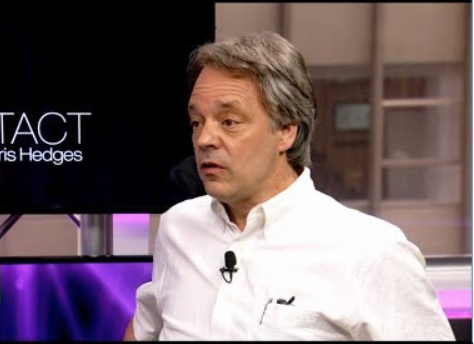
Paul Street is an independent radical-democratic policy researcher, journalist, historian, author and speaker based in Iowa City, Iowa, and Chicago, Illinois. He is the author of more than ten books and numerous essays. Street has taught U.S. history at numerous of Chicago-area colleges and universities. He was the Director of Research and Vice President for Research and Planning at the Chicago Urban League (from 2000 through 2005), where he published a highly influential grant-funded study: The Vicious Circle: Race, Prison, Jobs and Community in Chicago, Illinois, and the Nation (October 2002).
ZNetwork is funded solely through the generosity of its readers.
Donate




