


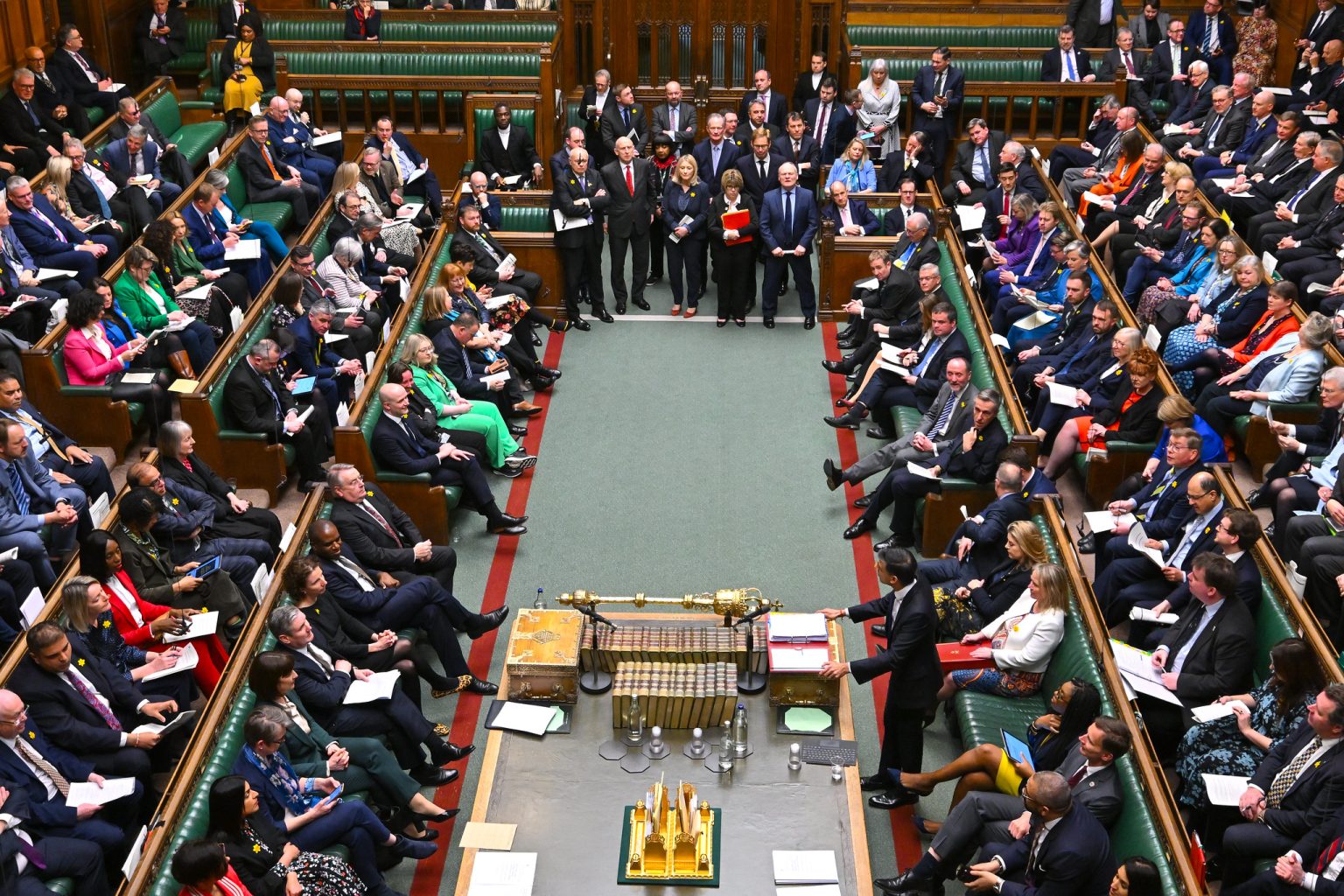
Parliament has been accused of an “outrageous abuse” that is “worthy of the Trump White House,” after blocking Declassified UK from holding a media pass.
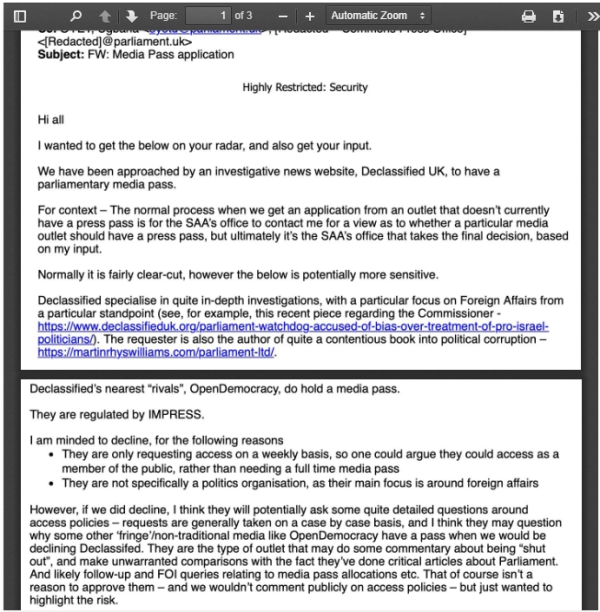
Internal emails reveal that officials cited our “in-depth investigations… from a particular standpoint,” when rejecting our application.
They also flagged a recent investigation Declassified published that raised concerns over pro-Israel bias in Westminster.
This is despite parliamentary authorities having a duty to remain politically impartial. Guidelines say that passes should be granted with “fair access across a range of outlets.”
The decision to deny Declassified access has been criticised by politicians across the political spectrum, including Labour, the Green Party, Plaid Cymru, and the Independent Alliance.
Almost 500 journalists currently hold a pass, which provides unfettered access to Westminster and daily government briefings. They include many from right-wing outlets like Guido Fawkes and GB News.
When Declassified’s application for a pass was first rejected, officials blamed space and capacity “due to limitations within the Parliamentary estate.”
But documents released under the Freedom of Information Act now reveal there is no limit to the number of press passes that can be issued – and capacity was not even discussed as a consideration.
In fact, at least three other journalists have been granted parliamentary passes since Declassified’s application was rejected.
In a bizarre attempt to justify the ban, documents also reveal that officials claimed Declassified’s focus on U.K. foreign policy does not count as “politics.”
An internal email said: “They are not specifically a politics organisation, as their main focus is around foreign affairs.”

“Outrageous Abuse”
Several politicians condemned the decision by parliament – and warned against “selectively silencing journalists.”
Jeremy Corbyn, the former Labour leader, said: “Declassified have done outstanding, vital work exposing the scale of British complicity in Israeli war crimes.
“A healthy democracy rests on transparency and accountability. What does Britain have to hide?”
Liz Saville-Roberts, the leader of Plaid Cymru, said that parliament “should be proud to make itself open to investigative journalists.”
She said: “The fact that media passes have been denied to certain outlets while others with clear political leanings are approved raises questions about the process of granting parliamentary media passes.”
And Shockat Adam, the Independent Alliance MP for Leicester South said: “The denial of a press pass to Declassified is an outrageous abuse by the parliamentary authorities.
He added:
“The UK has a long history of fearless and frank investigative journalism and Declassified is part of that tradition. The spurious reasons for refusing them a press pass revealed in their Freedom of Information request appears to reveal a sinister move to suppress investigative political journalism worthy of the Trump White House.”
The Labour peer Lord Prem Sikka told Declassified: “The flame of human rights and public accountability is being extinguished in front of our eyes. The authoritarian state is selectively silencing journalists in the march towards fascism. We need critical journalism more than ever before.”
And Ellie Chowns, the Green MP for North Herefordshire and leader of the party’s parliamentary group also condemned the decision, saying: “Press freedom is fundamental to our democracy.
“Decisions on media accreditation should be transparent, based on published criteria, and open to scrutiny so the public can have confidence the rules are applied consistently.”
Meanwhile, the National Union of Journalists responded to our findings saying: “The UK government should recognise the importance of supporting greater media plurality in which diverse views and voices from across the media landscape and political spectrum are represented.”
The union’s general secretary, Laura Davison, added:
“Journalists must be able to hold those elected to represent us to account. Public interest journalism requires adequate scrutiny including of parliamentary processes and decisions, and government has the opportunity to lead with transparency, demonstrating its commitment to press freedom.”
Threats
The decision to reject Declassified‘s media pass application was finalised by the Sergeant At Arms, Ugbana Oyet. But records suggest it was based on
advice from the House of Commons press office, who highlighted the “standpoint” of Declassified’s coverage.
When Declassified sent a “right of reply,” with advance notice of this article, the press office flatly denied the evidence contained in the internal emails. This is despite the fact they were disclosed by parliament itself, under the Freedom of Information Act.
Officials even threatened regulatory action against Declassified if it failed to publish a lengthy and misleading statement from a parliamentary spokesperson.
The statement claimed that decisions around press passes “are not based on an outlet’s editorial stance or coverage of any one issue, and any suggestion to the contrary is wholly untrue.”
And when Declassified said it was not prepared to quote from a misleading statement, parliament’s head of media responded: “We’d expect any outlet to use the full response we provide them – and would strongly dispute any suggestion that the statement provided is untrue.”
He added: “We would be happy to follow up with Impress [the media regulator] if our response is not reflected in your coverage.”
He also claimed thatDeclassified’s article was based on “incomplete material [which] does not reflect the full picture.” However, if this is true, it suggests that parliament failed to fully comply with Declassified’s Freedom of Information request.
The press office proceeded to ignore further questions and provided no further information.
The spokesperson had said:
“The House of Commons supports the work of a free and independent press – providing access and facilities to the Parliamentary Press Gallery. Demand far exceeds capacity here, hence numbers are required to be strictly controlled, whilst ensuring fair access across a range of outlets.
“For applications from an outlet that does not already have a pass, or for a request to increase the allocation given to an outlet, we require a business case to be submitted, details of which are available on our website. Unsuccessful applicants may reapply for a pass one year after their original application, and as Parliament is a public building, journalists are still able to visit, attend and report on proceedings and meet Members without a media pass. Decisions around accreditation are applied consistently across all applications.”
They added: “The range of media outlets currently granted access — spanning the full spectrum of political opinion and including a wide variety of independent and critical journalism — clearly demonstrates that the accreditation process is impartial and rooted solely in operational considerations and editorial relevance to parliamentary proceedings.”
The emails obtained by Declassified strongly suggest this claim is misleading.


Martin is Declassified UK's chief investigator. He previously worked for The Guardian, Channel 4 News and openDemocracy, where he was UK Investigations Editor. His book, ‘Parliament Ltd’, exposed widespread corruption in British politics and sparked multiple inquiries by Westminster authorities. It was described as “ground-breaking” by the Sunday Times, while the New Statesman said the book was “a powerful reminder that reporters can serve the public good”. Martin has published investigations on issues ranging from lobbying and dark money, to espionage and human rights. He has also produced investigations for TV and YouTube, including going undercover. Between 2015 and 2016, he co-presented a live stage show with comedian Josie Long which combined investigative journalism with stand-up.
ZNetwork is funded solely through the generosity of its readers.
Donate




