


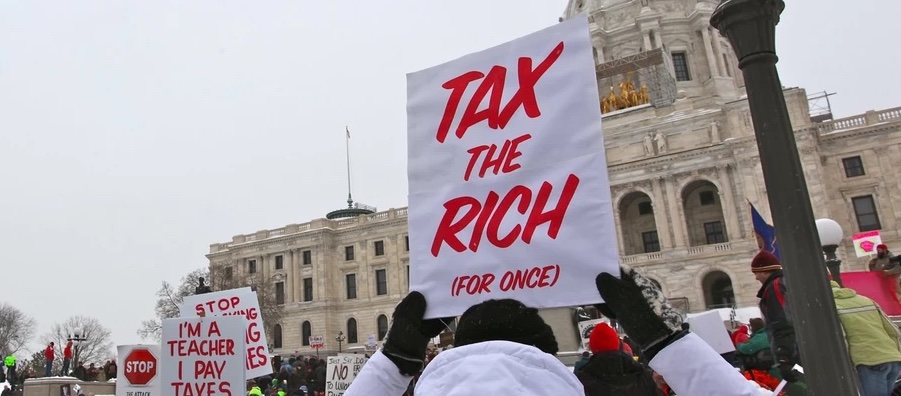
As the deadline for Americans to file federal income tax returns fast approaches, Oxfam America on Friday renewed calls for taxing the ultrarich while publishing an analysis showing America’s growing number of billionaires saw their wealth increase by nearly one-third since the start of the Covid-19 pandemic and by nearly 90% over the past decade.
“Wealth inequality in the U.S. is more extreme and dangerous than income inequality; and we need to change our approach, so we effectively tax wealth as well as income,” the charity said in an introduction to the report, Tax Wealth, Tackle Inequality.
Based on Forbes data, the report found that “U.S. billionaires are almost a third richer (over a trillion dollars, in real terms) than they were at the onset of the pandemic in 2020,” while overall U.S. billionaire wealth has soared 86% since 2013.
The number of U.S. billionaires—of which there are now more than 700—is also nearly 60% higher than it was a decade ago, according to the analysis.
As the report notes:
At the same time, our country has a “permanent underclass” of working families who are denied their economic rights, trapped in poverty, and unable to accumulate wealth no matter how hard they work. Oxfam data shows that almost a third of the U.S. labor force earns less than $15 an hour; half of all working women of color earn less than $15.14.
The racial wealth gap is actually growing wider since the 1980s, and today is close to what it was in 1950. The average Black American household currently has only about 12 cents in wealth for every dollar of the average white American household.
And while the gender pay gap has barely budged in two decades, the gender wealth gap is much wider. One study found a raw gender wealth gap of women owning 32 cents for every dollar of male wealth. For women of color, the gap is even more profound.
“At a time when the ultrawealthy are amassing historic and dangerous levels of wealth, a federal wealth tax offers a vital and necessary tool for directly redressing extreme wealth inequality, as well as advancing racial justice, tackling the climate crisis, and protecting democracy,” Oxfam argued. “It also offers a reminder that today’s debt ceiling gridlock is a consequence of giving tax breaks to the ultrawealthy.”
Oxfam urges Congress and the Biden administration to enact legislation like Sen. Elizabeth Warren’s (D-Mass.) Ultra-Millionaire Tax Act, which would impose a 2% annual tax on the net worth of households and trusts exceeding $50 million, plus a 1% annual surtax on billionaires.
According to an analysis by University of California, Berkeley economists Emmanuel Saez and Gabriel Zucman, the tax would bring in at least $3 trillion in revenue over 10 years without raising taxes on 99.95% of American households worth less than $50 million.
Citing figures from the Institute for Policy Studies and Patriotic Millionaires, Oxfam’s analysis showed that:
- The wealth tax proposed by Sen. Warren, based on taxing U.S. billionaires alone, would raise $114 billion annually—more than enough to pay for reinstating the Child Tax Credit;
- An annual net wealth tax could raise over half a trillion dollars ($582.6 billion) each year, by taxing more than only billionaires and using marginally higher rates: 2% for wealth above $5 million, 3% above $50 million, and 5% above $1 billion; and
- If there had been a net wealth tax of 6.9% since 2013, it would have kept billionaire wealth simply constant.
“Tax Day is a reminder that the tax system isn’t working for ordinary Americans. It’s built to favor the richest in our society,” said Nabil Ahmed, Oxfam America’s director of economic justice. “The ultrawealthy are sitting on mountains of wealth that remain largely untouched by taxes, and their wild riches are in no small part a result of intentional public policy.”
“We need to implement strategic wealth taxes if we want to stand any chance at reining in this kind of Gilded-Era wealth inequality that allows the super-rich to have a stranglehold over our economy,” Ahmed continued.
“Taxing the ultrawealthy is essential to tackle extreme wealth inequality and protect our democracy from the threat of oligarchy—but it is also central to advancing racial and climate justice, connections that we must pay more attention to,” he added. “It’s also clear that political gridlock around the debt ceiling is a consequence of tax cuts on the richest.”


Brett Wilkins is a San Francisco-based writer and activist whose work focuses on issues of war and peace and human rights. He is a staff writer at Common Dreams and a member of the international socialist writers’ group Collective 20. Before joining Common Dreams, he was a longtime freelance journalist and essayist whose articles appeared in a wide variety of print and online publications including Counterpunch, Truthout, Salon.com, Antiwar.com, Asia Times, The Jakarta Post, Alternet, teleSUR, Yahoo News, Mondoweiss, EcoWatch, and Venezuela Analysis.
ZNetwork is funded solely through the generosity of its readers.
Donate




