


* On one day in May, Italy met 87% of its electricity production needs from renewables. This statistic was a fluke, since ordinarily renewables supply less than a fifth of Italy’s electricity. Still, that on especially bright and windy days, the renewables can perform at this level is a harbinger for the future. There were no disruptions of the power lines. With enough investment, Italy could get most of its electricity from renewables
Italy is attractive as a market for solar energy, in part because it is a sunny country and solar is a much cheaper alternative to oil, gas and coal. Italy has high electricity rates, impelling a rush to renewables. Solar energy production was up 22% in 2016, and installations continue.
Renewables like wind and solar are up to 17% of Italian electricity production. (They only account for 10% of US electricity production).
An Italian firm also won the right to install solar panels in Bushehr, Iran. Iran generates some electricity with petroleum, which is a loss since it could be sold on the world market. It thus is interested in renewables. Each kilowatt hour brought to Iran by solar equates with more money that can be made by selling the oil abroad instead of wasting it domestically.
If you want to see the future, you don’t look at existing power generation mixes, you look at source of new power. In 2016, 90% of new power generation in Europe was renewables.
* Off Scotland, the world’s largest *floating* wind farm has been set up, supplying electricity to 20,000 homes. Offshore wind farms are usually sited on islands or use turbines anchored to a shallow underground shelf. These enormous turbines, however, just float. They are and experiment that if successful could be a game changer.
* Spain’s gridlocked right wing government had turned against renewables at one point, but is suddenly back in the game. European Union goals, which require Spain to try to get 20% of its electricity from non-hydro renewables by 2020, are part of the reason. Spain will easily reach the goal before 2020, since it already got over 17 percent of its electricity from renewables in 2015. It just let tenders for 5 gigawatts of solar and wind. Spain is a relatively low-carbon country because over a quarter of its electricity comes from hydro and some 28% from nuclear plants. Still about a quarter comes from coal and it needs to replace that dirty, toxic fuel with renewables. Just ot underline here that Spain is on the verge of getting twice as much of its electricity from renewables as the United States.
* France had been a laggard in renewables, depending heavily on nuclear reactors (though to be fair, they are also relatively low-carbon, though the problem of radioactive waste disposal hasn’t been solved). All that is changing with the new Macron government, which wants to have renewables supply a third of French electricity in only 13 years, by 2030. Hence, France just let a bid for 500 megawatts in solar installations.
* Telengana State in south India has plans to have solar panels power all 3,000 mosques and the many thousands of Hindu temples in the state. I always say, if you are a religious institution and you don’t have solar panels on your place of worship, you are getting your electricity from Satan.
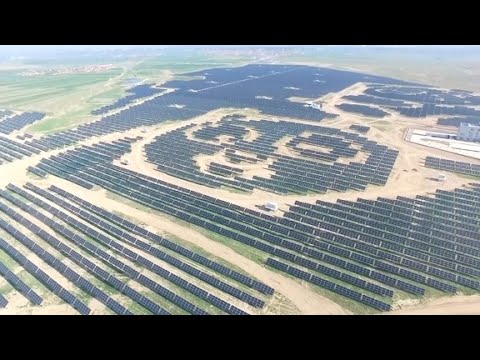
* The internet has gone gaga about China’s “ultra-adorable panda-shaped” 100 megawatt solar energy farm. Chinese like them too. They are planning to build 100 of them! China installed 34 gigawatts of new solar in 2016–about half of all the new solar power capacity installed in the whole world and twice that of the US last year. China added another 8 gigs in just the first quarter of 2017. China hopes to get a third of its energy from solar alone by 2050 and to phase out coal, currently its major source of electricity production, as quickly as possible.
————-
Related video:
CNNMONEY: ” China’s huge panda-shaped solar farm”


Juan R. I. Cole is Richard P. Mitchell Collegiate Professor of History at the University of Michigan. For three and a half decades, he has sought to put the relationship of the West and the Muslim world in historical context, and he has written widely about Egypt, Iran, Iraq, and South Asia. His books include Muhammad: Prophet of Peace Amid the Clash of Empires; The New Arabs: How the Millennial Generation is Changing the Middle East; Engaging the Muslim World; and Napoleon’s Egypt: Invading the Middle East.
ZNetwork is funded solely through the generosity of its readers.
Donate




