

The US prison population has exploded over the past few decades, creating the modern era of mass incarceration. But what’s less well-known is that the current incarceration rate isn’t just higher than what came immediately before it — it’s drastically higher than at any other time in American history.

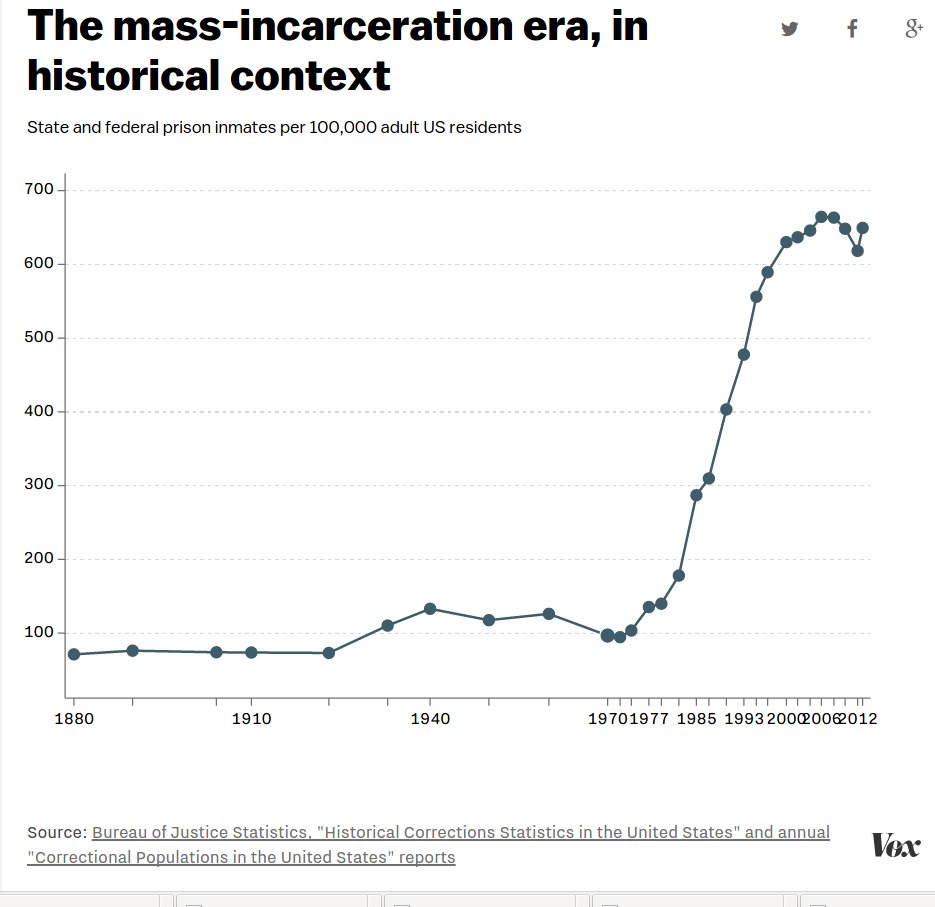
This chart is based on the number of people in state and federal prisons, per 100,000 adult US residents at the time. That’s one major way the incarceration rate was measured during the early 20th century. (Unfortunately, the government wasn’t as consistent in recording the jail population, so that’s not included here — but rest assured that there are a lot more people in jail than ever before, as well.)
Recently, the government has stopped reporting the incarceration rate this way: partly because it’s better at recording how many people are in jail, on probation, or on parole as well as in prison, but partly because the incarceration rate is so damn high that it’s better expressed as a percentage — X per 100 — than as X per 100,000. We calculated the prison rate in recent years by dividing the Bureau of Justice Statistics’ stats for state and federal prisoners by its estimate (and the Census Bureau’s) of adult US residents.
Imprisonment rates went down in the 1970s — but not by much
This matters because it helps us understand the relationship between mass incarceration and the crime explosion that happened in the 1960s and ’70s. Supporters of tough-on-crime policies (and some historians) think it’s myopic, or even dangerous, to focus too much on the past few decades — a time of rising incarceration and falling crime — and forget what was going on just before then. In the 1960s and early ’70s, they point out, crime was going up, but incarceration rates were actually falling. The implication: The US was way too soft on crime in the 1960s, and the ensuing decades were just a reaction to that.
David Frum, for example, draws a simple lesson from this: In the 1960s we were doing something wrong, and now we’re doing something right. We’d better not make too many changes to the criminal justice system until we can be sure they won’t affect crime rates.
Other observers take a slightly different approach: that there’s a happy medium between the declining incarceration/rising crime of the 1960s and the high incarceration/low crime of today. But both of these conclusions rest on the idea that the 1970s were a uniquely “soft on crime” era.
But this chart shows just how small, relatively speaking, the decline in imprisonment really was.
At the time, going from 120 to 100 prisoners per 10,000 adult residents probably seemed like a significant drop. But it was still within the range the imprisonment rate had been in for the past several decades — and still higher than it had been during the end of the 19th century and the beginning of the 20th. The rise in imprisonment during the 1980s and 1990s, on the other hand, was totally unprecedented. It dwarfed the drop in imprisonment of the Johnson and Nixon eras. And while it stabilized during the 2000s and has dropped (slightly and unevenly) during this decade, we’re still in a uniquely carceral period in American history.
ZNetwork is funded solely through the generosity of its readers.
Donate
