

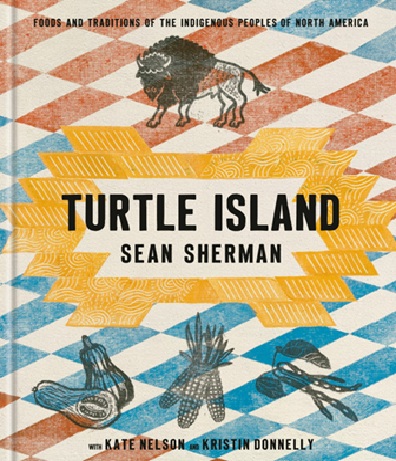
One of my favorite parts of researching The Gastro Obscura Cookbook is talking to leaders in the food world about the recipes that matter most to them. When it comes to Indigenous food of North America, few experts rival Sean Sherman. An Oglala Lakota chef raised on the Pine Ridge Reservation of South Dakota, Sherman has devoted his career to studying and promoting Indigenous cuisine.
From his Minneapolis restaurant, Owamni—which focuses on native ingredients and eschews post-colonial additions like dairy, wheat flour, sugar, and pork—to his first cookbook, The Sioux Chef’s Indigenous Kitchen, Sherman has made it his mission to showcase the bounty of Indigenous foodways.
But his latest project is probably his most ambitious: Turtle Island, a cookbook covering the cuisines of Indigenous communities across North America (known as “Turtle Island” to many Indigenous tribes). From Maya turkey pibil of the Yucatán Peninsula to Yurok hot-smoked salmon of Northern California, Sherman’s book covers an impressive swath of Indigenous culinary diversity.
I recently spoke with Sherman about his new book, his mission, and the recipe that he believes best embodies Indigeneity. Here’s an excerpt of our conversation.
Sam O’Brien: I’d like to start by talking about Turtle Island, which is impressively ambitious in its scope. You’re tackling all these different regions and communities. Can you talk about the process of making it?
Sean Sherman: The vision was to showcase all this Indigenous diversity that’s still very much alive, erasing these colonial construct borders and looking at this tapestry of diversity. I wanted to create something that wasn’t out there for people as a resource because a book like this didn’t really exist.
It felt like a continuation of my work because The Sioux Chef’s Indigenous Kitchen was a much smaller project. But that book was really just laying out the initial philosophy of how I was going about approaching Indigenous foods in today’s world and restructuring things, removing fry bread, removing all colonial ingredients like dairy and wheat flour, cane sugar, and beef, pork, and chicken, and just focusing on how you identify and cook what’s regional and Indigenous, and still paying homage to a lot of the tribes and their traditions.
So with this book, I wanted to go a little bit bigger, and I wanted to see the connection of Indigenous peoples everywhere, whether you’re Indigenous in Southern Mexico or Northern Alaska or the middle of the United States.
SO: Speaking of that vast diversity, did you learn anything in terms of how the food you grew up eating compares to other communities around North America?
SS: I didn’t grow up with a lot of Indigenous foods, like many people in tribal communities. We grew up in segregated communities as reservation systems. A lot of us grew up with commodity foods from the government, with canned vegetables, meats, and fruits, and empty white carbs like powdered milk and sugar. It’s created health epidemics in tribal communities.
A lot of this work about food sovereignty is bringing an understanding of our own foods back to us. We can work on rebuilding our food systems, not be reliant on government food programs that have made us really sick, and bring a lot of pride and connection back to our ancestors.
But envisioning this future means not being stuck in the past and making a couple of recipes or just adopting fry bread, but looking at so much more. Most of the recipes [in the book] were built with a future in mind because we weren’t trying to recreate the past. There’s a handful of traditional recipes in the book, but most of them are just interpretations of what we can do moving forward. To me, this is a futurist book of just looking at what would happen if we included the Indigenous perspective on our food systems and we could really showcase so much vast diversity in the regionality of our foods everywhere.
SO: Speaking of commodity foods and colonial ingredients, in Turtle Island, it’s striking to see the contrast between how you talk about your experience eating the commodity foods that were forced on you and how you talk about eating Indigenous foods at community gatherings. It’s so vivid reading about foods like wóžapi [a berry sauce] and tȟaníǧa [a bison or beef intestine soup]. How often were you able to eat foods like that growing up?
SS: We had wóžapi a few times a year. It was typically special, like holidays or birthdays. We would harvest the chokecherries as kids in the summer, and then my grandmother would make big batches of it, and we’d use it here and there. We also had a handful of foods like the tȟaníǧa, the intestine soup, like the thíŋpsiŋla [also known as “prairie turnips”].
So there were a handful of recipes that survived. I didn’t have to go far back into history because this was just my grandparents’ generation that was the first generation stripped away from all their stuff. Because my grandparents were born at the beginning of the century, they grew up speaking Lakota first, but they’re one of the first generations to be pushed through boarding schools and cut their hair, learn Christianity, and just be stripped away with what it meant to be Lakota.
But a lot of Lakota culture has been very strong and survived. We still have a lot of music. Our language is strong. Our stories are strong. But food was missing. So this work was really just trying to figure out why it was missing and what can we do to bring it back.
SO: I know it’s hard to pick one, but are there any recipes from Turtle Island, The Sioux Chef, or your restaurant that you think especially embody the story you’re trying to share with the world?
SS: I feel like different readers, especially if you’re from Indigenous backgrounds, will connect with different recipes from different regions. But for me, there’s a recipe called pápa waháŋpi, and it’s a dried bison soup. It’s a really traditional-style recipe, but to me, it tasted so much like home. You have the thíŋpsiŋla, the prairie turnips, from the Great Plains and the Dakotas, and a simple mushroom broth and the dried bison. It was just a really simple soup, but it had so much character to me, and it really spoke to home. It just connected to my soul.
SO: I’d love to make it. I know where I live, in Philadelphia, it might be hard to track down an ingredient like prairie turnip. Is it okay to make substitutions?
SS: Yes. And we offered some substitutions in the book of what people can do to at least try to mimic it. But some of these will be very special, and that’s just the way it was designed. When we wrote this book, the publisher knew that not everybody was going to be able to make every recipe. We don’t have to have instant access to everything because you’re not going to find thíŋpsiŋla in the market. You’re not going to find javelina [wild boar] at your local Whole Foods, and you’re probably not going to find seal meat at Target. Some of these recipes are special; you might need to be in the right region at the right time with the right group of people to experience them.
SO: I get that. In some ways, the book is a reference that’s telling a story, not just being like, Oh, you have to make this specific recipe. It’s educational in a very beautiful way.
SS: Yeah. That’s what it was meant to be, to use the power of the language of food to talk about some really important things. And some of these are difficult histories. Some things we don’t learn because we grew up in America. We don’t learn about American history, except through an obscured colonial viewpoint at best. And so there’s so much to talk about everywhere, and there’s so much connection that Indigenous peoples have that they’ve had to go through. And so food is a really great way to be able to convey a lot of that knowledge.
This interview has been edited and condensed for clarity.
ZNetwork is funded solely through the generosity of its readers.
Donate




