


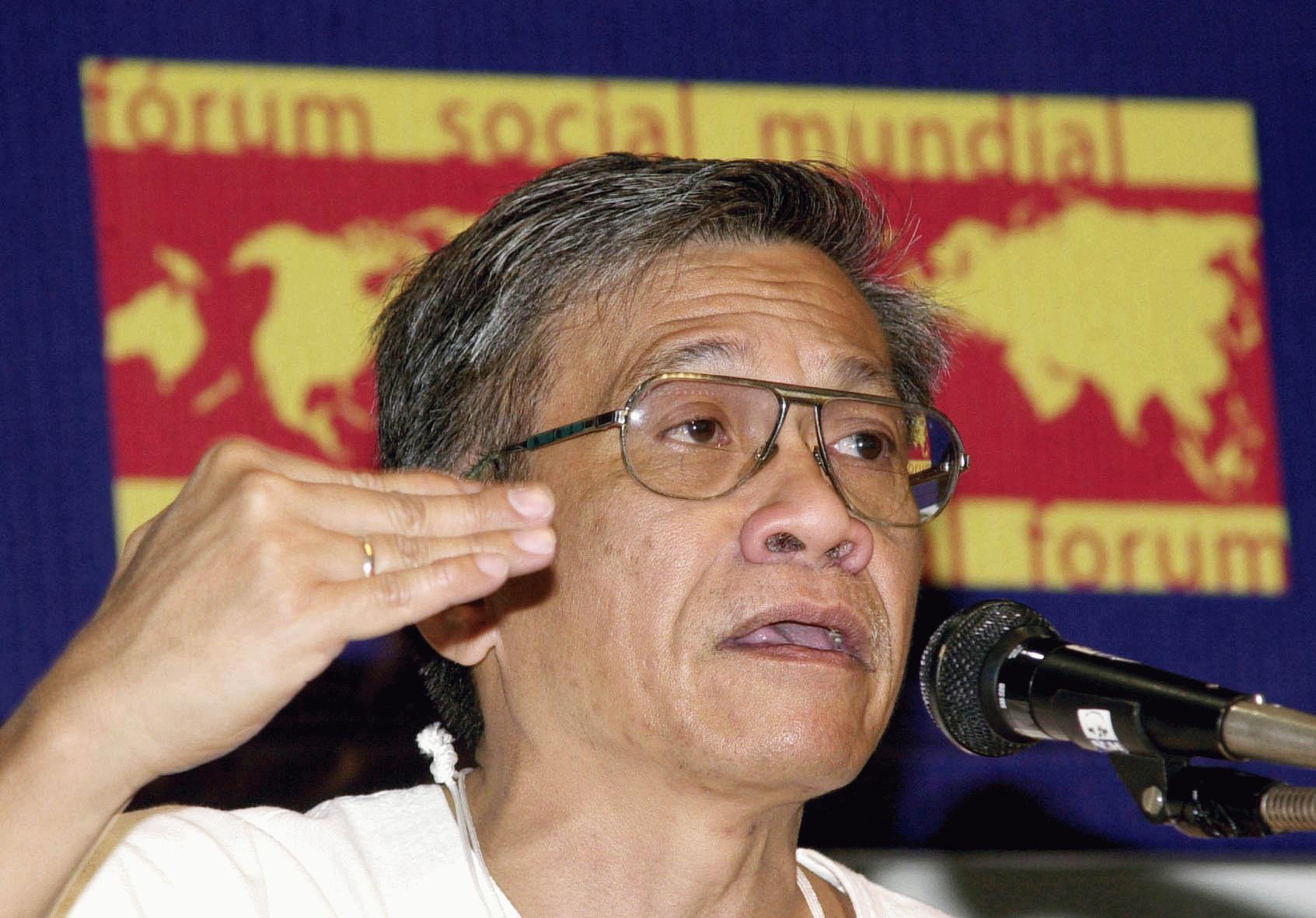
Global Battlefields: Memoir of a Legendary Public Intellectual from the Global South
By: Walden Bello
Clarity Press, 2025
Walden Bello has long been one of the Global South’s most important intellectual and activist figures. His written output has been prodigious, featuring heavily researched works on development economics, war and peace, and social justice. At the same time, he has led countless protests, been a prolific speaker, organized numerous public spectacles, obtained and released internal classified documents, testified before government committees, and debated all manner of opponents on behalf of a multitude of good causes.
In this autobiography (given the unfortunately rather pompous subtitle “memoir of a legendary public intellectual”), Bello describes both his intellectual and his activist contributions, offering some reflections on the relation between the two and the interaction of these with his democratic and humanistic values. In a touching chapter, he relates the story of his wife’s unsuccessful battle with cancer. And in a moving final section he grapples with the question—as so many of us of a certain age do—of the legacy of his political engagement.
From his first major research project—on political dynamics in Allende’s Chile—he found that the simplifications of left analysis don’t always correspond to reality. That the overthrow of the Popular Unity government was fully attributable to U.S. intervention has long been an article of faith on the left; Bello found, however, that it was not just CIA machinations, but a reluctance of the left to try to address the disaffection of the middle classes that led to the disaster.
Bello was in the United States when martial law was declared in his native Philippines, and he became a leader of the anti-Marcos movement. He led two Washington, DC, human rights lobbying organizations, co-authored a major report on U.S. military aid to the dictatorship and an exposé of how the World Bank helped in propping up Marcos, and revealed a significant classified State Department document showing U.S. thinking on the future of the regime.
After the fall of Marcos, Bello worked as executive director of Food First and then founded and led Focus on the Global South, leading anti-globalization organizations. In 2009 he was elected to the House of Representatives of the Philippines as a party list representative for the left-wing Akbayan political party, where he championed women’s rights, the protection of exploited overseas workers, and land reform. He resigned from his seat in 2015 over the failure of the government—with which his party was in coalition—to adhere to its anti-corruption pledge and take responsibility for a botched police operation. (He notes that this was the only resignation on principle in the history of the Philippine Congress.) He later ran unsuccessfully for vice-president as part of a new left-wing formation. And he has continued working for progressive causes in the Philippines and for social justice on a global scale.
There are two aspects of this memoir that raise questions for me. First is Bello’s relationship to the Communist Party of the Philippines (CPP). Bello tells us that he was a secret member of the party from 1974 to 1989, but he is by no means a CPP apologist. He had grown increasingly critical of the party, disillusioned with “Marxism’s lack of appreciation for individual rights.” He documented and harshly condemned a Stalinist purge in the party in the mid-1980s in which several thousand members were killed at the orders of the party leadership. And he sharply criticized the party’s decision to stand aside when Marcos was overthrown by a popular uprising in 1986, thus absenting itself from the crucial moments of the struggle it had been part of for decades. If these disagreements were not enough, in 2004 the party put out a list of people it accused of being “counter-revolutionary,” including Bello. This was not just sectarian rhetoric—some of those listed had already been assassinated by party operatives. Bello and an ally responded by publicizing the hit list and mobilizing public opposition to CPP thuggery. Hugo Chávez was one of the figures of the international left expressing concern for Bello’s safety, making it difficult for the CPP to go ahead with its plans. Bello’s subsequent political activities in the Philippines involved working with left parties of a democratic socialist orientation, pursuing electoral change, supporting agrarian reform and labor rights, but also women’s, LGBTQ, and indigenous rights, and environmental justice.
So the gap between Bello and the CPP is massive. Nevertheless, despite these deep differences, one of the four people or groups of people to whom Bello dedicates his book, astonishingly, is Jose Maria Sison, the founder and leader of the CPP. He calls Sison “a towering figure despite our differences.” But it is hard to understand how the differences can so easily be set aside. Sison presided over the mid-1980s party purge that Bello decried. And “it is impossible,” Bello writes, that Sison “did not have anything to do with my designation as an enemy of the people.” How then could the book be dedicated to him?
Bello’s memoir reprints the bulk of a lengthy article he published in January 1986 (when he was still a party member) praising Sison’s strategic judgment and the CPP’s internal democracy (the party is “said to enjoy a vibrant inner party democracy that would be the envy of other Leninist organizations”).
On the occasion of Sison’s death in 2022, Bello wrote a short obituary, crediting him with playing a key role if not the decisive one in the rebirth of the Philippine Left in the mid-1960s, and calling him “from beginning to end a true revolutionary.” Acknowledging that Sison’s legacy is contested, Bello also reprints a brief critical response to his obituary by Joseph Scalise, a student of the Philippine left, who commented, “No figure in the past half-century was more instrumental in the betrayal of the Filipino working class and oppressed masses than Joma [Jose Maria] Sison.” But Bello doesn’t summarize some of the key evidence Scalice provided in his definitive history, The Drama of Dictatorship: Martial Law and the Communist Parties of the Philippines (Cornell University Press)—and thereby makes Scalice’s criticism seem like simple name-calling.
In 1971, hand grenades were thrown at a Plaza Miranda rally of the Liberal party—the party opposed to then-president Ferdinand Marcos—killing nine and injuring about a hundred. Marcos claimed that communists were responsible for the bombing and he used that as one of his major rationales for imposing martial law a year later. To those of us in the anti-martial law movement, it was beyond obvious that Marcos had been behind the bombing. Scalice, however, has conclusively shown that in fact it was Sison who ordered the attack in hopes of heightening the contradictions in society. Whatever one thinks of Sison’s strategic brilliance, this certainly displayed no concern for democracy (internal or external) or basic morality. Bello cites Scalice’s book in his notes, but he never discusses the Plaza Miranda bombing.
One wonders whether Bello’s experiences and friendships in the CPP during his politically formative years made it personally difficult for him to offer the needed full-throated critique of the party.
The second issue that raises questions for me in Bello’s memoir is his discussion of China. He is certainly not reluctant to criticize China: he describes its system as “state-directed capitalism,” faults its environmental policies, notes its oppression of the Uighur minority, and calls for the people of Hong Kong to have a say in how they are governed (but why not the rest of China’s population?). And he is extremely opposed to China’s policy of claiming as its own all of the South China Sea and its islands, violating the rights of several countries, including the Philippines. Indeed, in 2011 when he was in Congress, Bello introduced a resolution renaming the South China Sea as the West or Western Philippine Sea and delivered a morale-boosting speech to Philippine troops at a flag-raising ceremony on one of the islands. He supported the Philippine decision to file a case against China’s claims with the Permanent Court of Arbitration in the Hague. China refused to recognize the legitimacy of the legal proceedings, but Bello considers that the Philippines won a moral victory in 2016 when the Court ruled that China’s claims were invalid.
At the same time, Bello has remained a committed opponent of U.S. military bases and intervention in the Philippines and in the Western Pacific more generally. He quite rightly calls for the Philippines to pursue a foreign policy independent of the superpowers and aiming toward a demilitarization and denuclearization of the entire South China Sea.
But yet he insists that China’s behavior is “understandable as strategic defensive moves” while that of the United States is aggressive. Such a claim seems problematic on several levels. First, we know that many aggressors have justified their foreign conquests by asserting the need for extended defense (think of the USSR in Eastern Europe or Israel in the Middle East). Second, Chinese military force structure has been increasingly designed for offensive, not defensive purposes, sea control instead of sea denial, building aircraft carriers instead of submarines. Studies of Chinese acquisition, doctrine, force posture, and training confirm that Beijing is not simply acting defensively. (See Rush Doshi, The Long Game: China’s Grand Strategy to Displace American Order [Oxford U.P., 2021].) And, third, U.S. actions, like sailing the 7th Fleet in the Taiwan Strait, are provocative, but hardly less so than China’s live missile launches around Taiwan, military incursions into the island’s air defense identification zone, and frequent large-scale war games.
China, not the United States, seeks to expand its territory in the Pacific. Bello is quite right, of course, that internationally Taiwan is recognized as part of China, but for socialists the self-determination rights of the people of Taiwan trump any historic claims. So, by all means, we should oppose aggressive U.S. actions and support peaceful resolution of conflicts. But it is hard to see why Beijing’s aggressive actions should be deemed “defensive in intent.”
Despite these disagreements, Bello’s contributions to movements for social justice in the Philippines and globally have been extensive, and this memoir provides a valuable summary of his distinguished career.


Stephen R. Shalom (born September 8, 1948) is professor emeritus of political science at William Paterson University in NJ. Among other topics, he writes about U.S. foreign policy and political vision. He is on the editorial board of New Politics and a member of Jewish Voice for Peace and the Real Utopia network.
ZNetwork is funded solely through the generosity of its readers.
Donate




