


Do you agree with the argument that Israel’s military offensive in Lebanon is “legally and morally justified?”
Noam Chomsky: The invasion itself is a serious breach of international law, and major war crimes are being committed as it proceeds. There is no legal justification.
The “moral justification” is supposed to be that capturing soldiers in a cross-border raid, and killing others, is an outrageous crime. We know, for certain, that Israel, the United States and other Western governments, as well as the mainstream of articulate Western opinion, do not believe a word of that. Sufficient evidence is their tolerance for many years of US-backed Israeli crimes in Lebanon, including four invasions before this one, occupation in violation of Security Council orders for 22 years, and regular killings and abductions. To mention just one question that every journal should be answering: When did Nasrallah assume a leadership role? Answer: When the Rabin government escalated its crimes in Lebanon, murdering Sheikh Abbas Mussawi and his wife and child with missiles fired from a US helicopter. Nasrallah was chosen as his successor. Only one of innumerable cases. There is, after all, a good reason why last February, 70% of Lebanese called for the capture of Israeli soldiers for prisoner exchange.
The conclusion is underscored, dramatically, by the current upsurge of violence, which began after the capture of Corporal Gilad Shalit on June 25. Every published Western “timeline” takes that as the opening event. Yet the day before, Israeli forces kidnapped two Gaza civilians, a doctor and his brother, and sent them to the Israeli prison system where they can join innumerable other Palestinians, many held without charges — hence kidnapped. Kidnapping of civilians is a far worse crime than capture of soldiers. The Western response was quite revealing: a few casual comments, otherwise silence. The major media did not even bother reporting it. That fact alone demonstrates, with brutal clarity, that there is no moral justification for the sharp escalation of attacks in Gaza or the destruction of Lebanon, and that the Western show of outrage about kidnapping is cynical fraud.
Much has been said about Israel’s right to defend itself from its enemies who are taking advantage of Israel’s withdrawal from Gaza, thus causing the latest chapter in the Arab-Israeli conflict. Do you agree?
NC: Israel certainly has a right to defend itself, but no state has the right to “defend” occupied territories. When the World Court condemned Israel’s “separation wall,” even a US Justice, Judge Buergenthal, declared that any part of it built to defend Israeli settlements is “ipso facto in violation of international humanitarian law,” because the settlements themselves are illegal.
The withdrawal of a few thousand illegal settlers from Gaza was publicly announced as a West Bank expansion plan. It has now been formalized by Prime Minister Ehud Olmert, with the support of Washington, as a program of annexation of valuable occupied lands and major resources (particularly water) and cantonization of the remaining territories, virtually separated from one another and from whatever pitiful piece of Jerusalem will be granted to Palestinians. All are to be imprisoned, since Israel is to take over the Jordan valley. Gaza, too, remains imprisoned and Israel carries out attacks there at will.
Gaza and the West Bank are recognized to be a unit, by the United States and Israel as well. Therefore, Israel still occupies Gaza, and cannot claim self-defense in territories it occupies in either of the two parts of Palestine. It is Israel and the United States that are radically violating international law. They are now seeking to consummate long-standing plans to eliminate Palestinian national rights for good.
The United States has refused to call for an immediate cease-fire, arguing that this would mean a return to the status quo ante, yet we are witnessing a “back to the past” re-occupation of parts of Lebanon, and Lebanon’s rapid decline to political chaos by the current conflict. Is the US policy correct?
NC: It is correct from the point of view of those who want to ensure that Israel, by now virtually an offshore US military base and high-tech center, dominates the region, without any challenge to its rule as it proceeds to destroy Palestine. And there are side advantages, such as eliminating any Lebanese-based deterrent if US-Israel decide to attack Iran.
They may also hope to set up a client regime in Lebanon of the kind that Ariel Sharon sought to create when he invaded Lebanon in 1982, destroying much of the country and killing some 15-20,000 people.
What will be the likely outcome of this “two-pronged” crisis in Lebanon and the occupied territories, in the near and long-term?
NC: We cannot predict much. There are too many uncertainties. One very likely consequence, as the United States and Israel surely anticipated, is a significant increase in jihadi-style terrorism as anger and hatred directed against the United States, Israel, and Britain sweep the Arab and Muslim worlds. Another is that Nasrallah, whether he survives or is killed, will become an even more important symbol of resistance to US-Israeli aggression. Hezbollah already has a phenomenal 87% support in Lebanon itself, and its resistance has energized popular opinion to such an extent that even the oldest and closest US allies have been compelled to say that “If the peace option is rejected due to the Israeli arrogance, then only the war option remains, and no one knows the repercussions befalling the region, including wars and conflict that will spare no one, including those whose military power is now tempting them to play with fire.” That’s from King Abdullah of Saudi Arabia, who knows better than to condemn the United States directly.
What steps do you recommend for the current hostilities to be brought to an end and a lasting peace established?
NC: The basic steps are well understood: a cease-fire and exchange of prisoners; withdrawal of occupying forces; continuation of the “national dialogue” within Lebanon; and acceptance of the very broad international consensus on a two-state settlement for Israel-Palestine, which has been unilaterally blocked by the United States and Israel for thirty years. There is, as always, much more to say, but those are the essentials.

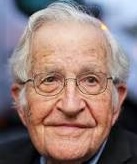
Noam Chomsky (born on December 7, 1928, in Philadelphia, Pennsylvania) is an American linguist, philosopher, cognitive scientist, historical essayist, social critic, and political activist. Sometimes called "the father of modern linguistics", Chomsky is also a major figure in analytic philosophy and one of the founders of the field of cognitive science. He is a Laureate Professor of Linguistics at the University of Arizona and an Institute Professor Emeritus at the Massachusetts Institute of Technology (MIT), and is the author of more than 150 books. He has written and lectured widely on linguistics, philosophy, intellectual history, contemporary issues, and particularly international affairs and U.S. foreign policy. Chomsky has been a writer for Z projects since their earliest inception, and is a tireless supporter of our operations.
ZNetwork is funded solely through the generosity of its readers.
Donate




