


The conflict between “free trade” and food rights came to the fore again at the World Trade Organisation (WTO) negotiations in September, when India did not back down from its stance that a permanent solution be found for food security issues before signing the Trade Facilitation Agreement (TFA).
The TFA is designed to push free trade further, with heavy losses to India’s food security. The US had challenged India at the WTO’s Bali Ministerial in 2013, on the ground that the Food Security Act adopted by the United Progressive Alliance (UPA) regime would increase India’s food subsidies beyond levels allowed by the WTO.
The rules allow subsidies at 10 per cent of the value of agricultural produce. Oddly, the base year for India has been fixed at 1986-88. India, justifiably, is demanding that this date be changed to reflect the reality of food prices today. Double standards in the WTO rules are also exposed when one realises that India’s subsidies of $12 billion to its 500 million farmers are considered “trade distorting”, while US subsidies of $120 billion to its 2 million farmers are not. India’s subsidies are $25 per farmer, while US subsidies amounts to $60,000 per farmer — that’s 2,40,000 per cent more than Indian subsidies. Yet the US is threatening India and demanding the removal of support to its small and marginal farmers.
These are not rules of trade, but rules of manipulation written during the Uruguay Round of Trade Negotiations which led to the establishment of the WTO, by agribusiness corporations seeking to profit from India’s large food and agriculture market. The WTO debate on food and agriculture subsidies is actually intended to force India to stop supporting its farmers through procurement at the minimum support price (MSP) so that 1.25 billion Indians, including the 810 million covered by the Food Security Act, become a market for multinational corporations.
The US has claimed that India has doubled the MSP in the last 10 years. What is hidden from the public view is the fact that costs of production have gone up more than 10 times. Inspite of MSP, farmers are not able to recover their production cost. In 2011-12, the cost of production of rice in Punjab was `1,700 per quintal, while MSP was `1,285. In the same year, the cost of production of wheat was `1,500, while MSP was `1,110. In Haryana, the cost of production of rice was `1,613, while MSP was `1,350.
In the Northeast, the cost of production has risen by 53 per cent between 2008-2009 and 2011-12, while MSP has risen by only 20 per cent. A negative economy translates into debt and un-payable debt translates to suicides. Debt is due to dependence on MNCs who sell costly seeds and chemicals.
The WTO rules are, in fact, written by corporations for transforming public goods into globally traded commodities and capturing our economies for their profits. Monsanto, now the world’s biggest seed giant, wrote the Trade Related Intellectual Property Rights (TRIPs) Agreement of WTO, which opened the floodgates for patenting seeds and life forms. It has blocked the mandatory review of Article 27.3 (b) since 1999 wherein governments, including India, have called for “no patents on life”. Cargill, the world’s grain giant, wrote the rules of the Agreement on Agriculture (AOA) and would be the biggest beneficiary if India stops procuring from its small farmers.
Food is a fundamental right, a basic need, and the livelihood of a majority of Indians. The rules governing it should be rules of sustainability and justice, not rules for the profit of a handful of seed and food multinationals.
It is time to review both, the TRIPs agreement and the agriculture agreement of the WTO, because they are destroying the planet, the livelihoods of our farmers and denying the poor and the vulnerable the Right to Food. One just has to look at the evidence. Since trade liberalisation was forced on us by the WTO in 1995, 3,00,000 farmers have committed suicide because of debt due to purchase of costly seeds and chemicals. Every fourth Indian is hungry. And every second Indian child is stunted.
Average calorie intake in rural areas has declined from 2,221 kcal in 1983 to 2,020 kcal in 2009-10; protein intake has dropped from 62 gm to 55 gm per day in the same period.
In urban areas the calorie intake stood at 1,946 in 2009-10, a decline from 2,089 kcal in 1983. Protein intake declined to 53.5 gm from 57 gm in the same period. These are direct consequences of the rules of trade liberalisation, which have transformed food from a right to a commodity for trade and profits.
Addressing the twin epidemics of farmers’ suicides and hunger requires rewriting the rules of trade on the basis of sustainability and justice. India’s refusal to dismantle its food security system to further benefit MNCs is an opportunity to start redefining global trade on the basis of people’s rights rather than corporate profits.
Seed sovereignty is the foundation of food sovereignty. Farmers’ suicides are linked to seed monopolies and high costs of seed. Seed must be put back in the farmers’ hands through creation of village seed banks and capacity-building in participatory and evolutionary breeding to deal with climate change.
Internationally, seed sovereignty requires ensuring that the mandatory TRIPs’ review of Article 27.3 (b) is completed. For food sovereignty we need to ensure that farmers do not fall into debt and are able to earn a dignified and fair income. While we need to defend our right to support farmers through MSP, it is evident that MSP is no longer covering costs of production. The government has, in fact, frozen MSP in 2013-2014. The alternative is to reduce costs of production by reducing dependence on chemicals and corporate seeds through ecological farming. This is why organic farming based on the principle of agroecology has become an imperative for food sovereignty.
The writer is the executive director of the Navdanya Trust

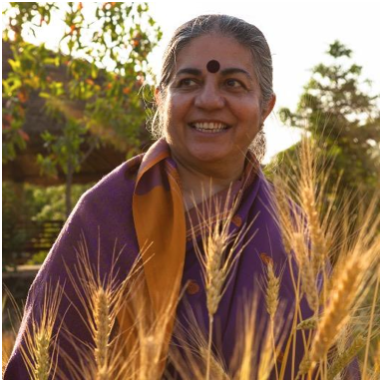
Vandana Shiva (born 5 November 1952) is an Indian scholar, environmental activist, food sovereignty advocate, ecofeminist, and anti-globalisation author. Based in Delhi, she has written more than 20 books. Shiva is one of the leaders and board members of the International Forum on Globalization, and a figure of the anti-globalisation movement. She has argued in favor of many traditional practices, as in her interview in the book Vedic Ecology (Ranchor Prime). She is a member of the scientific committee of the Fundacion IDEAS, Spain's Socialist Party's think tank, a member of the International Organization for a Participatory Society, and the founder of Navdanya, a movement for biodiversity conservation and farmers’ rights. She is also the founder and director of the Research Foundation for Science, Technology and Natural Resource Policy. Shiva fights for changes in the practice and paradigms of agriculture and food. She received the Right Livelihood Award in 1993, an award established by Swedish-German philanthropist Jakob von Uexkull, and regarded as an "Alternative Nobel Prize”.
ZNetwork is funded solely through the generosity of its readers.
Donate




