




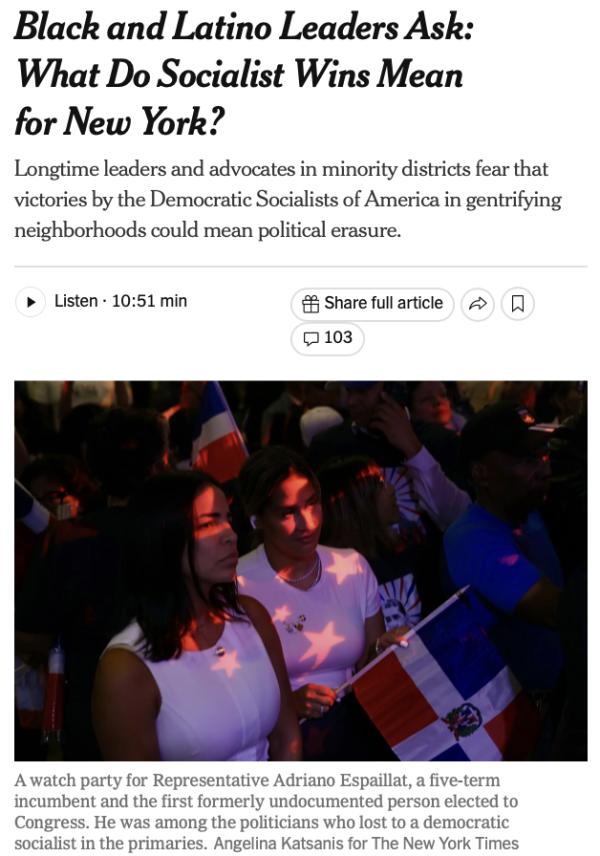
Democratic Socialists of America candidates won several Democratic primaries for Congress and the state legislature in New York. Seven months into his term, New York City Mayor Zohran Mamdani’s favorability has increased to 58% of New Yorkers, with only 26% disapproving—which, as the Guardian (7/12/26) pointed out, is “better than the Democratic Party as a whole.”
For establishment Democrats—and the corporate centrist press who love them—this is a crisis moment.
The New York Times (e.g., 6/16/25) has been vocal about its desire to keep DSA-backed candidates out of office, especially Mamdani. The recent momentum for DSA inspired the paper to publish a news story (7/19/26) that painted DSA’s pro-tenant, pro-worker, tax-the-rich platform not as a threat to the monied class, but as the project of white gentrifiers suppressing Black and Latino electoral power.
The article stated that, “after the wins by democratic socialists in gentrifying neighborhoods across the city,” there was worry that “work to empower Black and Latino voters to pick who represents them was being erased.”
One-third white-collar
This seems entirely laughable at the first read. In New York City, most of DSA’s congressional nominees and backed candidates are people of color; of the nine DSA state lawmakers currently serving in New York, eight of them are either Black, Latino or Asian. The co-chair of New York City DSA, Gustavo Gordillo, is Peruvian American, and Susan Kang, who often comments from the DSA perspective on Spectrum News NY1, is Korean American.
Oh, but the Times has a theory:
The tension is not centered on the ethnicity or race of the candidates supported by the DSA—many are Black and Latino. It is more about the group itself: A 2021 national survey of DSA members found that the group was 85 percent white, a decrease from 2013 when 96 percent of members were white. About a third of the group identified as teachers, academics, white-collar workers or tech workers.
The average voter doesn’t step into a primary wondering about the demographic background of the foot soldiers of a candidate’s affiliated political machine, but whether the candidate is going to serve the interests of the voter and their city/state/nation. This kind of statistic might say something about the DSA’s trouble recruiting a diverse pool of dues-paying members who remain active outside of local elections, an issue worthy of discussion. That doesn’t negate the fact that DSA-backed candidates can win in diverse districts with pro-tenant and pro-worker platforms.
“It’s racist to say a Black leader like myself is secretly operating on the whims of white people,” state Sen. Jabari Brisport of DSA told FAIR. “It implies Black socialist politicians don’t have agency.”
‘High-water mark’

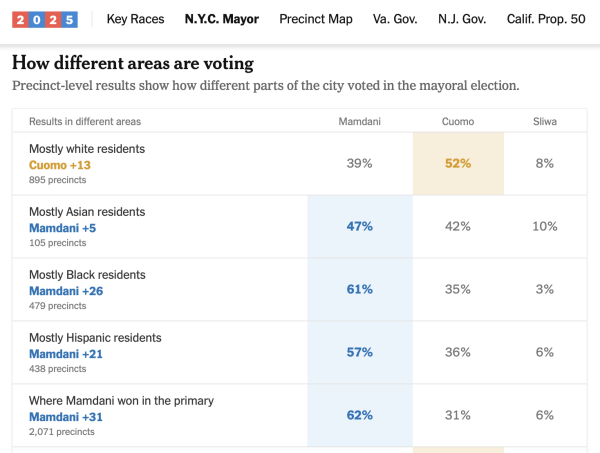
By the Times’ own reporting, Mamdani—the city’s first Muslim and South Asian mayor—won resoundingly citywide, notably losing ground to disgraced former Gov. Andrew Cuomo in the suburban outskirts and the ultra-rich Upper East Side. Mamdani beat Cuomo—and Republican Curtis Sliwa—with Black, Latino and Asian voters. Cuomo crushed it with the white vote, however.
A March poll found that Mamdani’s net approval rating, which is +10 points among white New Yorkers, is +23 among Latino voters and +42 among Black voters. Compare that to former Mayor Eric Adams, whose 2021 nomination “seemed to signal a high-water mark for Black political power” in New York City, according to the Times piece: In his last year in office, his net approval rating among Black voters was -36 (Quinnipiac, 3/5/25).
What the Times wants readers to believe is that insurgent DSA challengers are ousting incumbents who represent the poor and the marginalized, while DSA wins votes among gentrifiers. Take this nugget here:
In Upper Manhattan and the Bronx, Representative Adriano Espaillat, a five-term incumbent who became the first formerly undocumented person elected to Congress and then the chair of the Congressional Hispanic Caucus, lost to Darializa Avila Chevalier, a democratic socialist almost 40 years his junior.
Exit polls show that while Espaillat led with the district’s Latino voters, Avila Chevalier won among Black voters, meaning the candidates split the POC voting base.
The Times also forgot to tell readers that it was Avila Chevalier, not Espaillat, who had to fend off racist character attacks. A “former senior adviser for Rep. Adriano Espaillat…made racist comments about his primary challenger Darializa Avila Chevalier in Spanish-language media,” City & State (6/22/26) reported, and “cast suspicions on Avila Chevalier’s Dominican identity.”
‘Targeting communities’

But perhaps the most telling passage came at the end:
L. Joy Williams, the head of the New York State NAACP, said the signaling of DSA’s ambition was unmistakable. “The undercurrent is that they’re targeting communities that have historically and primarily been Black and Latino,” she said.
It’s logical that DSA would be “targeting” Black and Latino communities because they’re more likely than white voters to vote for a socialist candidate (Cato, 7/2/26). The Times piece failed to mention the long history of Black leaders and communities in socialist movements over the past century, including A. Philip Randolph, Martin Luther King, Jr., and the Black Panthers.
But DSA’s Brisport also noted that Williams’ read on the situation wasn’t accurate, telling FAIR:
We’ve run candidates in white Bay Ridge and white Park Slope, we ran a candidate way out in eastern Queens; none of these are traditionally Black or brown seats, but people ignore those to build a narrative.
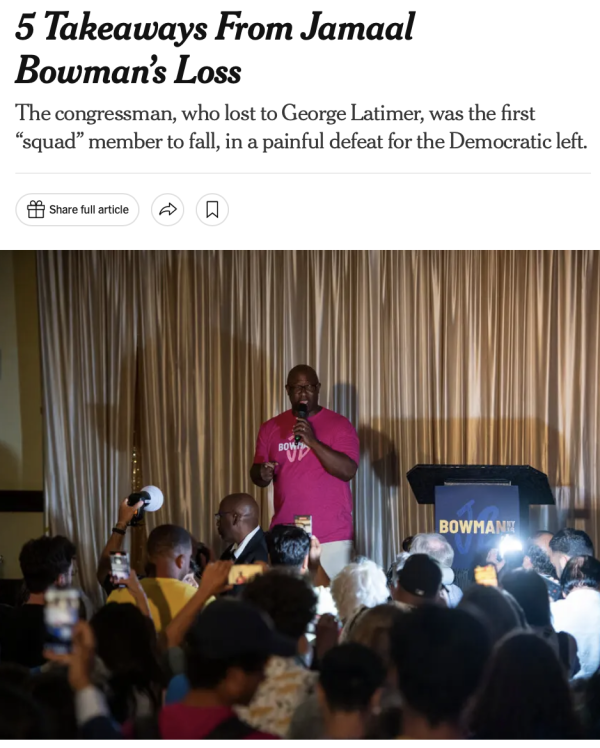
Brisport contrasted Williams’ comments to the fact that a Black DSA congressmember, Jamaal Bowman, was ousted in a primary by a white challenger with the help of $14.5 million in Israel lobby funding in 2024 (FAIR.org, 6/28/24). “They took out a Black principal and replaced him with a white guy who was loyal to Israel,” Brisport said. “These so-called Black leaders had nothing to say.”
In addition, Williams’ comment ignores the fact that DSA’s first major congressional victory was the election of Alexandria Ocasio-Cortez, a Puerto Rican woman who defeated a powerful and long-serving white incumbent (Time, 6/26/18). But the Times never offers this correction in its reporting.
Worse, passages like this normalize the idea that establishment incumbents are entitled to keep their positions, especially if they represent districts with Black and Latino politicians. The Times’ inclusion of this sentiment, punctuating the piece, insinuates that Black and Latino activists entering primaries, canvassing voters, promoting an affordability platform and turning out supporters in low-turnout elections is some kind of dirty trick. In other words, the Times is afraid of too much democracy.
It’s interesting to note that while the right-wing Wall Street Journal editorial board (6/21/26) is also horrified at DSA’s electoral rise, it is more clear-headed about why the group is surging than this swipe at the group in the Times’ news section. “These races—and others across the country—reflect the potent organizing of the DSA and the leftwing march of young progressive voters,” it said. “The DSA agenda is gaining among Democrats,” the paper acknowledged.


Ari Paul has reported for the Nation, the Guardian, the Forward, the Brooklyn Rail, Vice News, In These Times, Jacobin and many other outlets.
ZNetwork is funded solely through the generosity of its readers.
Donate




