

A progressive boss is still a boss. Yet for decades, senior leadership at left-leaning organizations have been excused from providing their staff with living wages, good benefits and inclusive work environments, in part because employees themselves feared holding bosses accountable for their hypocrisy could hurt the cause.
But, in recent years, workers at progressive nonprofits have realized that addressing issues on the job can make their organizations better by creating an environment where talented, passionate employees want to stay and work. They’ve taken action by organizing unions to address workplace problems and create more effective organizations. Estimates of the percentage of union nonprofit workers vary depending on how narrowly the category is defined, but the number may now be as high as 8 percent—higher than the private sector average.
Unfortunately, several recent pieces in The New York Times and The Intercept ignore the real problems that plague progressive organizations as well as the improvements nonprofit staff are making. Instead, these articles push the narrative that the left is struggling because nonprofit staff are overreacting to insignificant issues and causing internal disputes that make their organizations less effective.
These articles push the narrative that the left is struggling because nonprofit staff are overreacting to insignificant issues and causing internal disputes.
While omitting worker voices, the authors and the senior managers whom they quote depict nonprofit staff as over-sensitive and “over-woke.” They suggest that progressive nonprofits are being bogged down by meaningless forays into identity politics, redirecting valuable time and resources in ways that foster division.
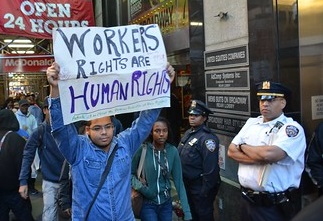
Yet unions are ultimately about solidarity, not division. Unions provide workers with a structure in which they can come together to build power as a class to improve their workplace. Nonprofit workers are still workers, and to characterize their collective action as a “distraction” ignores their needs as workers.
As leaders of a union of nonprofit employees, we’ve seen progressive organizations provide staff with shockingly low wages, jobs lacking health and retirement benefits, and even fostering hostile work environments. Progressive nonprofit workers join together in unions to create workplaces that provide them with the pay and benefits they need to live. The improvements our members secure by bargaining collectively represent a step forward for the nonprofit industry. Their efforts can help improve both retention and productivity; staff can perform better when they are supported and feel they have a voice on the job.
In every U.S. state except Montana, employees are de facto considered to be “at-will,” meaning they can be terminated or disciplined at any time for any reason except discrimination against a protected class. By contrast, union members typically have “just cause” clauses in their contracts, so that they cannot be arbitrarily disciplined or dismissed. This means that union contracts can protect people from one of the most consequential forms of so-called cancel culture: losing their livelihoods.
Like other bosses, bosses at progressive nonprofits can be reluctant to give up power, and unions redistribute workplace power to the workers. But organizations flounder when those in charge prioritize preserving their own power within the organization over fulfilling the organization’s mission. Nonprofits that divert considerable sums to union-busting law firms are not putting the mission first. Effective leadership requires respecting the people you hire and empowering them in their work. In this sense, union-busting is a clear form of mission sabotage.
Like other bosses, bosses at progressive nonprofits can be reluctant to give up power.
Meanwhile, through discussions with our members and review of organizations’ reports and financials, we know that many unionized progressive nonprofits continue to flourish. Donors have recognized the effectiveness of these organizations and have chosen to contribute accordingly. When progressive nonprofit staff form unions, they make their organizations more credible by compelling them to practice what they preach.
To have a solid foundation, the progressive movement must be built on solidarity and respect, not exploitation. Union organizing offers nonprofit workers an important way to come together to improve both their workplaces and their work. It is a source of organizational and movement strength, not weakness.
ZNetwork is funded solely through the generosity of its readers.
Donate
