


Interview with Noam Chomsky, conducted May 24, 2013, MIT, Cambridge, MA. Interview conducted by John Holder and Doug Morris.
Q: We asked some Middle School students to submit questions. We framed it around the idea that you are a philosopher. They can identify with what a philosopher does…think about the big questions. So, these are questions from kids…
NC: I was in California a couple weeks ago and my daughter-in-law wanted me to give a talk to a group of Cub Scouts; so I gave a talk to a bunch of eight year olds.
Q. How long was the talk?
NC: It stopped as soon as they got up and started walking around.
Q: Actually, the first question we have is from a seven year old.
NC: OK. I only talk to eight year olds.
Q: Beyond the seven year old, the questions are from Middle School students, 12, 13, 14, but I was talking with a friend’s seven year old daughter and I mentioned that we would be interviewing you, and tried to give her a little context, and I asked her, “If you were sitting down and asking Noam a question, what would you ask.” She said, “Hmmm…that is easy…I would ask ‘Why are we here?’”
NC: There are two views about that which go back to classical Greece, maybe before. One is we are here for the same reason that rocks and trees and grass are here. That is just the way the rules of nature worked out, and they happened to lead to us just like they led to other things. The other answer, which goes back to Aristotle actually, is that everything in nature has a purpose and a function. And the purpose of rain is to let crops grow. That is its essence, and so on for everything else.
And the purpose for humans is to be rational and thoughtful and to live “a considered life” thinking about how to do the right thing. And then Aristotle drew some pretty ugly conclusions from that. He said that is only true for educated Greeks. Others are not fully human. And for some, he said, their purpose is to be slaves. Their purpose is to serve the “real humans,” and therefore we should not deprive them from their function. So, to liberate slaves would be criminal…even the failure to enslave people, so they can fulfill their function as providing service to real humans, that would be immoral. But, we are here because the creator assigned us a function. Then there are variations of these.
The modern view among educated people who pay attention to what has been discovered about the world is the first one. We are here for the same reason that other things in the universe are here. It is the way the laws of nature work.
Q: And that would be the Chomsky view?
NC: Yes, that is my view.
Q: Along those same lines, should we assume that humans are more important than other animals on the planet?
NC: The fact of the matter is we do assume that. There is a kind of intuitive view that almost everyone has, even for people who do not believe it in the rational side of their minds. That is a view which is traditionally called The Great Chain of Being. There is a Great Chain of Being and at the top of it is God, the creator, and right below it is angels. Right below that are humans and then you keep going down until you get to worms, and plants, and the bottom of the Great Chain of Being.
You even see it in the sciences. For example, there is a lot of work in trying to teach apes the rudiments of lang

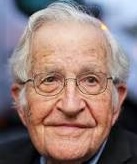
Noam Chomsky (born on December 7, 1928, in Philadelphia, Pennsylvania) is an American linguist, philosopher, cognitive scientist, historical essayist, social critic, and political activist. Sometimes called "the father of modern linguistics", Chomsky is also a major figure in analytic philosophy and one of the founders of the field of cognitive science. He is a Laureate Professor of Linguistics at the University of Arizona and an Institute Professor Emeritus at the Massachusetts Institute of Technology (MIT), and is the author of more than 150 books. He has written and lectured widely on linguistics, philosophy, intellectual history, contemporary issues, and particularly international affairs and U.S. foreign policy. Chomsky has been a writer for Z projects since their earliest inception, and is a tireless supporter of our operations.
ZNetwork is funded solely through the generosity of its readers.
Donate




