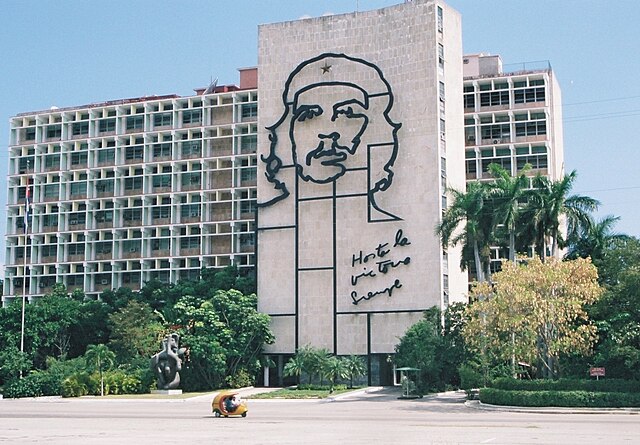
Source: Originally published by Z. Feel free to share widely.

For more than six decades, the United States has been suffocating the Cuban people by imposing anachronistic and inhumane economic sanctions. These measures affect the most vulnerable sectors of the island’s population, particularly the sick, children, the elderly, and pregnant women, and have a dramatic impact on all sectors of Cuban society. Retroactive and extraterritorial in nature, they violate the most basic principles of international law. Since 1992, they have been unanimously condemned every year by the United Nations General Assembly.

Imposed in 1960 with the aim of overthrowing the government of Fidel Castro, these sanctions have been steadily reinforced by successive U.S. administrations, particularly under the presidency of Donald Trump. During his first term, Trump imposed 243 new unilateral coercive measures – 50 of them in the midst of the Covid-19 pandemic – against the Cuban people, targeting the island’s main sources of revenue, namely medical cooperation, remittances from the diaspora, and tourism. Thus, from 2017 to 2020, the White House imposed on average one new sanction per week for four consecutive years.

In 2025, the sanctions cost Cuba 7.5 billion dollars, an average of 20 million dollars per day, 15,000 dollars per minute. This amount is equivalent to the electricity consumption of Cuba’s 10 million inhabitants for six years. With the same sum, Cuba could ensure the supply of basic necessities for the entire population for six years. Since their imposition in 1960, the sanctions have cost Cuba a total of 170 billion dollars, and more than 80% of the Cuban population has been born under this state of siege.

On January 29, 2026, the Trump administration issued a presidential decree designating Cuba as an “extraordinary and unusual threat to the national security of the United States,” imposing tariffs on any country that delivers oil to Cuba. As a result, the island – already severely affected by the economic blockade and repeated natural disasters – has been plunged into an extremely difficult situation, deprived of the fuel vital to its economy and essential services. In Cuba, the electrical system, which powers the drinking water sanitation network, hospitals, and schools, depends heavily on oil supplies.

Cuba is not experiencing a crisis: it is the victim of an economic crime perpetrated by the United States for decades. The international community must reject this illegal economic and energy stranglehold that is suffocating the island and provide urgent assistance to the Cuban population, which is facing an extremely grave humanitarian situation.

Salim Lamrani holds a PhD in Iberian and Latin American Studies from Sorbonne University, and is Professor of Latin American History at the Université de La Réunion, specializing in relations between Cuba and the United States.  His latest book in English is Cuba, the Media and the Challenge of Impartiality.


ZNetwork is funded solely through the generosity of its readers.

Donate
Donate
Leave A Reply

Subscribe

All the latest from Z, directly to your inbox.

Institute for Social and Cultural Communications, Inc. is a 501(c)3 non-profit.

Our EIN# is #22-2959506. Your donation is tax-deductible to the extent allowable by law.

We do not accept funding from advertising or corporate sponsors.  We rely on donors like you to do our work.

ZNetwork: Left News, Analysis, Vision & Strategy

Subscribe

All the latest from Z, directly to your inbox.

THE WIND CRIES FREEDOM

The Wind Cries Freedom, the new book from Z co-founder Michael Albert, is a sweeping oral history of a future American revolution.

Through thirty interconnected chapters, it draws out the strategies, failures, turning points, and hard-won wisdom of a movement that called itself the Revolutionary Participatory Society. These are not the polished memoirs of politicians: they are the unfiltered accounts of people who organized in neighborhoods, hospitals, universities, stadiums, courthouses, and places of worship, and kept a shared vision alive through cynicism and exhaustion.

The result is speculative political fiction that reads like history: messy, human, and quietly hopeful in the way that only real experience and long thought can produce.

Get your copy and peruse more features on the book’s website below.

“Read it, argue with it, but don’t look away. The future it recalls is one we must still fight to deserve.”

Yanis Varoufakis

“The most unusual and intriguing combination of prophecy, manifesto, and movement building manual that I have ever encountered.”

Bill Fletcher Junior

“This work fills a huge gap in our social movement literature.”

Cynthia Peters

This is your article this month.

We’re glad you keep coming back. If Z’s work has informed, challenged, or inspired you, that’s no accident: there are no paywalls, no ads, and no billionaire owners here, and there never will be. Independent media survives because readers choose to support it.

Billionaires fund their own media. We fund ours. Help us reach 1,000 sustaining donors:

Number of donors689
Our goal1,000

Sustainers at $9/month or more receive the digital Z Magazine.

Already a sustainer? Click here and we won’t ask again. Thank you!

Your reading count is stored only in your browser and is never sent to us.

Sound is muted by default.  Tap 🔊 for the full experience

CRITICAL ACTION

Critical Action is a longtime friend of Z and a music and storytelling project grounded in liberation, solidarity, and resistance to authoritarian power. Through music, narrative, and multimedia, the project engages the same political realities and movement traditions that guide and motivate Z’s work.

If this project resonates with you, you can learn more about it and find ways to support the work using the link below.

Independent media is not disappearing because the ideas are weak.

It is disappearing because platforms reward speed, outrage, and algorithmic visibility over thoughtful analysis.

More than 100,000 people read Z every month, free of paywalls, ads, and billionaire owners. It takes fewer than 1 in 100 of them to fund all of it: 1,000 donors who keep Z independent, for everyone, and build what comes next.

Number of donors689
Our goal1,000

Sustainers at $9/month or more receive the digital Z Magazine.

Subscribe

Join the Z Community – receive event invites, announcements, a Weekly Digest, and opportunities to engage.

Exit mobile version

