Want to know the real state of the US economy? Visit a local public school and find out how many student qualify for free or reduced-price lunches.

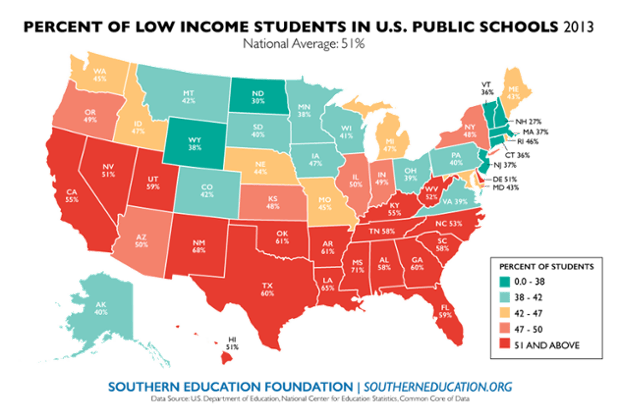
A new report found that, at 51%, the number of children who qualified for federal programs for free or reduced-price lunches is the highest in at least 50 years, according to the Southern Education Foundation. In other words, in 2013, more than half of the students attending public school lived in poverty.

Those numbers are representative of the growing problem of child poverty in the US. Overall, one in five US children live in poverty. It has only recently been dropping, with 14.7 million US children living in poverty in 2013, down from 16.1 million in 2012. In 2012, out of 35 economically developed countries, only Romania had a higher child poverty rate than the US.

In 2013, 21 states reported that the majority of students in their public schools came from low-income families. That’s a huge jump from 2011, when 17 states reported such majorities. Ten years ago, it was only four states.

There is a geographical element to poverty. Thirteen of those states with a majority of low-income students in their schools are located in the south, six in the west. Mississippi is faring the worst, with 71% of its public school students coming from low-income families. In Texas, that number is 60% and in Alabama 58%.

In 19 other states, including New York, low-income students made up between 40% and 49% of the states’ public school enrollment, the report found.

education poverty
About 51% of US public school students are from low-income families. Photograph: Southern Education Foundation

To deal with the number of US children that tend to go hungry, many food banks have added child nutrition programs​. Despite the conservative politics of many ​southern states, there is a consensus that children need proper nutrition and assistance.

“Even the toughest, hard-nosed, anti-government-funding person would say: ‘Well, kids ought to be able to eat good,’” Dave Reaney, who runs a food bank in Theodore Alabama, told the Guardian. “We try to make sure that they understand that whether you like it or not, [food stamps] help kids and kids can’t help themselves.”

The growth of American poverty is drawing interest from policymakers. To be more in touch with the people left behind by the current recovery – the “low- and moderate- income populations” – the Federal Reserve board of governors announced on Friday that it is creating an advisory council.
Advertisement

The Center for Popular Democracy cheered the Fed’s move away from a focus on the demands of banks and the stock market, saying: “The decision-making process within the Fed has, for too long, been dominated by the priorities and voices of banks and corporations. … It is essential that the Council include genuine representatives of working families and communities of color across the country.”

As local public schools struggle to educate America’s low-income children on limited budgets, the future of working families is at stake.

The US must make improving educational support for low-income students a priority, insist the researchers at the Southern Education Foundation. Otherwise, “the trends of the last decade will be a prologue for a nation not at risk, but a nation in decline.”


ZNetwork is funded solely through the generosity of its readers.

Donate
Donate
Leave A Reply

Subscribe

All the latest from Z, directly to your inbox.

Institute for Social and Cultural Communications, Inc. is a 501(c)3 non-profit.

Our EIN# is #22-2959506. Your donation is tax-deductible to the extent allowable by law.

We do not accept funding from advertising or corporate sponsors.  We rely on donors like you to do our work.

ZNetwork: Left News, Analysis, Vision & Strategy

Subscribe

All the latest from Z, directly to your inbox.

THE WIND CRIES FREEDOM

The Wind Cries Freedom, the new book from Z co-founder Michael Albert, is a sweeping oral history of a future American revolution.

Through thirty interconnected chapters, it draws out the strategies, failures, turning points, and hard-won wisdom of a movement that called itself the Revolutionary Participatory Society. These are not the polished memoirs of politicians: they are the unfiltered accounts of people who organized in neighborhoods, hospitals, universities, stadiums, courthouses, and places of worship, and kept a shared vision alive through cynicism and exhaustion.

The result is speculative political fiction that reads like history: messy, human, and quietly hopeful in the way that only real experience and long thought can produce.

Get your copy and peruse more features on the book’s website below.

“Read it, argue with it, but don’t look away. The future it recalls is one we must still fight to deserve.”

Yanis Varoufakis

“The most unusual and intriguing combination of prophecy, manifesto, and movement building manual that I have ever encountered.”

Bill Fletcher Junior

“This work fills a huge gap in our social movement literature.”

Cynthia Peters

You've just read your article on Z this month.

DOES Z'S SURVIVAL MATTER?

You keep coming back for a reason: serious political analysis, movement reporting, and debate beyond the priorities of corporate media. Today, Z is in a precarious financial position. If Z is part of how you understand the world, help keep it going. The readers who give monthly are the reason this work survives between fundraisers.

Z is in a precarious financial position. If it’s part of how you understand the world, help keep it going.

Number of donors705
Our goal1,000

Sustainers at $9/month or more receive the digital Z Magazine.

Already a sustainer? Click here and we won’t ask again. Thank you!

Your reading count is stored only in your browser and is never sent to us.

Sound is muted by default.  Tap 🔊 for the full experience

CRITICAL ACTION

Critical Action is a longtime friend of Z and a music and storytelling project grounded in liberation, solidarity, and resistance to authoritarian power. Through music, narrative, and multimedia, the project engages the same political realities and movement traditions that guide and motivate Z’s work.

If this project resonates with you, you can learn more about it and find ways to support the work using the link below.

Z is in the most precarious financial position in its history.

Z is a place to think beyond the limits of the present.

For decades, Z has brought together political analysis, movement reporting, debate, and visions of a different future from writers and activists around the world. That work is more than journalism. It is movement infrastructure: movements need places to develop ideas, test arguments, learn from experience, and imagine what comes next.

In the first two days of this fundraiser, 19 donors and 8 new monthly sustainers stepped up. Help us reach 1,000 donors who keep Z independent, for everyone.

For decades, Z has published the analysis, debate, and visions movements need, free of paywalls, ads, and billionaire owners. If that work should continue, Z needs your support now.

Number of donors705
Our goal1,000

Sustainers at $9/month or more receive the digital Z Magazine.

Subscribe

Join the Z Community – receive event invites, announcements, a Weekly Digest, and opportunities to engage.

Exit mobile version

