

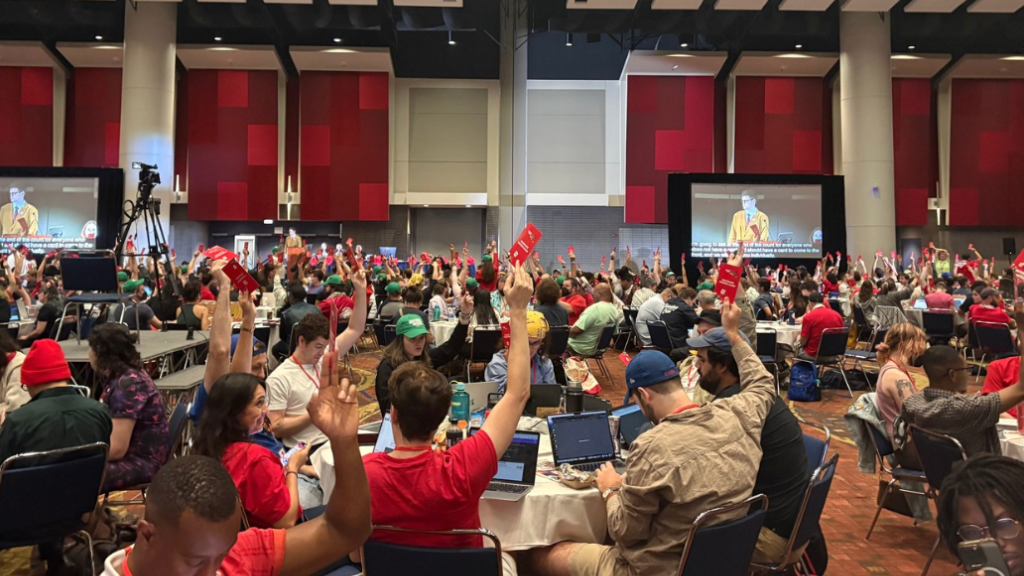
The big moment came on Sunday afternoon. Delegates to the Democratic Socialists of America’s biennial convention had been waiting all weekend for the announcement: Who would be elected to the organization’s 23-member National Political Committee (NPC)?
One by one, names and portrait photos of the winners flashed across two giant screens in the cavernous Chicago Convention Center. Cheers erupted in pockets around the hall — here, then there — as more than 1,200 delegates celebrated victories for their respective factions. The seating arrangements themselves told the story: Delegates had clustered by political affiliation, so the joy was as geographically concentrated as the disappointment. Just before, they had all stood together, fists raised, to sing The Internationale.
When the last name was read, applause rippled across the room. Then phones came out. Delegates began tallying up the results: Reformers versus revolutionaries, sectarians versus pragmatists, advocates of broad-based socialist organizing versus believers in a tightly disciplined workers’ party. The day before, delegates had re-elected Megan Romer and Ashik Siddique as co-chairs.
A movement stuck in place
The new NPC lineup suggested a rough stalemate between the two dominant blocs, with no clear power center emerging. Compared with the 2023 convention, not much had shifted. At the national level, DSA — the largest left-wing membership organization in the country — still seems unlikely to wield significant political clout. In certain cities and regions, however, the organization remains a meaningful force.
Siddique, a member of the Groundwork caucus, which champions mass politics, was quick to argue that the election results didn’t match the mood inside the organization. “The composition of the new NPC doesn’t reflect the balance of forces in DSA,” he told reporters, noting that the candidate slate had been finalized before Zohran Mamdani’s headline-grabbing victory in the New York mayoral primary. The excitement around Mamdani’s win, Siddique said, had not been translated into representation at the top.
Big tent, big problems
The factionalism was hard to miss — even for international guests. Pelle Dragsted, leader of Denmark’s Red-Green Alliance (Enhedslisten), had come to Chicago to observe what he called “the other America.” He was inspired by the sight of so many young socialists in one place, and stressed that the U.S. left “has an enormous responsibility” to build an alternative to Trumpism, something he believes the Democratic Party establishment is incapable of doing. Still, he admitted, DSA’s “very big tent”comes withinternal divisions that are “perhaps a little concerning.” The movement, he argued, needed a unifying purpose.
Those divisions were on full display outside the plenary hall, where factional activists handed out flyers, pamphlets, and stickers to push their preferred resolutions and NPC candidates. In the evenings, separate parties were held in different neighborhoods. A pre-convention tally had identified more than 20 caucuses represented among the delegates; only about 20 percent of delegates were unaffiliated.
Trump? Not the main topic
On day one, a majority rejected a motion from the “moderates” to prioritize debate on anti-Trump strategy. Instead, the convention focused largely on internal organizational questions. Nearly every caucus supports, in principle, the creation of a U.S. socialist party. Yet there was little appetite for discussing why past third-party experiments — from the Green Party to smaller socialist formations — had failed.
Delegates did spend several hours debating anti-Zionism, eventually passing a resolution calling for the expulsion of members who make “pro-Zionist” statements or engage in “pro-Zionist” activity.
For some, this was a missed opportunity. Paul Garver, a veteran member of DSA’s International Committee, agreed that factionalism and the absence of a coherent strategy to confront Trumpism were the convention’s defining features. Still, he pointed to bright spots: DSA chapters across the country are mobilizing in defense of immigrant rights and against Immigration and Customs Enforcement (ICE). He cited a boycott campaign against the low-cost airline Avelo, which had signed a contract with the Department of Homeland Security to transport detained migrants to facilities inside and outside the U.S. In July, Avelo announced it would close its base for “financial reasons” — a decision organizers took as an early victory.
A warning from within
One longtime DSA member, speaking on condition of anonymity, warned that nearly all caucuses share an “idealism-based” assumption that “DSA should be the core of a third party.” Without a coherent, organized push for socialist mass politics, they cautioned, the organization risks devolving into “a swamp of competing sects” — with or without Zohran Mamdani’s leadership.
The 2025 convention was, in many ways, a snapshot of the American socialist movement itself: energized, diverse, and ambitious — but also fragmented, insular, and unsure of how to seize the political moment staring it in the face.
Max Bohnel is a U.S. based freelance journalist working for German-speaking media, among them nd – journalismus von links (independent socialist daily newspaper, formerly Neues Deutschland)
English translation of this article via Portside.
ZNetwork is funded solely through the generosity of its readers.
Donate
