

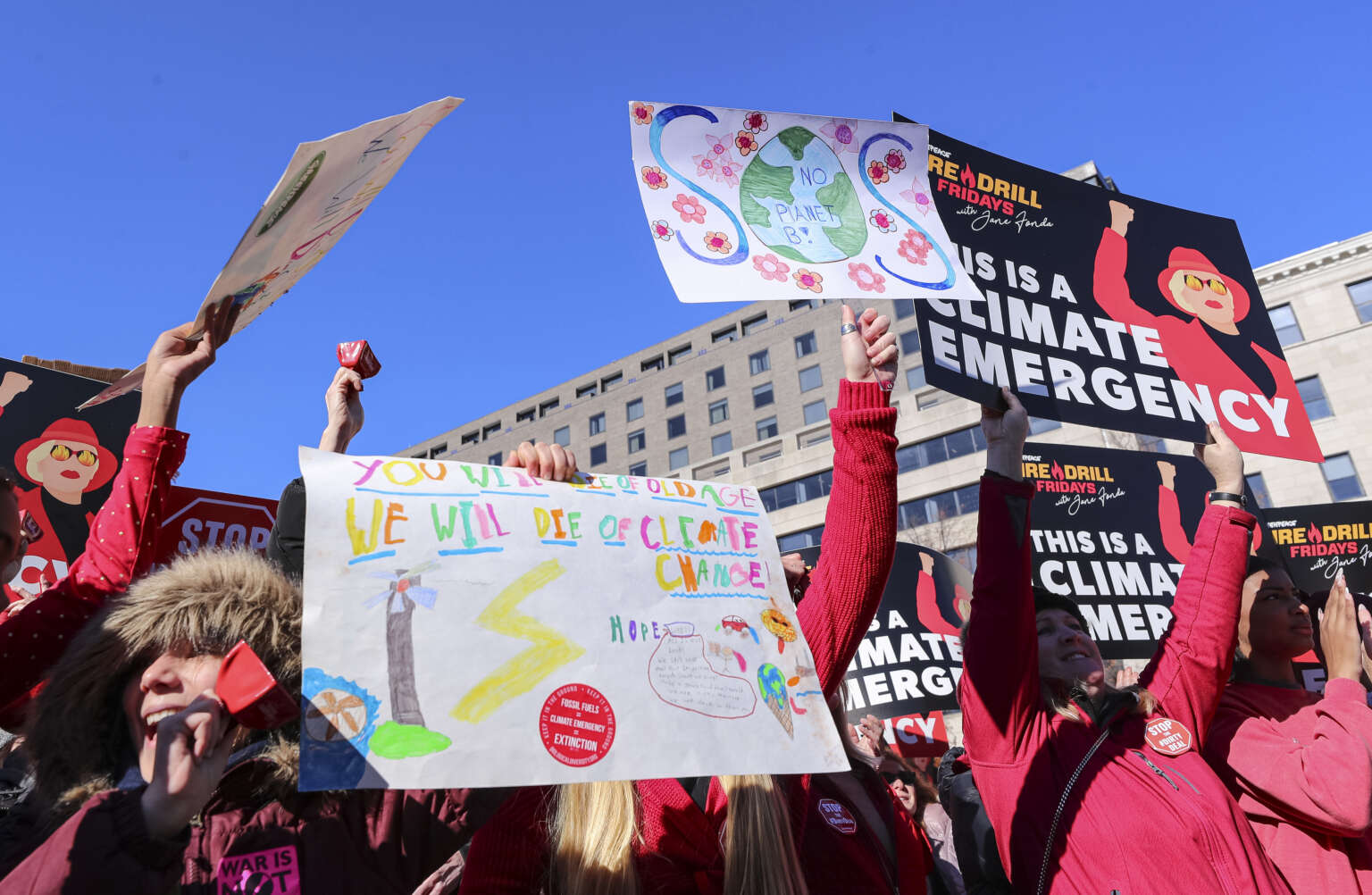
Climate change — caused primarily by capitalism’s incessant burning of fossil fuels — is happening faster than even the most pessimistic scientists predicted, causing freak weather events and mass displacement worldwide. From floods submerging one third of Pakistan to temperatures of 100 degrees Fahrenheit (100°F) in the Siberian Arctic, evidence abounds that rich countries better cut off their fossil fuel dependence fast. Among those rich countries, argues John Bellamy Foster in his new book, Capitalism in the Anthropocene, the United States is the epicenter. The U.S. military alone boasts a carbon footprint larger than that of many countries.
But as many have observed, for many people it’s easier to envision the end of the world than the end of capitalism. Foster’s book tells us that we have a choice: “ruin or revolution.” The reason for the necessity of revolution is that tinkering won’t solve our problems. Technocratic fixes won’t save the Earth as a place fit for human habitation. The problem, as he told me in the interview that follows, is systemic: capitalist accumulation, its endless growth and its phenomenal waste.
Eve Ottenberg: The common conception is that the main environmental crisis is the climate catastrophe, but your book mentions that three planetary boundaries out of nine have already been crossed. Can you elaborate?
John Bellamy Foster: Developing the concept of the Anthropocene, scientists didn’t base it simply on climate change, but on nine planetary boundaries, climate change being one, then the destruction of the ozone layer, loss of genetic diversity (including species extinction), ocean acidification, the disruption of biogeochemical (nitrogen and phosphorus) cycles, loss of groundcover/forests, loss of fresh water, chemical pollution and the release of novel entities, and atmospheric aerosol loading. These boundaries are defined in terms of the Holocene, the geological epoch which goes back 11,700 years and in which civilization developed. The Earth System environment was very conducive to the development of civilization and prosperity for human beings.
In conceiving of the planetary boundaries, scientists codified various changes with respect to each boundary that signal moving away from the Holocene and into global ecological crisis. So far, we’ve crossed the boundaries for climate change, species extinction and biogeochemical (or phosphorous and nitrogen) cycles. And we’re in the process of crossing others. The chemical pollution boundary may have been crossed. Crossing each boundary constitutes a global ecological crisis that threatens the planet as a place of habitation not only for human beings but also for innumerable other species. The problem is that a lot of these things are irreversible. For example, we could end up killing off 30 to 50 percent of all species this century. Well, that’s irreversible.
You argue that the more elite, technocratic and capitalist elements are in the driver’s seat in the U.S. climate movement. Can you explain?
We live in a capitalist society — students sometimes think the system is democracy, I say no, the system is capitalism. And the system, like any other, wants to perpetuate itself. Capital is geared to accumulation and growth, it’s a class-based system of economic accumulation, and in all of these problems, crossing the planetary boundaries, there’s one common denominator, and that’s capitalism, capital accumulation, the growth process. And the powers that be, the ruling elements of our society, the billionaires, the ruling class, the capitalist class, the power elite that embraces those who are part of the political system — they don’t want to change the system, it’s their system and they want to keep it going, even though we know that it’s the accumulation of capital that’s destroying the Earth System as a place of human habitability.
So, the vested interests pretend that we can solve the problems with technology or with the market, because they say the market is inherently efficient. The difficulty there is that, as every economist would admit, climate change is the biggest market failure in history and you can’t really solve a problem with the same system that created it, not a problem this big. And of course, those in power don’t want to talk about changing the actual social relations, or how we produce, or even how we consume. They want to keep the system going the way it is.
Since the market can’t solve it, the powers that be say technology will solve it. And everybody believes in technology. But technology can’t break the laws of physics, and we’ve got a system here of exponential economic growth based on capital accumulation that’s simply destructive to the planet. If you have a 3 percent rate of growth, in 100 years, you’ll have a world economy 16 times bigger than the present, in 200 years 250 times bigger than the present, in 300 years 4000 times, and so forth. But we’re already reaching the limits of how we can live on the planet. We have to reorganize, do things differently. There are no existing technologies themselves that can solve the planetary emergency we now face, which requires a change in social relations.
Could you elaborate on the waste-based accumulation that characterizes U.S. monopoly capitalism and what that means for the global economic budget?
This comes out of economic theory. In the 19th century we produced things that were used and needed, use values. Now under monopoly capitalism, it is a demand-constrained system, because corporations have so much productive capacity, they can’t utilize it, particularly at the prices they set, because they set high monopoly prices. So, there’s always an underutilization of productive capacity. Twenty-five or even 30 percent excess capacity is not unusual, say for the U.S. economy. And in this system, it then becomes oddly rational to produce a lot of junk and a lot of marketing to sell the junk. So, we spend trillions on marketing every year in the U.S. economy, trying to get people to purchase things they neither want nor need. That’s what marketing does. The Marxist economist Paul Baran once encapsulated this irrational situation by saying that we now live in a society in which we neither want what we need nor need what we want.
In our society we produce an enormous amount of material goods that are unnecessary, destructive even, and that are inefficient because they’re designed for a throw-away society, a throw-away economy, so that you go back and buy more. And we deemphasize everything to do with the quality of life, so we try to convince people that if they want love or community, they can get it by buying a Dr. Pepper. But we can actually improve the quality of life by producing differently, by focusing on needs, focusing on genuine efficiency and so on.
Some are advocating for “Green Keynesianism.” Can you explain what that is?
In Keynesianism the economic problem is one of effective demand. It’s geared towards getting people employed to increase demand. Green Keynesianism attempts to merge ecology and the economy, saying we can solve the ecological problem by creating lots of green jobs. We’ll create green things, green jobs and expand the economy that way, instead of expanding the economy based on anti-ecological things. The problem is that it still wants to expand the economy, still wants to increase consumption, still wants to increase the scale of everything, and that isn’t realistic in physical, scientific or ecological terms. So, it promises a progressive approach to the environmental problem that will appeal to workers, but in some ways, it’s lying about the nature of the problem.
Will an environmental proletariat arise in the Global South?
I often think in terms of Engels’s “The Condition of the Working Class in England,” one of the great works on the Industrial Revolution, written in 1845. It was all about the epidemiological problems faced by the working class, the disease, the pollution, the bad food. But we tend to think of the proletariat or working class in terms of economic factors, simply in terms of factories. But the times when the proletariat or working class has been most radical is when faced with not simply the degradation or exploitation in the workplace, but also the destruction of their environment, including, of course, the urban environment. We’ve separated the economy and the environment in our society, and I think they’re becoming less separated. People are being forced into a more materialist view in which the environment and the economy are both material aspects of our reality that are interrelated.
This is being forced on people in the Global South even faster than here. So in Pakistan, where 30 percent of the land was flooded this year, 33 million people were affected, you can believe that people are now involved in material struggles that are just as environmental as they are economic. Think about being deprived of food — is that an environmental or an economic problem? People will think more in terms of environmental struggles as an essential part of their material reality and as their position as workers. You can see this happening all over the world. This really is a hope for change.
Could China be the global leader in promoting ecological civilization in the Anthropocene?
We can hope so. They actually have a plan to peak their carbon emissions by 2030. Initially it involves expanding carbon emissions and then a rapid downshift. I don’t know if this is going to happen. But the fact that it’s a very serious effort is important. They’re already the leader in solar in the world, in alternative technologies, in reforestation. They’ve done more recently to reduce pollution than any other country. But there are a lot of struggles in that society, there are massive environmental movements in China and I’m on their side. But without China going toward ecological civilization, as they call it, it’s difficult to see how the world’s going to get out of this mess, because they are such a large part of the world population and production. So, we have to be on the side of that effort.
Their plan to peak in 2030 is really set in stone. They’ve got a very detailed operation going and a lot of Western environmental movements think this is realistic and offers hope, so we just have to see. Our whole situation worldwide is really dangerous and untenable now, but if we’re to get out of this mess, we have to look for where the hope lies, what are the things that seem realistic and that will lead us in the right direction. My hope is based on the movements on the ground, everywhere in the world, including China, that are having an effect. What we know is there’s going to be a struggle over this. Humanity’s going to struggle over this. It’s a question of whether you’re going to join the struggle.


John Bellamy Foster (born August 19, 1953) is editor of the independent socialist magazine Monthly Review and professor of sociology at the University of Oregon in Eugene. His writings have focused on political economy, environmental sociology, and Marxist theory. He is author of numerous books, most recently (with Brett Clark and Richard York) Critique of Intelligent Design: Materialism versus Creationism from Antiquity to the Present, (with Fred Magdoff), The Great Financial Crisis: Causes and Consequences, and The Ecological Revolution: Making Peace with the Planet.
ZNetwork is funded solely through the generosity of its readers.
Donate




