

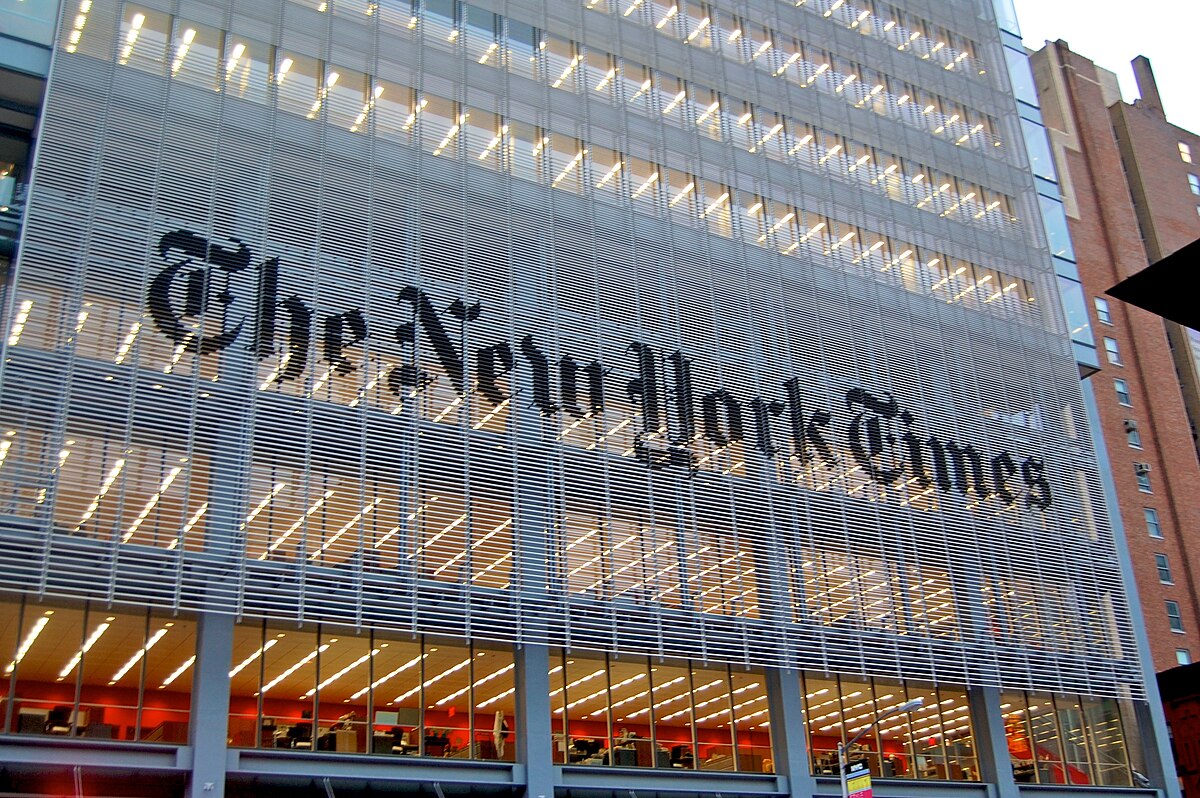
On September 17th, the Sunday edition of the New York Times featured an editorial entitled “How to Support Ukraine Beyond the Next Election.” “Open discussion is essential to shoring up support for the country from Congress and the American public,” read the hard copy subheading, spelling out a foregone conclusion at odds with the notion of democratic exchange that “open discussion” seems meant to signify.
Evidently, any input that might undermine “support” (which the editors go on to specify should be understood as “full support against Russia’s unprovoked invasion”) is supposed to be excluded. So, what is allowed in this debate, according to the Times editorial board? First and foremost, an admission that Ukraine is lagging on the battlefield, that polls reveal diminishing support for further U.S. investment in a losing fight, and that how to end the war has become a hot topic prompting “sometimes nasty” discussion. Or, to put it more bluntly than the Times ever would, measures must be taken lest the public grow disenchanted with the dollar drain required to pay for endless bloodshed, particularly given the obvious failure of Ukraine’s much-hyped counter-offensive.
The Times’s massaging of stale talking points to adapt to unfortunate facts on the ground is a diversionary tactic.
In a sign of things to come later in the piece, which could serve as a textbook example of massaging consent (my term for the job of maintaining manufactured consent in good working order), the editors don’t acknowledge the striking fact that 55% of respondents to a CNN survey released on August 4 opposed further Ukraine funding. Instead, hinting at the pro-war trope that dismisses anti-war sentiment as an exclusively right-wing phenomenon, they cite the poll’s finding that “among liberals, 69 percent back more funding, but only 31 percent among conservatives do.”
The editorial’s crux—the place, so to speak, where the massage therapist bears down on a key trigger point–is a passage slipped in just before the conclusion. Approvingly remarking that the U.S. is negotiating “long-term security commitments” under which to continue arming Ukraine, the editors signal an endless proxy war despite the vanishing probability of battlefield success. Rather than encouraging a genuine peace settlement so Ukraine and Russia might enjoy a future free of civil war, cross-border raids, and the threat of another large-scale conflict, they effectively endorse the Biden administration’s latest bid to keep on targeting Russia.
Clearly, given the Times’s position as the “newspaper of record,” this editorial life-raft for the Pentagon signals concern from on high that messaging on expenditures of upwards of $115 billion taxpayer dollars requires deft massaging to succeed with an increasingly skeptical public. On a more profound level, it hints at anxieties surrounding desperate yet unflagging efforts to retain U.S. dominance as the sole superpower. Having toiled valiantly to manufacture consent (see, for example, this recent article by FAIR’s Bryce Green), the Times now doubles down.
How do the editors pull it off, I wondered? How do they construct an alternate reality so seamlessly fashioned that at first glance it appears impenetrable? These people deserve the cynical compliment famously delivered by Humphrey Bogart’s Sam Spade to a lying lady villain in The Maltese Falcon: “You’re good. You’re very good.”
Taking a closer look, I was struck by the deft deployment of dodgy assumptions that solicit reader complicity. Who would be so churlish as to question, for instance, that the U.S. operates from the noblest of motives? Who has the temerity to complain of the contradiction in calling for open debate while simultaneously forbidding inquiry into basic matters like the stubborn refusal of our policy-makers to engage in diplomacy?
The editors write as if from a parallel universe in which the United States has had nothing to do with provoking and sustaining this conflict. Never mind that it set the wheels of destruction in motion by encouraging Ukraine to join NATO, thus crossing a red line for Putin, who had made it clear that he would not invade if the alliance refused Ukraine’s membership.
Perhaps nervous about the litany of US and NATO provocations, the editors omit any mention of other relevant history, including the U.S. role in the 2014 Euromaidan coup that launched a civil war in the Donbass. Their resort to the hackneyed phrase “Russia’s unprovoked invasion” is yet another sign of their eagerness to forestall uncomfortable questions about that record.
In this universe, the U.S. is not a “decider” but only a kindly upholder of Ukrainian agency, despite having sabotaged a draft peace agreement that might have ended the war in March-April 2022 with a Russian withdrawal in exchange for a pledge of Ukrainian neutrality; despite having either perpetrated or colluded in the destruction of the Nord Stream pipelines; despite having pressured an ill-prepared and reluctant Ukraine to begin its disastrous counter-offensive; and despite being the major funder of this conflict, to the profit of our military-industrial overlords.
Ignoring the obvious fact that the war would already be over absent said funding, the Times insists that “the United States is in no position to compel [the warring parties] to come to the table.” To top it all off, “an open [sic] debate,” on the war must have the objective of ensuring a manifest impossibility: that the U.S. will assist Ukraine to arrive at the negotiating table in tiptop shape after many more months or years of hideous carnage. “In the end, there is no way to tell how long it will take for peace talks to reach the horizon,” the Times concludes from its lofty perch. “America’s duty is to help ensure that Ukraine reaches that point strong and free, and that support can be sustained only by an open discussion and an informed public.”
Never mind that Ukraine is already badly weakened, not only by its massive battlefield losses but by the decimation of its infrastructure and the departure of many millions of war refugees. Never mind that the Zelensky government has banned opposition parties, silenced independent media, failed to counter the significant influence of fascist elements in the military and society at large, and persecuted homegrown peace activists, falsely claiming they are “Russian propagandists.”
Righteously indignant at so many manipulations, I rushed to submit a scathing reader comment, but was halted in my tracks by the truthful simplicity of another reader’s take. Someone identified as Daniel from Boston had posted: “This editorial doesn’t mention ‘death,’ or ‘casualties’ or anything like that even once. But every minute, every hour, and every day, huge numbers of people are dying at the front. [Meanwhile] The lines have barely shifted in 9 months….The barbarism of the conflict simply cannot be understood by Americans at home here in the U.S. imagining the potential success of another stirring offensive.”
This gets to the heart of the matter. The Times’s massaging of stale talking points to adapt to unfortunate facts on the ground is a diversionary tactic. Maintaining the U.S. public’s consent to Ukraine’s destruction as a means to target Russia requires, as always, obscuring not only the actual objectives of our foreign policy but the hideous, ever-mounting human toll it inflicts.
ZNetwork is funded solely through the generosity of its readers.
Donate




